

Daily Dose Of Jazz…
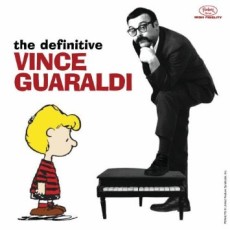
Vince Guaraldi was born Vincent Anthony Dellaglio on July 17, 1928 in San Francisco, California. Growing up in the North Beach area, taking the name of his stepfather Tony Guaraldi after being adopted and being around his maternal uncle was a musician, singer and whistle all became an important influence on his blossoming musical career. He attended Lincoln High School, went on to San Francisco State University and then enlisted and served as an Army cook during the Korean War.
His first recording was a self-titled LP recorded in 1953 with the Cal Tjader Trio and released early the following year. By 1955, Guaraldi had his own trio with Eddie Duran and and Dean Reilly. Reuniting with Tjader in 1956 he became an integral part of two bands that the vibraphonist assembled, the first band played mainly straight jazz with Al Torre on drums and Eugene Wright on bass and Luis Kant playing congas and bongos. The second band included Al McKibbon, Mongo Santamaria, Willie Bob, Paul Horn and Jose “Chombo” Silva. He made a big splash with his performance with Tjader at the 1958 Monterey Jazz Festival.
Vince left the group early in 1959 to pursue his own projects full-time. He probably would have remained a well-respected but minor jazz figure had he not written an original number to fill out his covers of Antonio Carlos Jobim/Luis Bonfá tunes on his 1962 album, Jazz Impressions of Black Orpheus. His label, Fantasy Records released the single Samba de Orpheus with his original Cast Your Fate To The Wind on the B-side trying to catch the building bossa nova wave. As providence would have radio DJs began flipping it over and playing the B-side and the gentle, likeable tune stood out from everything else on the airwaves and became a grassroots hit and won the Grammy for Best Original Jazz Composition.
Guaraldi would go on to record with Brazilian guitarist Bola Sete, began experimenting with electric piano and then composed a series of Latin influenced waltz tempos and jazz standards for the Eucharist chorus at the San Francisco Grace Cathedral. Through contact with Peanuts television producer Lee Mendelson, he was commissioned to score the upcoming Christmas special and played what would become Linus and Lucy over the phone two weeks later. The Vince Guaraldi Trio with drummer Jerry Granelli and bassist Fred Marshall recorded the soundtrack and he would go on to compose scores for seventeen Peanuts television specials, plus the feature film A Boy Called Charlie Brown.
Pianist and composer Vince Guaraldi passed away at age 47 on February 6, 1976. The evening before, he had dined at Peanuts producer Lee Mendelson’s home and was reportedly not feeling well, complaining of indigestion-like chest discomfort that his doctor had told him was nothing to worry about. The following evening, after concluding the first set at Butterfield’s Nightclub in Menlo Park, California with his interpretation of the Beatles’ Eleanor Rigby, Guaraldi and drummer Jim Zimmerman returned to the room they were staying in that weekend at the adjacent Red Cottage Inn, to relax before the next set. Walking across the room he just collapsed. That was it. The cause of death has been variously described as a heart attack or an aortic aneurysm. He had just finished recording the soundtrack for It’s Arbor Day, Charlie Brown earlier that afternoon. He left us a modest catalogue of some 32 albums as a leader or co-leader, 14 notable appearances as a sideman and another eleven showcasing or featuring his music.

Give A Gift Of Jazz – Share
Daily Dose Of jazz…
Bola Sete was born Djalma de Andrade on July 16, 1923 in Rio de Janiero, Brazil. His name translates to Seven Ball and in Brazilian billiards the seven ball is the black ball on the table. He got this nickname when he was the only black member of a small jazz group. He studied guitar at the Conservatory of Rio and started performing with his own sextet and local samba groups while he was still a student. His early influences were guitarists Django Reinhardt, Charlie Christian, Barney Kessell and Oscar Moore, as well as the big band sounds of Dizzy Gillespie, Tommy Dorsey and Woody Herman that toured South America.
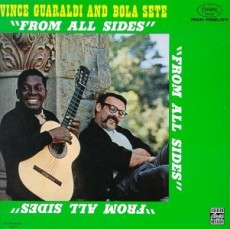
His career began in 1952 playing various clubs and hotels around Italy for four years. Then returning to Brazil while touring South America he was spotted by the manager of the Sheraton hotels who brought him to the States to play in New York’s Park Sheraton and San Francisco’s Sheraton Palace. Dizzy Gillespie was staying there at the time and listening to Bola Sete playing every day. When Gillespie decided to bring his pianist Lalo Schifrin to the hotel, he discovered that Lalo and Bola had already met and played together in Argentina. This meeting was the beginning of Bola’s success in the US. In the fall of 1962, Gillespie took the guitarist to the 9th Annual Monterey Jazz Festival. Enjoying huge success he toured for a while with Gillespie then returned to San Francisco and joined the Vince Guaraldi Trio.
Bola was already well known in the US, and his partnership with Guaraldi yielded several well-received recordings. After staying for a couple of years Bola formed his own trio with his fellow Brazilians, bassist Sebastian Neto and drummer Paulinho da Costa. In the 1970s, he became friends with guitarist John Fahey, who had been an admirer of Sete’s. In 1975, Fahey used his Takoma label to release Ocean, which is now seen as one of Sete’s greatest accomplishments.
During the eighties, Sete suffered from lung cancer and though he attempted to counter with yoga and meditation, on February 14, 1987 guitarist Bola Sete passed away at Marin General Hospital in Greenbrae, California from complications caused by pneumonia and cancer.
Inspire A Young Mind
More Posts: guitar

Daily Dose Of Jazz…
Tisziji Muñoz was born July 15, 1946 in Brooklyn, New York. He learned to play guitar as a child using a single-line playing style, due to a childhood wrist injury. Spirit-taught, the avant-garde jazz virtuoso and extreme guitarist is best known for his uniquely original guitar sound and playing style, likened to that of a spiritual tornado.
Tisziji became interested in jazz in 1968 when he was introduced to the music of John Coltrane while enlisted in the US Army 440th General’s Band. Upon discharge he pursued his musical interests in Canada and took a lead role in the development of Toronto’s underground music scene, where he began a long lasting working relationship with pianist Paul Shaffer and performed as guitarist in the musicals Hair and Godspell.
In the mid-70’s, Muñoz returned to New York City and began collaborating and performing with saxophonist Pharoah Sanders followed by projects and releases with Ravi Coltrane, Dave Liebman, Marilyn Crispell, Paul Shaffer, Steve Kuhn, Lam Sobo John Medeski, Bernie Senensky, Chris Caswell, Henry Kaiser, Ra Kalam Bob Moses, Don Pate, John Lockwood, David Finck and the late greats Rashied Ali, Lew Soloff, John Hicks, Nick Brignola and Hilton Ruiz.
Tisziji has performed at the Montreal Jazz Festival, appeared on The late Show with David Letterman, played Carnegie Hall, The Village Vanguard and Gate, Iridium, Dizzy Club coca Cola and Jazz at Lincoln Center among other venues.
An accomplished author, Tisziji has independently published numerous written works encompassing his own Heart-Fire Sound realization and embracing the subjects of spirituality, genius, creativity and time mastery. His books and music have radically transformed the manner in which musicians think and play music, validating the spirit of the genuine creative artist – from the inside out. Avant-garde jazz guitarist continues to compose, record and perform.
Dose A Day – Blues Away
More Posts: guitar

Daily Dose Of Jazz…
Akua Dixon was born July 14th and raised in New York City, growing up in a family suffused with music, starting with her early experience singing in the Baptist church. She began playing cello in the fourth grade and soon was playing with her sister, the late violinist Gayle Dixon. By junior high they were playing little gigs and in high school she started freelancing.
After graduating from the High School of the Performing Arts, Dixon studied at the Manhattan School of Music and post graduation she joined the pit band at the Apollo Theater as an essential proving ground. There she backed such artists as Rev. James Cleveland, Barry White, James Brown and Dionne Warwick, but after Sammy Davis Jr. insisted the Westbury Music Fair include Black musicians in the orchestra she broke into Broadway pit bands and worked shows the likes of Charles Aznavour, Liza Minnelli (Liza with a Z), La Cage Aux Folles, Cats, Doonesbury, Dream Girls, and many others.
Finding a home with the Symphony of the New World, she experienced the Ellingtonian epiphany that led her to her study and immersion into jazz, spirituals and the secret s of improvising. In the Seventies she joined Noel Pointer’s String Reunion, served as director of new music and supplied the group with a steady stream of compositions and arrangements. At the same time, Akua launched her own string quartet, Quartette Indigo, which made its big league debut at the Village Gate with her sister Gayle Dixon, Maxine Roach, and John Blake Jr.
Throughout her career Dixon has worked and collaborated with Archie Shepp, Rahsaan Roland Kirk, Woody Shaw, Jimmy Heath, Frank Foster, Leroy Jenkins, Charles Burnham, Abdul Wadud, Archie Shepp, Don Cherry, Buster Williams, Carmen McRae, Dizzy Gillespie, Abbey Lincoln, Tom Harrell, and her former husband Steve Turre, She was a founding member of the Max Roach Double Quartet where she learned to phrase bebop. She’s conducted for the Alvin Ailey American Dance Theatre, lectured at the Smithsonian Institution, and composed an opera commissioned by the Rockefeller Foundation, The Opera of Marie Laveau that premiered at Henry Street New Federal Theatre in New York City.
As an educator she has spent much of her time teaching at various institutions and conducting dozens of performances through the Carnegie Hall Neighborhood Concert Series. Cellist, arranger, composer, vocalist and educator Akua Dixon stays busy composing new music for her string group, the Moving On Quartet and other ensembles in addition to performing and recording.
Take A Dose On The Road
More Posts: cello
Daily Dose Of Jazz…
Albert Ayler was born on July 13, 1936 in Cleveland Heights, Ohio and was first taught alto saxophone by his father Edward, who was a semiprofessional saxophonist and violinist. They played alto saxophone duets in church and often listened to jazz records together, including swing era jazz and then-new bop albums. He attended John Adams High School adding oboe to his instruments, followed after graduation with studies at the Academy of Music with jazz saxophonist Benny Miller. It was during his teenage years that he picked up the nickname “Little Bird” because of his understanding of bebop style and mastery of standard repertoire.
In 1952, at the age of 16, Ayler began playing bar-walking, honking, R&B style tenor with blues singer and harmonica player Little Walter, spending two summer vacations with the band. By 1958 he was in the Army, switched from alto to tenor sax, playing in the regiment band and jamming with other enlisted musicians, including tenor Stanley Turrentine. Stationed in France a year later, he was further exposed to the martial music that would be a core influence on his later work. After his discharge from the army, Ayler tried to find work in Los Angeles and Cleveland, but his increasingly iconoclastic playing, which had moved away from traditional harmony, was not welcomed by traditionalists.
In 1962 Albert relocated to Sweden, where his recording career began, leading Swedish and Danish groups on radio sessions, and jamming as an unpaid member of Cecil Taylor’s band. It was here in Copenhagen that he recorded My Name Is Albert Ayler with Niels-Henning Orsted Pedersen and Ronnie Gardiner. 1963 saw his return to settle in New York City, develop his personal style, record his debut as a leader titled Witches and Devils and begin a relationship with ESP-Disk Records in 1964, recording his breakthrough album Spiritual Unity with Gary Peacock and Sunny Murray, which was also the label’s first jazz album. His trio would go on to record with Don Cherry, John Tchicai and Roswell Rudd on the soundtrack to New York Eye and Ear Control, which was followed by a tour with his trio plus Cherry producing the albums The Copenhagen Tapes, Vibrations, and The Hilversum Session.
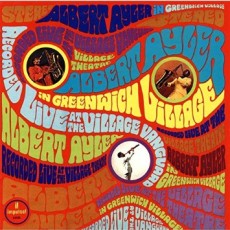
In 1966 Ayler signed with Impulse Records at the urging of Coltrane but his radically different music never found a sizable audience. However his first set titled Albert Ayler in Greenwich Village with his brother Donald, Michael Samson, Beaver Harris, Henry Grimes and Bill Folwell too Ayler back to the alto on his tribute tune “For John Coltrane”. He first sang on a recording in a version of “Ghosts” performed in Paris in 1966. He would go on to record three albums of lyrics and vocals of his girlfriend Mary Maria Parks and introduce regular chord changes, funky beats and electronic instruments.
Avant-garde jazz saxophonist, singer and composer Albert Ayler disappeared on November 5, 1970, and he was found dead in New York City’s East River on November 25,1970, a presumed suicide. In tribute, Swedish filmmaker Kasper Collin was so inspired by hiss music and life that he produced a documentary by the name of My Name is Albert Ayler, which includes interviews with ESP-Disk founder Bernard Stollman, along with interviews with his family and band mates.
Give The Gift Of Knowledge
More Posts: saxophone