

Daily Dose Of Jazz…
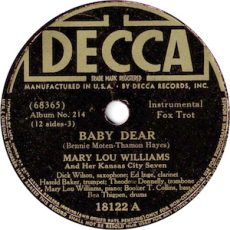
Booker Collins was born on June 21, 1914 in Roswell, New Mexico. Emerging from the New Mexico Military Institute to play in Bat Brown’s Band, a territory band. By the mid-’30s he was keeping very good company playing with pianist Mary Lou Williams and Her Kansas City Seven, cutting sides with her when he was only 16. In 1934, his break came when he got into the band of Andy Kirk and His Clouds Of Joy, staying for the next decade and playing alongside Williams in the rhythm section. Kirk’s hiring replaced the tuba with the double bass.
Booker’s final job of note was with Chicago, Illinois guitarist and drummer Floyd Smith as part of his trio, a stint that lasted from 1946 until the early ’50s, when this great bass man finally laid his big instrument down in terms of full-time playing. He made a few appearances at festival occasions in the ensuing decades but was in Chicago’s recording studios in the late ’50s cutting sides for independent labels.
Returning to performing he joined a combo called the Shades of Rhythm to backup blues singer Mad Man Jones on the demanding Come Here. Collins’ involvement with this group of shifting personnel began in 1952 when he was part of a version that took the risk of cutting sides for the Chance label.
He also performed and recorded with Bert Johnson and the group Six Men And A Girl. Little is known about the death of double bassist Booker Collins who also played the valve trombonist and tuba. It appears he faded into obscurity.

More Posts: bass,history,instrumental,jazz,music,trombone,tuba
Three Wishes
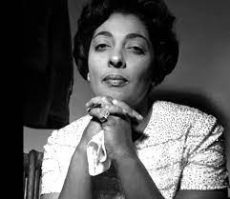
Girl talk always ensued when Pannonica and Carmen McRae were together and when she wanted to know what her friend would say asked her what her three wishes would be and she told her:
- “I wish that we had more people that appreciated good American music.”
- “I wish my father were alive – it’s in the wrong order! That should come first.”
- “And the other one… I hope that I’ll know when I’ve had it.”
*Excerpt from Three Wishes: An Intimate Look at Jazz Greats ~ Compiled and Photographed by Pannonica de Koenigswarter

More Posts: baroness,history,instrumental,jazz,music,pannonica,three,vocal,wishes
Daily Dose Of Jazz…
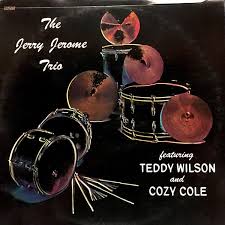
Jerry “Buck” Jerome was born on June 19, 1912 in Brooklyn, New York and he didn’t begin playing the saxophone until he was in high school in Plainfield, New Jersey.
Jerome became part of a national tour in 1936 with bandleader Harry Reser and his Clicquot Club Eskimos. He joined Glenn Miller’s original orchestra in 1937 and was a member until it broke up in 1938. He played and soloed on the Glenn Miller recording Doin’ the Jive. He then joined the Red Norvo band which was followed by his joining the Benny Goodman orchestra in 1938.
When Goodman broke up his band in 1940, he joined the Artie Shaw Orchestra. While with Shaw he appeared the same year he joind the band in the film Second Chorus, starring Fred Astaire and Burgess Meredith. By the end of the 1940s, Jerry became involved in broadcasting, working various positions as a conductor, composer, arranger and musical director.
Tenor saxophonist Jerry Jerome, who composed the Winston tastes good like a cigarette should jingle for the tobacco company, transitioned on November 17, 2001 at the age of 89.
More Posts: history,instrumental,jazz,music,saxophone
Daily Dose Of Jazz…
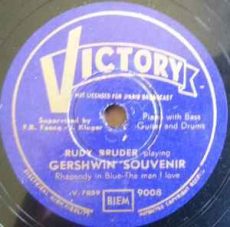
René “Rudy” Bruder was born on June 15, 1914 in Brussels, Belgium. His father was a bandleader and Rudy played in his father’s group in the mid-1930s. He then joined Jean Omer’s group, accompanying visiting American musicians such as Benny Carter, Bill Coleman, Coleman Hawkins, and Bobby Martin.
He worked with Omer through the early 1940s. He also recorded several times with Jean Robert and Gus Deloof. He led his own band, which recorded in the early 1940s and again in 1946.
Pianist Rudy Bruder retired from music and according to sources is 108 yers old.
More Posts: bandleader,history,instrumental,jazz,music,piano
Daily Dose Of Jazz…
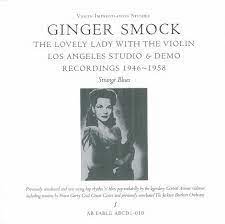
Ginger Smock was born Emma Smock on June 4, 1920 in Chicago, Illinois and grew up in Los Angeles, California. She graduated from Jefferson High School and studied violin privately with Bessie Dones. By the time she hit the age of 10 she appeared as a soloist at the Hollywood Bowl. She was featured on Clarence Muse’s radio program at the age of thirteen performing Edward MacDowell’s To A Wild Rose. She earned degrees in music from Los Angeles City College, and the Zoellner Conservatory of Music. At the latter institution she was a pupil of Edith Smith.
During 1944 she led a trio with Nina Russell and Mata Roy. In 1951, she led an all-female sextette, featuring Clora Bryant, on the Chicks and the Fiddle show hosted by Phil Moore that broadcasted for six weeks on CBS. The next year she was the featured soloist on KTLA’s variety show, Dixie Showboat.
1953 had Smock recording as part of a group with Gerald Wiggins, Freddie Simon, Red Callender, and Rudy Pitts, accompanying the vocalist Cecil “Count” Carter.
During the mid 1970s, she spent ten years as concertmaster of show orchestras in Las Vegas. In addition to her work in jazz and rhythm & blues, she performed with the All City Symphony Orchestra of Los Angeles. A violin owned by Smock is in the collection of the National Museum of African American History and Culture
Violinist, orchestra leader, and local Los Angeles television personality Ginger Smock, who recorded as a leader but is perhaps best known from her recordings with the Vivien Garry Quintet, transitioned on June 13, 1995.
More Posts: bandleader,concertmaster,history,instrumental,jazz,music,violin