

Daily Dose Of Jazz…
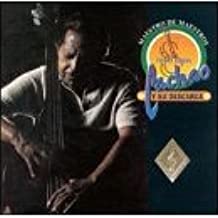
Israel López Valdés was born into a family of musicians on September 14, 1918 in Havana, Cuba. Better known as Cachao, a nickname and stage name given to him by his grandfather, as an 8-year-old bongo player, he joined a children’s son Cubano septet directed by a 14-year old Roberto Faz. A year later, already on double bass, he provided music for silent movies in his neighborhood theater, in the company of a pianist who would become a true superstar, the great cabaret performer Ignacio Villa, known as Bola de Nieve.
His parents made sure he was classically trained, first at home and then at a conservatory. In his early teens, Lopez was already playing contrabass with the Orquesta Filarmónica de La Habana, of which Orestes was a founding member. Under the baton of guest conductors such as Herbert von Karajan, Igor Stravinsky, and Heitor Villa-Lobos, he played with the orchestra from 1930 to 1960.
He and his older brother Orestes were the driving force behind one of Cuba’s most prolific charangas, Arcaño y sus Maravillas. As members of the Maravillas, Cachao and Orestes pioneered a new form of ballroom music derived from the danzón, the danzón-mambo, which subsequently developed into an international genre, mambo.
In the 1950s, Cachao became famous for popularizing improvised jam sessions known as descargas. In 1961, Cachao went into exile. He crossed the Atlantic by boat, reaching Madrid thanks to Ernesto Duarte, who demanded him to play with his orchestra–Orquesta Sabor Cubano–and where he spent a few years touring the country until the orchestra finally broke up in 1963. Moving to the United States that same year, Cachao became a session musician and was one of the most in-demand bassists in New York City, along with Alfonso “El Panameño” Joseph and Bobby “Big Daddy” Rodríguez.
Joseph and López substituted for each other over a span of five years, performing at New York City clubs and venues such as the Palladium Ballroom, The Roseland, The Birdland, Havana San Juan and Havana Madrid. While Cachao was performing with Machito’s orchestra in New York, Joseph was recording and performing with Cuban conga player Cándido Camero. When Joseph left Cándido’s band to work with Charlie Rodríguez and Johnny Pacheco, it was Cachao who took his place in Cándido’s band. In the 1970s, Cachao fell into obscurity after moving to Las Vegas, Nevada and then later Miami, Florida releasing albums sporadically as a leader.
The 1990s saw his re-discovery by actor Andy García, who brought him back to the forefront of the Latin music scene with the release of a documentary and several albums. Throughout his career, he performed and recorded in a variety of music styles ranging from classical music to salsa.
Double bassist and composer Cachao Lopez, who rose to prominence during the boogaloo years, who recorded sixteen albums as a leader and another twenty as singles, collaborator, and sideman, passed away in Coral Gables, Florida at age 89 on March 22, 2008.

More Posts: bandleader,bass,composer,history,instrumental,jazz
Daily Dose Of Jazz…
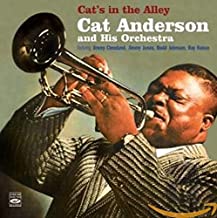
Cat Anderson was born William Alonzo Anderson on September 12, 1916 in Greenville, South Carolina. Losing both parents when he was four years old, he was sent to live at the Jenkins Orphanage in Charleston, South Carolina where he learned to play the trumpet. It was his classmates that gave him the nickname “Cat” based on his fighting style.
He toured and made his first recording with the Carolina Cotton Pickers, a small group based at the orphanage. After leaving the Cotton Pickers, Anderson played with guitarist Hartley Toots, the Claude Hopkins Big Band, Lucky Millinder, the Erskine Hawkins Orchestra, the Sabby Lewis Orchestra, the Lionel Hampton Orchestra, with whom he recorded the classic Flying Home No. 2, and the Doc Wheeler Sunset Orchestra with whom he also recorded from 1938–1942.
His career took off in 1944 when he joined Duke Ellington’s orchestra at the Earle Theater in Philadelphia, Pennsylvania. He quickly became a central part of Ellington’s sound. Although Anderson was a very versatile musician, capable of playing in a number of jazz styles, he is most renowned for his abilities in the extreme high or “altissimo” range. He had a big sound in all registers but could play up to a “triple C” with great power, able to perform his high-note solos without a microphone.
A master of half valve and plunger mute playing, Cat was capable of filling in for anyone else who was not there. He led and fronted his own big band and in addition, he was a very skilled arranger and composer. He performed his own compositions El Gato and Bluejean Beguine with Ellington, and others of his compositions and arrangements with his own band, for example on his 1959 Mercury recording, Cat on a Hot Tin Horn.
After 1971, he settled in the Los Angeles, California area, where he continued to play studio sessions, perform with local small and big bands, and to tour Europe. He recorded seven albums as a leader, and as a sideman recorded sixty-four with Johnny Hodges, Quincy Jones, Rosemary Clooney, Frances Faye, Mel Torme, Earl Hines, Bell Berry, Benny Carter, Claude Bolling, Gene Ammons, Louis Bellson, Duke Ellington, Ella Fitzgerald, and Lionel Hampton. Trumpeter Cat Anderson passed away from cancer on April 29, 1981.
More Posts: arranger,bandleader,composer,history,instrumental,jazz,music,trumpet
Daily Dose Of Jazz…
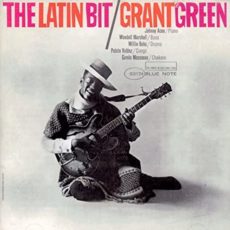
John Adriano Acea was born September 11, 1917 in Philadelphia, Pennsylvania to Adriano Acea of Cuba and Leona Acea of Virginia. One of six children, he was stricken with rheumatic fever and wasn’t expected to live during his first decade of life.
During the 1930s, Acea started out as a trumpeter and saxophonist and after his military service in the Army in 1946, he switched to playing the piano. He later became a session musician with jazz veterans Eddie Lockjaw Davis, Cootie Williams, Dizzy Gillespie, Illinois Jacquet, Dinah Washington, James Moody, Zoot Sims, and Roy Haynes. Between 1951 to 1962 he would record with Grant Green, Dodo Greene, Joe Newman, Leo Parker, Don Wilkerson, and Jesse Powell.
Acea is listed as co-composer of Nice ‘N’ Greasy that was the closing track to Lou Donaldson’s 1962 album, The Natural Soul. He is also credited as a composer on recordings by Gillespie, Jacquet, and Moody.
Pianist Adriano Acea, known as Johnny Acea, passed away on July 25, 1963.
More Posts: history,instrumental,jazz,music,piano,saxophone,trumpet
Daily Dose Of Jazz…
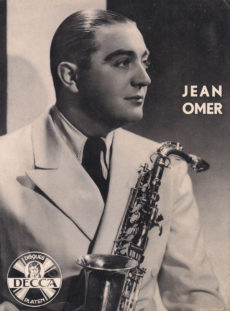
Jean Omer was born in Nivelles, Belgium on September 9, 1912. He played violin before switching to clarinet and saxophone, playing with local groups in Strassburg and Brussels. He worked in France in the band of Billy Smith, then played with the Golden Stars and in René Compère’s band.
Omer participated in a recording session with Gus Deloof in 1931. Following a tour with Fud Candrix’s Carolina Stomp Chasers, he founded his own group, which included at times, Lauderic Caton and Jean Robert. He and Robert De Kers accompanied Josephine Baker in the mid-1930s and played in a group with Ernst van’t Hoff late in the decade.
In 1941, he recorded with Rudy Bruder. He settled in Brussels and led a band into the 1960s which played at the club Le Boeuf sur le Toit. Clarinetist, saxophonist, and bandleader Jean Omer passed away on May 30, 1994 in Brussels, Belgium.
More Posts: bandleader,clarinet,history,instrumental,jazz,music,saxophone
Daily Dose Of Jazz…
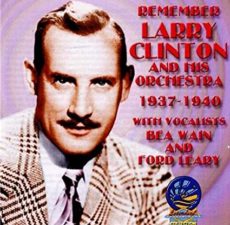
Ford Leary was born on September 5, 1908 in Lockport, New York. He married early, had a son, and left both wife and child for a music career. During the thirties he performed as part of the Frank Trumbaur band and with the Bunny Berigan band, the latter being one of his better positions while scuffling to make ends meet freelancing in New York City.
Ford would go on to work with Larry Clinton in the late Thirties and in the early 1940s with Charlie Barnet, Mike Riley, and Muggsy Spanier. As he was readying to begin a new career path as a replacement performer in the Broadway show Follow The Girls, he suffered a back injury from which he never fully recovered.
His short career ended in the late ‘40s when trombonist and vocalist Ford Leary, the only trombonist of note to die institutionalized at Bellevue Hospital, passed away on June 4, 1949 at age 40.