

Daily Dose Of Jazz…
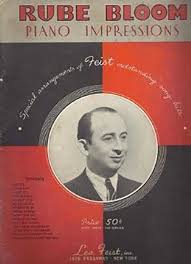
Reuben Bloom was born on April 24, 1902 in New York City, where he learned to play the piano. During the 1920s he wrote many novelty piano solos which are still well regarded today. He recorded for the Aeolian Company’s Duo-Art reproducing piano system various titles including his Spring Fever.
In 1927 Rube had his first hit with Soliloquy and his last hit was “Here’s to My Lady” in 1952, which he wrote with Johnny Mercer. In 1928, he made a number of records with Joe Venuti’s Blue Four for OKeh Records, including five songs he sang, as well as played piano.
He formed and led a number of bands during his career, most notably Rube Bloom and His Bayou Boys. They recorded three records in 1930 that are considered some of the best made during the early years of the Depression. The Bayou Boys was an all-star studio group consisting of Benny Goodman, Adrian Rollini, Tommy Dorsey and Mannie Klein. At other times, Bloom played with other bands, such as with Bix Beiderbecke and Frankie Trumbauer in the Sioux City Six as well as his continued frequent work with Joe Venuti’s Blue Four.
During his career, Rube also worked with many well-known performers, including Ruth Etting, Stan Kenton, Jimmy Dorsey. He collaborated with a wide number of lyricists including Ted Koehler, and Mitchell Parish. During his lifetime he published several books on the piano method.
Bloom’s I Can’t Face the Music with lyrics by Ted Koehler was recorded by Ella Fitzgerald on her 1962 Verve release, Rhythm is My Business, in a fabulous swing/big band version with Bill Doggett. Some of his best-known composition collaborations with lyricists were Day In, Day Out and Fools Rush In (Where Angels Fear to Tread) with lyrics by Johnny Mercer; Give Me the Simple Life with Harry Ruby; and Maybe You’ll Be There with lyrics by Sammy Gallop.
Pianist, vocalist, songwriter, arranger, bandleader, recording artist, and author Rube Bloom passed away on March 30, 1976 in his hometown.

More Posts: arranger,author,bandleader,history,instrumental,jazz,music,piano,recording artist,songwriter,vocal

Daily Dose Of Jazz…
Anthony C. Mottola was born on April 18, 1918 in Kearny, New Jersey. He started out learning to play the banjo, then took up the guitar and had his first guitar lessons from his father. In 1936 he toured with an orchestra led by George Hall, marking the beginning of his professional life.
His first recordings were duets with guitarist Carl Kress. In 1945 he collaborated with accordionist John Serry Sr. in a recording of Leone Jump for Sonora Records which was played in jukeboxes throughout the United States. Tony’s only charted single as a soloist was This Guy’s In Love With You, which reached No. 22 on the Billboard magazine Easy Listening Top 40 in the summer of 1968.
Mottola worked often on television, appearing as a regular on shows hosted by vocalist Perry Como and comedian Sid Caesar and as music director for the 1950s series Danger. From 1958–1972, he was a member of The Tonight Show Orchestra led by Skitch Henderson.
He composed music for the TV documentary Two Childhoods, which was about Vice President Hubert Humphrey and writer James Baldwin, and won an Emmy Award for his work. In 1980, Mottola began performing with Frank Sinatra, often in duets, appearing at Carnegie Hall and the White House. He retired from the music business in 1988 but kept playing at home almost every day.
Guitarist Tony Mottola, who released dozens of albums as a leader, passed away in Denville, New Jersey on August 9, 2004.
More Posts: bandleader,guitar,history,instrumental,jazz,music
Daily Dose Of Jazz…
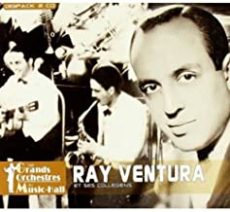
Raymond Ventura was born on April 16, 1908 into a Jewish family in Paris, France and learned to play the piano as a child. By the time he turned 17 in 1925 he was the pianist for the Collegiate Five, which recorded as the Collegians for Columbia Records beginning in 1928 and then for Decca in the 1930s.
Later he led the Collegians and it became a dance orchestra resembling a big band. His sidemen included Alix Combelle, Philippe Brun, and Guy Paquinet. In the early Forties, Ray led a big band in South America and in France during the rest of the decade.
One of his band’s popular songs from 1936 was Tout va très bien, Madame la Marquise in which the Marquise is told by her servants that everything is fine at home except for a series of escalating calamities. It was seen as a metaphor for France’s obliviousness to the approaching war.
Between 1931 and 1953 he appeared with his big band in four films, American Love, Beautiful Star, Women of Paris, and A Hundred Francs A Second. Pianist and bandleader Ray Ventura, who helped popularize jazz in France in the 1930s, March 29, 1979 in Palma de Mallorca, Spain.
More Posts: bandleader,history,instrumental,jazz,music,piano
Daily Dose Of Jazz…
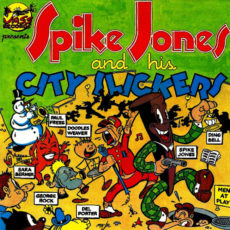
Del Porter was born Delmar Smith Porter on April 13, 1902 in Newberg, Oregon. He first began singing in 1928 as a member of the Foursome, which came to prominence in the Ethel Merman Broadway hit shows, Girl Crazy in 1930 and 1934’s Anything Goes. With the Foursome’s arranger and Porter’s lifelong friend, Raymond M. Johnson, he reorganized the quartet around 1946 as the Sweet Potato Tooters, one of the hottest bands in the country at the time. He would go on to record as a leader, toured with Glenn Miller, and recorded with Bing Crosby, Dick Powell, and Red Nichols.
They recorded extensively for Decca, but a long dry spell followed the quartet’s appearance in the Eleanor Powell movie Born to Dance which resulted in the creation of a six-piece group the Feather Merchants, patterned after the cockeyed musical humor of Frank & Milt Britton and Freddie Fisher’s Schnickelfritz Band. This band evolved into City Slickers, a band he co-founded with Spike Jones about the time the group split up.
The zany band that revolutionized the field of comedy music during World War II, from their earliest days, as lead vocalist, clarinetist, composer, and arranger. He wrote two songs Siam and Pass the Biscuits, Mirandy which became staples of the band’s repertoire. But he was all talent and no ambition, and soon took a back seat to Jones.
After leaving the Slickers in 1945, he returned to lend his melodious voice on Spike Jones Plays the Charleston and their Bottoms Up album. In addition to his music publishing business, Tune Town Tunes, with fellow City Slicker and songwriting partner Carl Hoefle. Porter later wrote jingles for Paper Mate pens, recorded with his Sweet Potato Tooters for Capitol transcriptions, as well as Mickey Katz and Spade Cooley. He continued to dabble in songwriting in his later years.
Vocalist, saxophonist, and clarinetist Del Porter, who in the 1940s, led his own big band, passed away on October 4, 1977 in Los Angeles, California.
More Posts: bandleader,clarinet,history,instrumental,jazz,music,saxophone,vocal

Daily Dose Of Jazz…
Tullio Mobiglia was born in Carezzano, Italy on April 12, 1911. In the early 1930s, after his studies at the conservatory in Genova and his first local engagements, he made several trips to the United States as a member of an on-board ship’s orchestra. Once in America, he made the acquaintance of the leading tenor saxophonists, including Coleman Hawkins.
In 1940 he visited Berlin, Germany as a member of the Italian Orchestra Mirador and in 1941 Tullio was with the Heinz Wehner Orchestra, and from April to November, he formed his own sextet played in the Patria Bar and was also in the Komiker Cafe’s musical revue Dreams About Me.
In the early Forties, Mobiglia’s orchestra played in the Rosita Bar and he also did some Film and Recordings during this period. Kramer combined musicians from two different generations to form his orchestra utilizing trumpeter Alfredo Marzaroli and saxophonist and clarinetist Francesco Paolo Ricci from the Twenties along with the younger members, Tullio Mobiglia, Eraldo Romanoni, Carlo Pecori, and the Triestino Angelo Bartole that performed during the Second World War II in Berlin.
After the war, he operated mainly in Italy, but also performed in Dortmund and Frankfurt Germany. From 1967 into the ’80s, he was active as a violin teacher at the Sibelius Conservatory in Helsinki, Finland.
Tullio directed a band without interruption in Berlin between 1941 and 1943, along with the Kramer’s Orchestra during the second half of the Thirties, the only stable group in the history of Italian Jazz between the years 1935 and ’43. He enlisted the brilliant and inventive guitarist Alfio Grasso to take part in the recordings.
Tenor saxophonist, violinist and bandleader Tullio Mobiglia passed away on July 24, 1991, aged 80, in Helsinki, Finland.
More Posts: bandleader,history,instrumental,jazz,music,saxophone,violin