

Daily Dose Of Jazz…
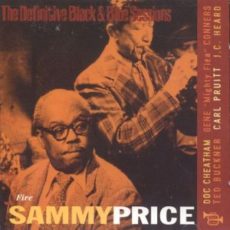
Samuel Blythe Price was born in Honey Grove, Texas on October 6, 1908 and during his early career, he was a singer and dancer in local venues in the Dallas, Texas area. While living in Kansas City, Missouri, Chicago, Illinois and Detroit Michigan he played jazz. In 1938 he was hired by Decca Records as a session sideman on piano, assisting singers such as Trixie Smith and Sister Rosetta Tharpe.
Price was most noteworthy for his work on Decca Records leading his own band, known as the Texas Bluesicians, that included fellow musicians Don Stovall and Emmett Berry. He would also go on to have a decade-long partnership with Henry “Red” Allen.
Later in his life, Sammy partnered with the Roosevelt Hotel in New York City, and was the headline entertainment at the Crawdaddy Restaurant, a New Orleans themed restaurant in New York in the mid-1970s. Here he would play with both Benny Goodman and Buddy Rich.
During the Eighties he moved to Boston, Massachusetts switched to performing in the bar of Copley Plaza. Pianist and vocalist Sammy Price passed away from a heart attack on April 14, 1992, at home in Harlem, in New York City, at the age of 83.

Daily Dose Of Jazz…
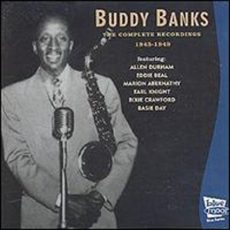
Ulysses Banks, nicknamed Buddy, was born on October 3, 1909 in Dallas, Texas and began playing saxophone in his youth. Moving to Los Angeles, California in the early Thirties he played with the Charlie Echols band from 1933 to 1937. He remained in the group after it was taken over by Claude Kennedy and subsequently by Emerson Scott due to Kennedy’s death. The group then scored a gig at the Paradise Cafe, and Cee Pee Johnson became its leader and played in Johnson’s ensemble until 1945.
Following his departure from the group Buddy led his own group that featured tenor saxophone and trombone as its most prominent instruments. Holding down the trombone chair was Allen Durham and then by Wesley Huff. Guitarist Wesley Pile and drummer Monk McFayalso recorded as members of this group. The ensemble played throughout southern California and recorded until 1949.
Banks led a new group in 1950, but disbanded it quickly and started playing piano, and though he accompanied Fluffy Hunter on tenor saxophone in 1953, he spent most of the rest of his life on piano. From 1953 to 1976 he enjoyed a piano-bass duo with Al Morgan. By 1980 he was playing solo piano.
Tenor saxophonist, pianist and bandleader Buddy Banks passed away on September 7, 1991 in Desert Hot Springs, California.
Daily Dose Of Jazz…
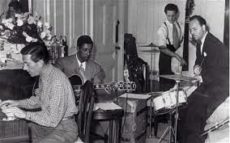
Joe Mudele also Joe Muddel was born on September 30, 1920 in Downham in the south-east of London, England. His father died in 1931 following the consequences of a war and after leaving school at the age of 14, he worked as a singer in a cinema and soon played in local bands. He served in the RAF during the Second World War where he had lessons with James Merritt, contrabassist at the Philharmonia Orchestra.
1946 saw Mudele beginning to work as a professional musician, initially as a member of the Tito Burns Sextet. He met Ronnie Scott and John Dankworth and with them he belonged to the group of musicians who held the first bebop sessions as Club Eleven. To listen to Charlie Parker he attended the Festival International 1949 de Jazz and had the opportunity to play two numbers with Parker and his drummer Max Roach.
At the beginning of the 1950s, Mudele was a member of the Club Eleven Johnny Dankworth Seven but he soon left for family reasons to work the Coconut Grove nightclub in London’s West End. He toured with musicians like Hoagy Carmichael, Sophie Tucker, Judy Garland and Billy Eckstine. In 1951, he formed his own band with saxophonist Joe Harriott.
In the 1940s and 1950s, Alan Dean, Ralph Sharon, Larry Adler, Humphrey Lyttelton, Tommy Whittle, the Melody Maker All Stars in 1952 and 1955, and George Chisholm and Sid Phillips. In the 1960s, he recorded with Johnnie Spence and Alan Branscombe while his last recordings under his own name were made with pianist Robin Aspland and Geoff Gascoyne on drums.
Between 1948 and 2010 he performed on radio and television with Mantovani, Cilla Black, Yehudi Menuhin, Stéphane Grappelli, and the Big Ben Banjo Band, and the Sing Something Simple radio program. He also played regularly at the Bexley Jazz Club.
He recorded some 52 jazz recording sessions, however, outside the jazz he also played on recordings with Johnny Mercer, Barry Gray, John Williams and the Cliff Adams Singers. Bassist Joe Mudele, one of the pioneers of bebop in England, passed away on March 7, 2014.
More Posts: bass
Daily Dose Of Jazz…
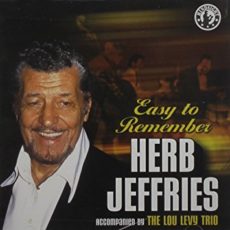
Herb Jeffries was born Umberto Alexander Valentino on September 24, 1913 in Detroit, Michigan of mixed heritage. Never knowing his father who died in World War I and grew up in a rooming house in a mixed neighborhood without encountering severe racism as a child. Showing great interest in singing and intensely musical from boyhood, during his formative teenage years he was often found hanging out with the Howard Buntz Orchestra at various Detroit ballrooms. After the Wall Street Crash of 1929, he dropped out of high school to earn a living as a singer.
He began performing in a local speakeasy where he caught the attention of Louis Armstrong, who gave the teenager a note of recommendation for Erskine Tate at the Savoy Ballroom in Chicago, Illinois. Knowing that Tate fronted an all-black band, Jeffries claimed to be a Creole, and was offered a position as a featured singer three nights a week. Later he toured with the Earl Hines Orchestra through the Deep South.
The 1940s and 1950s saw Herb record for a number of labels, including RCA Victor, Exclusive, Coral, Decca, Bethlehem, Columbia, Mercury and Trend. His album Jamaica, recorded by RKO, is a concept album of self-composed calypso songs. He often used makeup to darken his skin in order to pursue a career in jazz and to be seen as employable by the leading all-black musical ensembles of the day.
He also starred in several low-budget race Western feature films aimed at black audiences from 1937 to 1939, Harlem on the Prairie, Two-Gun Man from Harlem, Rhythm Rodeo, The Bronze Buckaroo and Harlem Rides the Range. He also acted in several other films and television shows billed as Herbert Jeffrey, Herbert Jeffries or the Sensational Singing Cowboy.
Singer and actor Herb Jeffries, who was the only Black singing cowboy star in Hollywood has a star on the Hollywood Walk of Fame, was inducted into the and a Golden Palm Star on the Palm Springs Walk of Stars, passed away on May 25, 2014 in Los Angeles, California.
More Posts: vocal
Daily Dose Of Jazz…
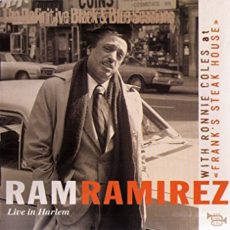
Ram Ramirez was born Roger J. Ramirez on September 15, 1913 in San Juan, Puerto Rico and grew up in New York City. He started learning piano when he was eight and was a professional five years later. In the early Thirties he worked with the Louisiana Stompers, Monette Moore , Rex Stewart, the Spirits of Rhythm and Willie Bryant.
Traveling to Europe with Bobby Martin’s group from 1937 to 1939, when Ramirez returned to New York City and had his own band before working with Ella Fitzgerald, Frankie Newton and Charlie Barnet in the Forties. After a second stint with Newton, he played with the John Kirby Sextet in 1944.
Ram mostly led his own trio from the mid-1940’s on and began doubling on organ in 1953. Active into the 1970’s. playing with the Harlem Blues and Jazz Band at the end of the decade. He became semi-active in the 1980’s and never gaining much fame except among knowledgeable musicians in the swing, bop and trad settings.
Through the years he led sessions for Gotham, Super Disc, Black & Blue, RCA and Master Jazz. He also played with Helen Humes, Putney Dandridge, John Kirby, Ike Quebec, Rex Stewart, Annie Ross, King Pleasure and Duke Ellington’s Small groups. Pianist and composer Ram Ramirez, best known as a co-writer of the classic song Lover Man (Oh, Where Can You Be?, passed away on January 11, 1994 in Queens, New York.

More Posts: piano