

Daily Dose Of Jazz…
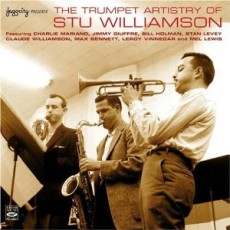
Stu Williamson was born on May 14, 1933 in Brattleboro, Vermont and is the younger brother of jazz pianist Claude Williamson. The trumpeter relocated to Los Angeles in 1949 and became a regular on the West Coast scene. He played with Woody Herman, Mel Lewis-Pepper Adams Quintet, Elmo Hope, Lennie Niehaus, Billy May and Charlie Barnet the first half of the Fifties.
Williamson played a significant role in Stan Kenton’s Orchestra, Howard Rumsey’s Lighthouse Café All-Stars and Terry Gibbs’s Dream Band. Between 1954 and 1958 Williamson played intermittently with Shelly Manne and was a ubiquitous session player up until 1968.
Although he had a beautiful, rich, round tone and his ability to create melodic solos full of invention, power and clarity gave him the opportunity to front small groups and big bands. Disappearing from the jazz scene after battling drug addiction for much of his life, including for years after he left the music. Trumpeter Stu Williamson passed away on October 1, 1991 in Studio City, California.

Dose A Day-Blues Away
More Posts: trumpet
Daily Dose Of Jazz…
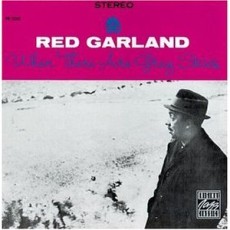
William “Red” Garland was born in Dallas, Texas on May 13, 1923. Showing an early interest in music, he began his musical studies on the clarinet and alto saxophone but switched to the piano. Garland spent copious amounts of time practicing and rapidly developed into a proficient player. A short early career as a welterweight boxer did not seem to hurt his playing hands and he fought a young Sugar Ray Robinson before making the switch to a full-time musician.
Garland’s trademark block chord technique, a style that would influence many forthcoming pianists in the jazz idiom and a commonly borrowed maneuver in jazz piano today, was unique and differed from the methods of earlier block chord pioneers such as George Shearing and Milt Buckner. His block chords were constructed of three notes in the right hand and four notes in the left hand, with the right hand one octave above the left. The right hand played the melody in octaves with a perfect 5th placed in the middle of the octave.
After WWII he performed with Roy Eldridge, Coleman Hawkins, Charlie Parker and Lester Young. He found steady work in Boston, New York and Philadelphia and by the late 40s he was touring with Eddie Vinson at the same time that John Coltrane was in Vinson’s band. His creativity and playing ability continued to improve, though he was still somewhat obscure. By the time he became a pianist for Miles Davis he was influenced by Ahmad Jamal and Charlie Parker’s pianist Walter Bishop.
Red Garland found fame in 1955 when he joined the Miles Davis Quintet along with John Coltrane, Philly Joe Jones and Paul Chambers and together they recorded several Prestige albums such as Workin’, Steamin’ Cookin’ and Relaxin’, that would later influence the free jazz movement. He would go on to play on ‘Round About Midnight and Milestones but would be eventually be fired by Miles.
In 1958 Garland formed his own trio. Among the musicians the trio recorded with Pepper Adams, Nat Adderley, Ray Barretto, Kenny Burrell, Eddie “Lockjaw” Davis, Jimmy Heath, Harold Land, Leroy Vinnegar and many others to numerous to list.
Red released some 46 albums as a leader, recording sessions for Prestige, Fantasy, Galaxy, Jazzland, Keystone, Xanadu, Alfa, Moodsville and New Jazz record labels. He sat in as a sideman for such greats as Arnett Cobb, Art Pepper, John Coltrane and Phil Woods.
Stopping his playing professionally for a number of years in the 1960s when jazz lost popularity to rock and roll, he returned to Dallas to care for his mother. Pianist Red Garland recorded sparsely through the 70s but continued recording and performing until his death of a heart attack on April 23, 1984 at the age of 61.
Inspire A Young Mind
More Posts: piano
Daily Dose Of Jazz…
Mike Melvoin was born on May 10, 1937 in Oshkosh, Wisconsin and began playing piano at age three. He studied English at Dartmouth College but after graduating decided to pursue a career in music.
In 1961 he moved to Los Angeles and began playing with Frank Rosolino, Leroy Vinnegar, Gerald Wilson, Paul Horn, Terry Gibbs, Joe Williams, Peggy Lee, Tom Waits and others.
He worked extensively as a studio musician, in addition to playing Los Angeles clubs, accompanying singer Bill Henderson and playing with Herb Ellis and Plas Johnson on concord Jazz releases. As a composer he lent his scoring talents to the Partridge Family, Fame and MacGyver.
Pianist, composer and arranger Mike Melvoin served as chairman and president of The Recording Academy, was nominated for a Grammy for Best Jazz Instrumental Solo from his album It’s Always You, played between the jazz, rock and pop genres. A prolific studio musician he associated with among numerous others Frank Sinatra, Natalie Cole, The Jackson 5, The Beach Boys, Barbra Streisand, John Lennon, and The Wrecking Crew, passed away at the age of 74 in Burbank, California on February 22, 2012.
Put A Dose In Your Pocket

Daily Dose Of Jazz…
Teresa Brewer was born Theresa Veronica Breuer on May 7, 1931 in Toledo, Ohio and at the age of two her mother took her to audition for a radio program, “Uncle August’s Kiddie Show” on Toledo’s WSPD, performing for cookies and cupcakes. Although she never took singing lessons, she took tap dancing lessons and from age five to twelve, she sang and danced on the “Major Bowes Amateur Hour,” then a popular touring radio show.
At the age of 12, Theresa returned to Toledo, ceased touring, went back to school and continued to perform on local radio. By 1948 at 16 she won a local competition, went to New York, won a number of talent shows and played New York nightclubs including the Latin Quarter.
Discovered by agent, Richie Lisella she signed with London Records and in 1949 recorded her first session that sold over a million copies and “Music! Music! Music!” became her signature song.
In 1951 she switched labels, going to Coral Records and had a string of hits. Since she never learned to read music, she had demos sent to her to learn the melodies of the songs she would record. During those years she continued to play nightclubs in New York, Chicago, Las Vegas and elsewhere. In the mid-50s, she did a number of covers of rhythm and blues and country songs, and co-wrote “I Love Mickey” for Yankees center fielder Mickey Mantle, appeared in the musical “Those Redheads From Seattle” stealing the show fro veterans Rhonda Fleming, Agnes Moorehead and Guy Mitchell.
By 1962 she switched to Philips Records, recorded many singles and albums over a five-year period, also re-recorded her earlier material with new arrangements and instrumentation. In 1977 Teresa guest starred on The Muppet Show and Sha Na Na.
Throughout the ‘80s and ‘90s she re-emerged as a jazz singer paying tribute to Bessie Smith, Louis Armstrong, Fats Waller and Irving Berlin. She recorded with Count Basie, Duke Ellington, Earl “Fatha” Hines and Bobby Hackett.She recorded nearly 600 song titles, received a star on the Hollywood Walk of Fame and inducted into the Hit Parade Hall of Fame.
Singer Teresa Brewer passed away on October 17, 2007 in New Rochelle, New York of Progressive Supranuclear Palsy, a rare degenerative brain disease at 76.
Dose A Day-Blues Away
More Posts: vocal
Daily Dose Of Jazz…
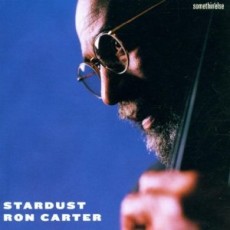
Ron Carter was born May 4, 1937 in Ferndale, Michigan and started playing the cello at the age of 10, but when his family moved to Detroit, he ran into difficulties regarding the racial stereotyping of classical musicians and instead moved to bass. He attended Cass Technical High School and later the Eastman School of Music, played in the later Philharmonic Orchestra. He received his bachelor’s degree at Eastman in 1959, and in 1961 a master’s degree in double bass performance from the Manhattan School of Music.
His first jobs as a jazz musician were with Jaki Byard and Chico Hamilton and made his first records were made with Eric Dolphy and Don Ellis in 1960. Ron led his first date as leader, “Where?”with Dolphy and Mal Waldron and a date “Out There” with Dolphy, George Duvivier and Roy Haynes playing advanced harmonies and concepts were in step with the third stream movement. He truly came to fame in the early ‘60s in the second great Miles Davis quintet with Herbie Hancock, Wayne Shorter and Tony Williams.
Over the course of his career, Carter who is also an acclaimed cellist has appeared on over 2,500 albums make him one of the most-recorded bassists in jazz history. He has played with Sam Rivers, Freddie Hubbard, Duke Pearson, Lee Morgan, McCoy Tyner, Andrew Hill, Horace Silver, Joe Henderson, Hank Jones and too many more to name.
He was a member of the New York Jazz Quartet, the Classical Jazz Quartet, was a Distinguished Professor Emeritus of the Music Department of The City College of New York after twenty years teaching and received an honorary Doctorate from the Berklee College of Music. He is currently on the faculty of the Julliard School teaching bass in the school’s Jazz Studies program, sits on the Advisory Committee of the Board of Directors of The Jazz Foundation of America.
Inspire A Young Mind