

Daily Dose Of Jazz…
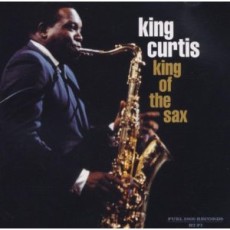
Born Curtis Ousley on February 7, 1934 in Fort Worth, Texas he was known to the jazz world as King Curtis. He learned to play the saxophone and as a youth he played in the same high school band as Ornette Coleman. He led his own group while in school and by 19 was touring with Lionel Hampton before settling in New York. Once there he led a trio containing Horace Silver.
Becoming involved in session work in the mid-50’s Curtis’ prominence rose, playing behind the Coasters and others, then replaced Red Prysock in the Alan Freed radio show band. Regular live appearances at Small’s Paradise and the Apollo Theatre between the late 50’s and early 60’s led him to become musical and studio director for Aretha Franklin and others. During this period he recorded a number of singles for Atco, Prestige and Capitol and Atlantic record labels cranking out hits like Soul Serenade, Memphis Soul Stew and Ode To Billy Joe.
Curtis played tenor, alto and soprano saxophones and was the last of the great R&B tenor sax giants. He was known for his distinctive riffs and solos and loved playing jazz, funk, and rhythm and blues, but chose to make his living playing rock and roll.
All aspects of his career were in full swing at the time he became embroiled in an argument with two men outside his 86th Street apartment in New York City. One of the men stabbed him in the heart and after being rushed to Roosevelt Hospital, King Curtis died from his wound on August 13, 1971. He was 37 years old. On the day of his funeral, Atlantic Records closed its offices.

More Posts: saxophone
Daily Dose Of Jazz…
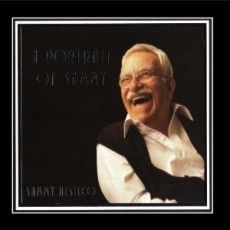
Sammy Nestico was born Samuel Lewis Nestico on February 6, 1924 in Pittsburgh, Pennsylvania. Studying and learning to play the trombone, he started his professional career in 1941 at age 17 as a staff arranger for ABC radio affiliate WCAE.
Over the course of his career he arranged for Count Basie from 1967-1984, for the US Air Force and Marine Bands for twenty years while in Washington, DC, and played trombone in Tommy Dorsey, Woody Herman, Gene Krupa and Charlie Barnet big bands.
A professor at the University of Georgia from 1998-99 Nestico taught commercial orchestration and conducting the Studio Orchestra, but was unable to find the necessary administrative support to remain there. He has also directed music programs at Los Angeles Pierce College, and the Westinghouse Memorial High School in Wilmerding, PA.
During his life in the television and film industry, Sammy has arranged and conducted projects for artists such as Bing Crosby, Sarah Vaughan, Frank Sinatra, Toni Tennille, Phil Collins, Barbra Streisand among others and orchestrated nearly seventy television programs such as Mission Impossible, Mannix, Charlie’s Angels and The Mod Squad.
He has written commercial jingles for numerous companies including Ford, Dodge, Anheuser-Busch and Mattel and has published nearly 600 numbers for school groups and professional big bands. A trombone player and a prolific, well-known composer and arranger of big band music, he is best known for his arrangements for the Count Basie orchestra. Sammy Nestico continues to compose, arrange, conduct and perform.
From Broadway To 52nd Street
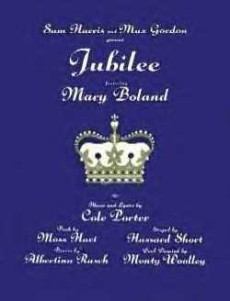
The Imperial Theatre aptly opened Jubilee on October 25, 1935 with music composed by Cole Porter and starring Melville Cooper, Mary Boland, Charles Walter and Margaret Adams. Running for 169 performances, entering into the jazz lexicon are two songs from the musical, Begin The Beguine and Just One Of Those Things.
The Story: Set approaching the anniversary of the coronation and the King and Queen admit they have become jaded with their luxurious but constrained life and Prince James & Princess Diana agree. When a royal nephew leads an insurrection, the royal family rushes into seclusion and emerges incognito. The queen flirts with a movie star, the princess has an affair with a writer and the prince takes a celebrated dancer out on the town. The king is happy to remain at home playing his beloved parlor games. Inevitably they are recognized, so when the insurrection dies, the royal family returns to its comfortable restricted world.
Broadway History: The first decade of the century witnessed the creation of numerous theatres in the new Longacre Square area, and, in 1902 when the Hotel Pabst was razed to allow the Times Building to be built on that spot, Longacre Square became Times Square. New theatres in the area included the Victoria at 42nd & 7th built in 1899; the Republic on 42nd built in 1900;; The Lyric and The New Amsterdam both a few doors down built in 1903. The following year the Lew Fields Theatre was built on the same block. There were several others built in the area from 39th to 45th streets, and some enterprising individuals were progressing even further uptown to Columbus Circle and Central Park West.
In 1900, Broadway (the Broadway we’re interested in) extended from The Star Theatre on 13th Street to the New York Theatre on 45th Street and patrons were paying $1.50 to $2.00 each for the best seats to see their favorite stars.
Sponsored By

www.whatissuitetabu.com
More Posts: broadway
Daily Dose Of Jazz…
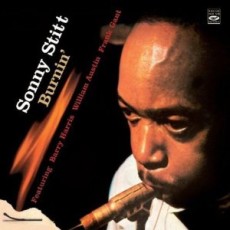
Sonny Stitt was born Edward Stitt on February 2, 1924 in Boston, Massachusetts but grew up in Saginaw, Michigan in a musical family and was given a strong musical background as a child. His father was a college music professor, his mother a piano teacher and his brother was a classically trained pianist.
Meeting Charlie Parker in 1943, the two found their styles extraordinarily similar, due in part to Stitt’s emulation. Considered on of Parker’s greatest disciples he was also influenced by Lester Young, both helping Sonny develop his own style, which would later influence John Coltrane.
Nicknamed the “Lone Wolf” by jazz critic Dan Morgenstern, attributing his relentless touring and devotion to jazz, Stitt recorded over 100 albums in his lifetime. His earliest recordings were with Stan Getz in 1945, he played in swing bands like Tiny Bradshaw’s big band and replaced Charlie Parker in Dizzy’s band, and sat alongside bop pioneers Dexter Gordon and Gene Ammons in Billy Eckstine’s big band in the forties.
Sonny began to develop a far more distinctive sound on tenor playing with other bop musicians Bud Powell and Eddie “Lockjaw” Davis. In the fifties he teamed up with Thad Jones and Chick Corea and experimented with Afro Cuban jazz. He joined Miles Davis briefly in 1960 but was fired for an excessive drinking habit he developed.
Stitt went on to record a number of albums with his long-time friend Gene Ammons, regarded as some of their best work of dueling partnerships; then ventured into soul jazz with Booker Ervin, recorded with Ellington alumnus Paul Gonsalves and was a regular at Ronnie Scott’s in London during the sixties.
By the 1970s, Sonny slowed his recording output slightly, experimenting with an electric saxophone called the “Variphone” heard on the album “Just The Way It Was – Live At The Left Bank” in ’71 and returning to the alto to record the classic “Tune Up” in 1972. Sonny joined the Giants Of Jazz along with Art Blakey, Kai Winding, Dizzy Gillespie, Thelonious Monk and Al McKibbon, and continued to record throughout the seventies.
A fiery tenor with enthusiastic solos, he was equally effective with blues and ballads, whether he was playing the alto, tenor or baritone. Sadness fell upon the jazz world on July 22, 1982 when Sonny Stitt passed away in Washington, D.C. after suffering a heart attack.

More Posts: saxophone
Daily Dose Of Jazz…
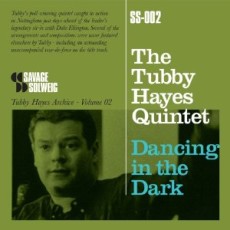
Tubby Hayes was born Edward Brian Hayes on January 30, 1935 in London and started playing the violin at the age of 8, changed to the tenor at twelve and started playing professionally at fifteen. His early influences were Charlie Parker, Sonny Rollins and Stan Getz. In 1951 he joined Kenny Baker and playing in the big bands of Ambrose, Vic Lewis and Jack Parnell.
Tubby led his own octet in 1956 and encourage by Victor Feldman he started playing the vibes in December of that year. Following his octet, Tubby co-led the Jazz Couriers with Ronnie Scott from ’57 to ’59 and toured Germany with Kurt Edelhagen. His international reputation grew rapidly and he was the first British contemporary to appear regularly in the U.S. at the Blue Note, the Boston Jazz Workshop and Shelly Manne’s Manne-Hole.
In 60’s London he led his own big bands, hosted his own TV show, sat in with Duke Ellington’s orchestra, and with Charles Mingus, Dave Brubeck and others. Tubby appeared in All Night Long, and with his own quintet in The Beauty Jungle and House of Horrors.
Hayes was a virtuoso musician on tenor and flute, an excellent vibist, and a composer/arranger of rare talent. He toured extensively through Europe playing the major festivals, such as Antibes, Lugano, Vienna and Berlin. He was one of the few Brits that recorded as a leader of all-American groups with Clark Terry, Roland Kirk and James Moody.
Plagued with heart trouble he underwent open-heart surgery in the late Sixties, putting him out of action until 1971. Working again was brief and while undergoing a second heart operation, Tubby Hayes died on June 8, 1973 in Hammersmith, London, England. He was just 38 years old.
More Posts: flute,saxophone,vibraphone