

Daily Dose Of Jazz…
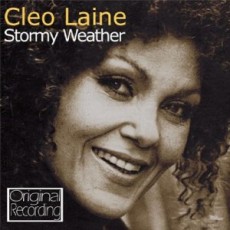
Cleo Laine was born Clementina Dinah Campbell on October 28, 1927 in Southall, Middlesex, England of mixed heritage to a black Jamaican father and white English mother. She began taking singing and dancing lessons at an early age and attended the Featherstone Primary School. Prior to her singing career she worked as an apprentice hairdresser, librarian and for a pawnbroker, married a roof tiler and had a son, all before 1957.
Laine took up singing professionally in her mid-twenties, auditioning successfully for John Dankworth’s band, with which she performed until 1958, when she married Dankworth in secret. She began her career as a singer and actress, playing the lead in a new play at London’s Royal Court Theatre in the 50s. This propelled her into consistent theatre applause and acclaim over the next two decades.
During this period she had two major recording successes, You’ll Answer to Me, reaching the British Top 10 and Shakespeare and All that Jazz with Dankworth received widespread critical acclaim. Cleo’s international recognition started in 1972 with her first tour of Australia followed by performances in the U.S. at Lincoln Center and Carnegie Hall, and then heading to Canada with coast-to-coast tours of both countries. Television saw her on the Muppet Show, with a succession of record releases; several nominations and a Grammy win for her live Carnegie Hall 1983 concert.
In 1979 Laine was made an Officer of the Order of the British Empire (OBE) for services to music and in the 1997 New Year’s Honours list, her membership of the order was elevated to Dame Commander, and she was appointed Dame Cleo Laine DBE, the equivalent of a knighthood for women.
Singer and actress Cleo Laine is a contralto with a three-octave range and is the only female performer to have received Grammy nominations in the jazz, popular and classical music categories. She has published a self-titled autobiography Cleo in 1994 followed up with You Can Sing If You Want To in 1997. She has recorded over a hundred albums, received several honorary doctorates, fellowships and awards, has had a street named after her and at 85 years of age the longevity of her voice has been almost unchanged from decades earlier.
More Posts: vocal
Daily Dose Of Jazz…
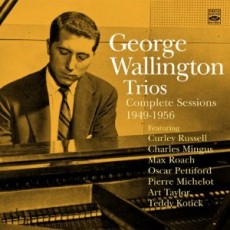
George Wallington was born Giacinto Figlia on October 27, 1924 in Palermo, Italy but his family moved to the United States in 1925. He didn’t arrive on the New York scene until the 40s at around 18 years old, but from 1943 to 1953 he played with Joe Marsala, Charlie Parker, Serge Chaloff, Allan Eager, Kai Winding, Terry Gibbs, Brew Moore, Al Cohn, Gerry Mulligan, Zoot Sims, Red Rodney and Lionel Hampton.
He was Dizzy Gillespie’s pianist in his first bop band at the Onyx club in 1944, where his contributions reflected his innate creative ability, a talent that established him as one of the best composers in the progressive field. His astonishing, fast-moving eloquence as a pianist, contrasted strangely with his introvert, laconic manner as a person.
Wallington recorded as a leader for Savoy and Blue Note and led groups in New York that included newcomers Donald Byrd, Jackie McLean and Phil Woods from 1954 to 1960. He would record with these groups for Prestige and Atlantic record labels. In 1960 he retired to work in the family business, but returned to music in 1984 and recording three albums. His style is often compared to the legendary Earl “Bud” Powell.
George’s best known compositions are the bop standards “Lemon Drop” and “Godchild”, he sat in on the recording of Lady Fair on the Verve release Metronome All-Stars 1956 and was closely associated with the progressive jazz movement in Harlem and on 52nd Street during the 1940s.
Bop pianist, arranger and composer George Wallington, one of the first bop pianists alongside Al Haig and Bud Powell, passed away in Cape Coral, Miami, Florida on February 15, 1993. He left a ten record discography as a leader with several more as a sideman.

More Posts: piano
From Broadway To 52nd Street
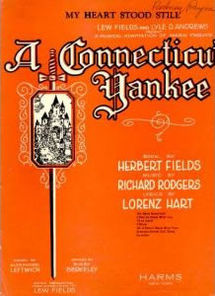
A Connecticut Yankee opened on November 3, 1927 in the Vanderbilt Theatre and ran for four hundred and eighteen performances starring William Gaxton, Constance Carpenter and Nana Bryant.Richard Rodgers and Lorenz Hart composed the music for this delightful romp and from the body of music came two jazz standards Thou Swell and My Heart Stood Still. Based on the Mark Twain fantasy.
The Story: A modern man is thrust back to King Arthur’s Court in a dream caused by a blow to the head given by his fiancée for flirting with a girl. In his dream appear all the people important in his life, each taking on the personality he perceives in real life. While at court he falls in love with the girl, his attempts to woo her are thwarted by Merlin and Morgan le Fay. When he awakens he leaves his fiancée and decides to marry the girl.
Jazz History: Four clubs were pivotal in setting up The Street. 21 brought glamour, high society, top politicians and the columnists who spread the fame of The Street. Tony’s at No. 57-59 attracted the literary and theater set of the famous Algonquin Roundtable. At No. 33 Leon & Eddie became home for the tourists, cloak and suiters and show biz folk who couldn’t make it at 21 or Tony’s. At Joe Helbeck’s Onyx, originally an “in” spot for studio musicians at No. 35 triggered the awareness and influx of the public through its song hits.
In the early thirties, humorist Robert Benchley along with Jack Kriendler, one of the founder-owners of 21 drank their way west to 6th Avenue and back up the even numbered side of the street east to 5th counting the number of speakeasies and coming up with no less than 38.
Sponsored By

www.whatissuitetabu.com
More Posts: broadway

Daily Dose Of Jazz…
Roberto Menescal was born on October 25, 1937 in Vitoria (ES) Brazil and by eighteen the guitarist and vocalist was making his debut as a professional along with Elis Regina, Silvia Telles and others. By the late 50s he spawned a brilliant career as a composer being in good company with Carlos Lyra, Tom Jobim and Ronaldo Boscoli.
Menescal was important to the founding of the Bossa Nova movement in which many of his songs are references to the sea, such as his best-known composition “O Barquinho” (“Little Boat”). He was one of the musicians who promoted the swing of bossa nova around the world with his compositions “The Barquinho”, “You” and “We and the Sea” and was a part of the famous 1962 Bossa Nova Concert at Carnegie Hall in New York City.
Choosing to return to Brazil to raise a family, his fame is mostly relegated to his home country and with bossa nova fans around the world. Roberto very easily moves between musical mediums playing Latin, Brazilian pop, Musica Popular Brasiliera, Bossa Nova and Samba. He provided music for the film Bye Bye Brasil and was nominated for a Latin Grammy for his work with his son’s bossa group Bossacucanova in 2002.
With a career spanning over 50 years, he has worked with the likes of Paul Winter, Toots Thielemans, Herbie Mann, Lucio Alves, Caetano Veloso, Joao Bosco, Maysa and Alcione. Donning his producer and arranger hats he has recorded Elis Regina, Leila Pinheiro, Wanda Sa, Chico Buarque, Emilio Santiago, Fagner, Gal Costa, Nara Lion, Jeanne, Ivan Lins and Oswaldo Montenegro who are a fraction of a long list of artists.
From 1970 to 1985, Menescal was at Polygram Records as producer, director and general manager but left to found his own production company – Albatross. Since the late Nineties he has been a part of “Tokyo-River Road” to Japan, was musical director for “Nara – A Lady Say” that ran five months in Rio de Janiero, and released a three instrumental CD “Zen” set of bossa nova, bolero and jazz.
In 2008 Roberto not only celebrated his 50 years of bossa nova but also the 50th anniversary of the music genre. That same year he was the musical director for the show “50 Years of Bossa Nova” held on Ipanema Beach to an audience of over 60,000 people. Composer, producer, arranger, guitarist and vocalist Roberto Menescal is also an educator, who between performances and recordings conducts numerous workshops at universities, conferences and musical events around the world.

Daily Dose Of Jazz…
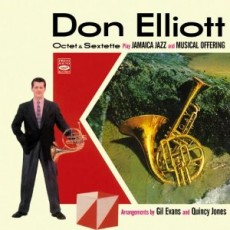
Don Elliott was born on October 21, 1926 in Somerville, New Jersey. He played mellophone in his high school band and played trumpet for an army band. After study at the University of Miami he added vibraphone to his arsenal of instruments. He recorded with Terry Gibbs and Buddy Rich before forming his own band.
From 1953 to 1960 he won the Down Beat readers poll several times for “miscellaneous instrument-mellophone.” Known as the “Human Instrument”, Elliott additionally performed jazz as a vocalist, trombonist, flugelhornist and percussionist. He pioneered the art of multi-track recording, composed over 5000 jingles with a countless number being prize-winning advertising jingles, prepared film scores, recorded over 60 albums and built a thriving production company.
Don scored several Broadway productions, such as The Beast In Me and A Thunder Carnival, the latter of which he performed with the Don Elliott Quartet, provided one of the voices for the novelty jazz duo the Nutty Squirrels, and lent his vocal talents to such motion picture soundtracks as The Getaway, $ (Dollars), The Hot Rock and The Happy Hooker.
His album Calypso Jazz is considered by some jazz enthusiasts to be one of the definitive calypso jazz albums. He worked with Paul Desmond, Bill Taylor, Billy Eckstine, Bill Evans, Urbie Green, Michel Legrand, George Shearing and Mundell Lowe among others over his career. Multi-instrumentalist, vocalist, publisher and producer Don Elliott, who was a longtime associate of Quincy Jones, passed away of cancer in Weston, Connecticut on July 5, 1984.

More Posts: flugelhorn,mellophone,percussion,trombone,trumpet,vibraphone,vocal