

Daily Dose of Jazz…
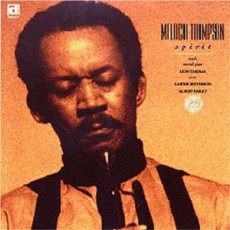
Malachi Richard Thompson was born on August 21, 1949 in Princeton, Kentucky and moved to Chicago as a child. He credited his interest in the trumpet to hearing Count Basie’s band at the Regal Theatre when he was 11 years old. Malachi worked in the rhythm and blues scene on Chicago’s South Side as a teen and in 1968 he joined the Association for the Advancement of Creative Musicians (AACM), spending some time in the AACM big band. Thompson graduated from Governor’s State University in 1974 with a degree in music composition.
He performed and toured with the Operation Breadbasket Big Band, which was affiliated with the Southern Christian Leadership Conference. He has worked with saxophonists Joe Henderson, Jackie McLean, Frank Foster and Archie Shepp among other musicians while living in New York City. He formed his “Freebop” band in 1978, eventually relocating to Washington, D.C., working with Lester Bowie’s Hot Trumpets Repertory Company and formed Africa Brass, inspired by traditional New Orleans brass bands.
With a goal of preserving the Sutherland Theater on Chicago’s South Side, Thompson founded the Sutherland Community Arts Initiative in 1991, a non-profit corporation, and wrote incidental music for a play about the theater. Diagnosed in 1989 with T-cell lymphoma and learning he had one year to live, Thompson claimed he was healed by radiation and reading about jazz. He died in Chicago from a relapse of his cancer on July 16, 2006.
More Posts: trumpet
From Broadway To 52nd Street
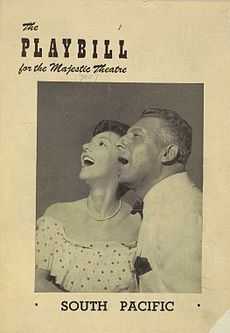
South Pacific hit the stage of the Majestic Theatre on April 7, 1949 in the first of a 1,925 performance run. Richard Rodgers and Oscar Hammerstein composed the music from the compositions “Happy Talk”, “Some Enchanted Evening” and “A Wonderful Guy” became jazz standards. The musical starred Enzio Pinza, Mary Martin, Juanita Hall, William Tabbert, Betta St. John and Myron Mccormick.
The Story: An American nurse stationed on a South Pacific island during World War II falls in love with a middle-aged French expatriate plantation owner but struggles to accept his mixed-race children. A secondary romance, between a U.S. lieutenant and a young Tonkinese woman, explores his fears of the social consequences should he marry his Asian sweetheart. The issue of racial prejudice is candidly explored throughout the musical, most controversially in the lieutenant’s song, “You’ve Got To Be Carefully Taught”. Supporting characters, including a comic petty officer and the Tonkinese girl’s mother, help to tie the stories together. However, Hammerstein’s lack of military knowledge hampered his writing that part of the script, so the director of the original production, Logan, assisted him, receiving credit as co-writer of the book.
Broadway History: The production won an unprecedented 10 Tony Awards including Best Musical, Best Score and Best Libretto. It is the only musical production to win Tony Awards in all four acting categories. Its original cast album was the bestselling record of the 1940s. Due to it’s 1,925 it was ushered into the blockbuster hall of fame surpassing it’s predecessors by more than 800 performance.
Sponsored By

www.whatissuitetabu.com
Daily Dose Of Jazz…
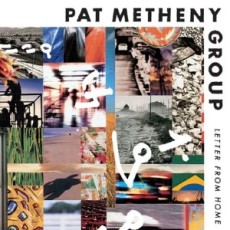
Patrick Bruce Metheny was born August 12, 1954 in Lee’s Summit, Missouri, a suburb southeast of Kansas City. At 15 he won a Down Beat scholarship to a one-week jazz camp, taken under the wing of guitarist Atilla Zoller and met Jim Hall and Ron Carter In NYC. Following high school graduation in 1972, he briefly attended the University of Miami, was quickly offered a teaching position but moved to Boston, accepting a teaching assistantship at Berklee College of Music with vibraphonist Gary Burton, making his name as a teenage prodigy.
In 1974, Metheny gained notoriety playing two sessions with Paul Bley and Carol Goss’ Improvising Artists label along with bassist Jaco Pastorius. He entered the wider jazz scene in 1975 when he joined Gary Burton’s band and his musical momentum carried him rapidly to the point that he had soon written enough material to record his debut album “Bright Size Life” with Pastorius and drummer Bob Moses.
One of the most successful and critically acclaimed jazz and New Age musicians to come to prominence in the 1970s and ’80s, he is the leader of the Pat Metheny Group, is involved in side projects, and has released notable solo, trio, quartet and duet recordings. He has worked with musicians such as Jim Hall, Dave Holland, Roy Haynes, Toninho Horta, Gary Burton, Joni Mitchell, Chick Corea, Pedro Aznar, Jaco Pastorius, Charlie Haden, John Scofield, Jack DeJohnette, Herbie Hancock, Bill Stewart, Ornette Coleman, Brad Mehldau and many others.
His style incorporates elements of progressive and contemporary jazz, post-bop, new age, Latin jazz and jazz-fusion. He has been voted Guitarist of the Year by the Down Beat Magazine Readers Poll several times, was granted the Miles Davis Award by the Montreal International Jazz Festival, has amassed an impressive catalogue of 97 albums as a leader, collaborator or sideman, has three gold albums and has received 20 Grammy Awards.
Guitarist Pat Metheny has been touring for more than 30 years, playing between 120-240 concerts a year.
More Posts: guitar
From Broadway To 52nd Street
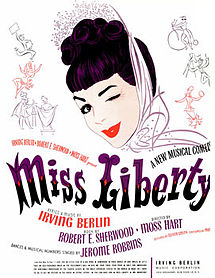
Miss Liberty brought to the stage its star Eddie Albert at the Imperial Theatre on July 15, 1949. The show ran for three hundred and eight performances with music composed by Irving Berlin. The song “You Can Have Him” became a jazz standard.
The Story: In 1885, New York Herald publisher James Gordon Bennett assigns novice reporter Horace Miller to find the woman who served as Frédéric Auguste Bartholdi’s model for the Statue of Liberty. In the artist’s Paris studio, Miller sees a photograph of Monique DuPont and mistakenly believes she was the one. Bennett arranges for her and her grandmother to accompany Horace back to New York City, where she becomes a media darling. When rival publisher Joseph Pulitzer discovers it was Bartholdi’s mother who actually posed for him, he exposes Monique as a fraud in his New York World. She faces deportation until a sympathetic Pulitzer comes to her rescue, paving the way for her to plan a future with Horace, who jilts his American girlfriend Maisie Doll in favor of the French beauty.
Jazz History: As the widely performed bebop or hot jazz began to wane in some sectors of the country, cool jazz began to emerge by the early 1950s. “Cool” was used to describe a kind of toned-down jazz. Later the term became associated with a number of white musicians who relocated to California where they could get day gigs at movie studios, unlike black musicians, while playing jazz at night. In this form it was called West Coast jazz. For white players to represent a kind of cool jazz is ironic since the idea of coolness has its roots in Black culture. Cool jazz contrasts with hot jazz in that it has limited vibrato, restrained timbre, stable dynamics, melodic calm, sophisticated harmonies that tempered the blues idiom.
Sponsored By
www.whatissuitetabu.com
Daily Dose Of Jazz…
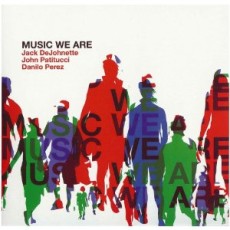
Jack DeJohnette was born August 9, 1942 in Chicago, Illinois and studied drums and piano. He first became known as a member of Charles Lloyd’s band, along with pianist Keith Jarrett. He played with Bill Evans in 1968 on the acclaimed Bill Evans at the Montreux Jazz Festival and from 1969 to 1972 played with Miles Davis.
The 70s saw Jack recording for Milestone/Prestige and ECM appearing widely on ECM also as a sideman. Since then he has recorded for MCA, Blue Note and Kindred Rhythm. He led several groups since the early-1970s, including Compost, a jazz-rock group that produced two albums; then went on to lead sessions that produced the albums “Directions”, “New Directions” and “Special Edition”.
He has worked with a host of jazz lions to numerous to list but suffice it say they range from Eddie Gomez to Dave Holland to Arthur Blythe, David Murray and Chico Freeman. He is a dazzling improviser and a clear stylistic successor of Roy Haynes, and two of the greatest drummers of the 1960s, Tony Williams and Elvin Jones.
Since 2003, Jack has been part of Trio Beyond with organist Larry Goldings and guitarist John Scofield that paid tribute to The Tony Williams Lifetime Trio and he also appears as a member of the Bruce Hornsby Trio. He has been nominated for several Grammy Awards and in 2009 DeJohnette received the Grammy for Best New Age Album “Peace Time”. He has been awarded an NEA Jazz Masters Fellowship for his significant lifetime contributions to the enrichment of jazz and the further growth of the art form.
Jack DeJohnette successfully incorporates elements of free jazz and world music while maintaining the deep grooves of jazz and R&B drummers. His exceptional experience of time and style, combined with astounding improvisational ingenuity, make him one of the most highly regarded and in-demand drummers. He also occasionally appears on piano, on his own recordings and has built a catalogue too immense to cite as he continues to perform, record and tour.
More Posts: drums