

Daily Dose Of Jazz…
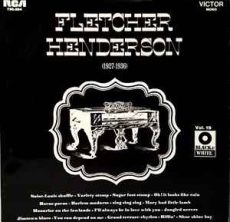
Clarence Holiday was born Clarence Halliday on July 23, 1898 in Baltimore, Maryland and attended a boys’ school with the banjo player Elmer Snowden. Both of them played banjo with various local jazz bands, including the Eubie Blake band. At the age of 16, he became the unmarried father of Billie Holiday, who was born to 19-year-old Sarah Fagan, but rarely visited them. He moved to Philadelphia, Pennsylvania when he was 21 years old.
Holiday played rhythm guitar and banjo as a member of the Fletcher Henderson Orchestra from 1928 to 1933. He went on to record the following year with Benny Carter, then Bob Howard in 1935 and worked with Charlie Turner, Louis Metcalf, and the Don Redman Big Band between 193 and 1937.
Exposed to mustard gas while serving in World War I, he later fell ill with a lung disorder while on tour in Texas. Refused treatment at a local hospital when he finally managed to see a doctor, Clarence was only allowed in the Jim Crow ward of the Veterans Hospital. By then pneumonia had set in and without antibiotics, the illness was fatal.
Guitarist and banjoist Clarence Holiday died in Dallas, Texas on March 1, 1937.

On The Bookshelf
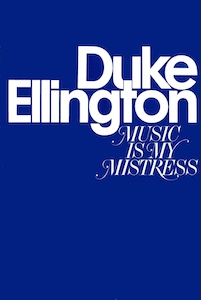
Duke Ellington: Music Is My Mistress
My favorite tune? The next one. The one I’m writing tonight or tomorrow, the new baby is always the favorite. The author of these words has created some of the best loved music in the world: Mood Indigo, Sophisticated Lady, Caravan, Take The A Train, Solitude.
Music is my mistress, and she plays second fiddle to no one.” This is the story of Duke Ellington, the story of Jazz itself. Told in his own way, in his own words, a symphony written by the King of Jazz and published by Doubleday & Company, Inc. His story spans and defines a half-century of modern music. This man who created over 1500 compositions was as much at home in Harlem’s Cotton Club in the 1920s as he was at a White House birthday celebration in his honor in the 1960s.
For Duke knew everyone and savored them all. Passionate about his music and the people who made music, he counted as his friends hundreds of the musicians who changed the face of music throughout the world: Bechet, Basie, Armstrong, Lena Horne, Ella Fitzgerald, Sinatra, to name a few of them.
In this 522 page volume are 100 photographs to give us an intimate view of Duke’s world, his family, his friends, his associates. What emerges most strongly in his commitment to music, the mistress for whom he saves the fullest intensity of his passion.
”Lovers have come and gone, but only my mistress stays,” he says. He composed not only songs that all the world has sung, but also suites, sacred works, music for stage and screen and symphonies. This rich book, the embodiment of the life and works of the Duke, is replete with appendices listing singers, arrangers, lyricists and the symphony orchestras with whom the Duke played. There is a book to own and cherish by all who love jazz and the contributions made to it by the Duke.
Daily Dose Of Jazz…
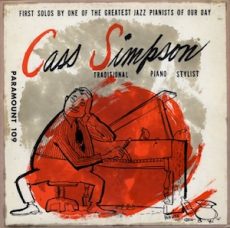
Wendell “Cassino” Simpson was born on July 22, 1909. He may have studied piano under Zinky Cohn. His first recording was in 1923 with Bernie Young, then recorded with the Moulin Rouge Orchestra in 1925. Following this he joined Arthur Sims’s orchestra, recording with them in 1926. With Sims dying soon after Bernie Young took over as bandleader and Simpson remained in the ensemble until 1930.
He simultaneously recorded with Jabbo Smith’s Rhythm Aces on his 1929 Brunswick Records releases. From 1931 to 1933 he played with Erskine Tate, though he never recorded with him. Cass recorded as a leader under various names, with Jabbo Smith and Milt Hinton as sidemen. In 1933 he cut a few sides with Half Pint Jaxon, a female impersonator.
Soon after his recordings with Jaxon, Simpson apparently became mentally disturbed, and was institutionalized in 1935 in Elgin, Illinois. While there, he continued to play piano and vibraphone in a hospital dance band, and played bass drum in the hospital’s marching band.
He recorded solo piano numbers on the grounds of the hospital in the middle of the 1940s. Pianist Cass Simpson, who was best known for his associations on the Chicago, Illinois jazz scene and was never released from the hospital, died on March 27, 1952.
More Posts: bandleader,history,instrumental,jazz,music,piano
Daily Dose Of Jazz…
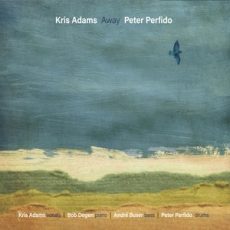
Peter Perfido‘was born on July 21, 1956 in Hartford, Connecticut. He started his drumming musical journey in the early Sixties being influenced by the British Wave of the Beatles, the Kinks, the Animals, and the Who. By the mid 70’s Peter had begun to discover jazz and improvised music. While predominantly self-taught, he studied privately with Kit McDermott, Bob Moses and Jerry Granelli. His career has involved playing jazz, improvised music, rock and blues with scores of lauded musicians from diverse styles and backgrounds.
Peter has performed and/or recorded with Chet Baker, Gary Peacock, Lee Konitz, Jimmy Woode, Bill Barron, Art Lande, Julian Priester, David Friedman, Tomasz Stanko, Sal Nistico, Kent Carter, Rasul Siddik, Bob Degen, Heinz Sauer, Bob Mover, Ed Schuller, Anthony Braxton, Joe Lee Wilson, Lou Bennett, Bobby Few, Barney Wilen, Bobby Few, Liz McComb, Michelle Hendricks, Ferenc Snetberger, Rinde Eckert, Lonnie Plaxico , Stephen Haynes, Michel Pilz, Lonnie Plaxico, and the list goes on.
He has toured across the USA, Western Canada, Europe, Asia, the USSR and the Pacific islands. Currently living in Hohrod, Alsace, France, drummer Peter Perfido performs mostly in Europe these days with groups spanning a wide spectrum of influences from mainstream modern jazz to open ended explorations with free improvisation, as well as shuffling and rocking the blues.
More Posts: bandleader,drums,history,instrumental,jazz,music
Requisites
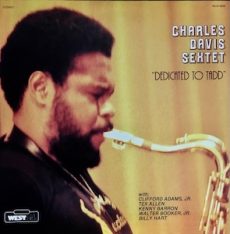
Dedicated to Tadd ~ The Charles Davis Sextet | By Eddie Carter
The Charles Davis Sextet steps into this morning’s spotlight, showcasing the multi-instrumentalist on his second outing as a bandleader with Dedicated to Tadd (West 54 WLW 8006). My introduction to Davis came through three standout albums: “Breakthrough,” “Illumination,” and “Manhattan Project.” Davis has contributed as a sideman to more than 100 recordings, with some of jazz’s brightest talents; however, he is best known for his work with Archie Shepp and Sun Ra. This date features a stellar lineup: Tex Allen on trumpet; Clifford Adams, Jr. on trombone; Charles Davis alternates between baritone sax (A2, B3), soprano sax (A1, B2), and tenor sax (A3, B1); Kenny Barron on piano; Walter Booker, Jr. on bass; and Billy Hart on drums. My copy of the album is the 1979 U.S. stereo release.
Monking, the first of four originals by Charles Davis, gets off to a good start with the sextet’s engaging melody in unison. The fun begins as Tex leads with a lively opening solo. Clifford comes in next, laying down an infectious groove. Kenny takes over to deliver a performance executed with thoughtful, nuanced articulation. Charles glides effortlessly through the closing statement on soprano into the climax. Eastern Vibrations comes to life with the ensemble’s collective theme at medium speed. Allen steps forward first with a bright and captivating solo. Adams is especially impressive in the following reading. Barron tackles the third reading incisively, and then Booker seizes the moment in his first statement. Davis’s baritone brings it all home with unmistakable authority, leading to the theme’s reprise.
The group ventures onto Mexico Street next, beginning with Billy’s concise introduction ahead of the sextet’s rapid-fire theme. Tex sets the bar with a brisk and agile solo, paving the way for Clifford’s energetic interpretation. Charles’s tenor sax brings a thrilling intensity to the following statement. Kenny keeps things rolling in an electrifying performance, then Walter and Billy both make a brief comment preceding the ensemble’s robust exit. The title tune, Dedicated to Tadd, unfolds as a graceful ballad, opening with a soft piano prelude that ushers in the group’s beautiful melody. Davis draws out the song’s tenderness in the opening tenor sax statement. Barron infuses the following solo with sensitivity and finesse, before the ensemble’s gentle reprise of the theme and a touching ending.
The last two tracks come from the pen of Tex Allen, starting with the sextet’s introduction and medium melody to Love Gods. Charles gets the opening solo underway with a laid-back soprano interpretation. A brief piano interlude leads to Tex, who hits his target in the following interpretation. A second short piano break leads to the sextet’s closing chorus and finale. Sir Charles, the trumpeter’s tribute to Charles Davis, turns the beat upward one final time for the ensemble’s introduction and theme. Davis gets right to work on the baritone sax and turns in an opening solo that’s a sheer delight. Allen shines in a flawless performance, which in turn leads to Barron’s final statement preceding the sextet’s return to the theme, affording Adams a concise comment as the music gracefully fades away.
Roger Pola produced the album, and the executive producer was Pierre Bourdain. Allan Tucker was behind the dials as the recording engineer. The album’s sound quality is excellent, featuring a superb soundstage that places the musicians directly in the listener’s sweet spot with impressive fidelity. Dedicated to Tadd is an enjoyable album that showcases each artist at their best. If you’re a sax fan and are looking for something fresh to add to your library, I offer for your consideration Dedicated to Tadd by the Charles Davis Sextet on your next record-shopping trip! It shines a spotlight on a truly talented multi-instrumentalist deserving of wider recognition!
~ Breakthrough (Cobblestone CST 9011), Illumination! (Impulse A-49/AS-49), Manhattan Project (Bee Hive Records BH 7001) – Source: Discogs.com
© 2025 by Edward Thomas Carter
More Posts: choice,classic,collectible,collector,history,instrumental,jazz,music,saxophone