

Daily Dose Of Jazz…
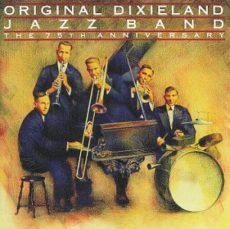
Antonio Sparbaro, better known as Tony Sbarbaro or Tony Spargo was born on June 27, 1897 in New Orleans, Louisiana to an immigrant Sicilian family. Early in his career he played with the Frayle Brothers Band, possibly as early as 1911 and the Reliance Band of Papa Jack Laine.
After doing side work with Merritt Brunies and Carl Randall he joined the Original Dixieland Jazz Band for their initial recordings in 1917. Tony became its leader in the 1940s and remained a member of the ensemble until its dissolution in the 1960s. At the time the band broke up he was the only founding member still in the group.
Sbarbaro composed for the group, writing the tune Mourning Blues among others. He remained a fixture of Dixieland jazz performance for most of his life, performed at the New York World’s Fair in 1941 and with Connee Boswell in the 1950s. Later in life in New Orleans he played with Miff Mole, Big Chief Moore, Pee Wee Erwin, and Eddie Condon. Quitting music in the Sixties due to the popularity of rock & roll, drummer Tony Sbarbaro passed away on October 30, 1969.

#preserving genius
More Posts: drums
Daily Dose Of Jazz…
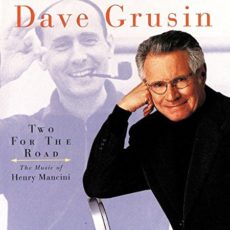
Dave Grusin was born Robert David Grusin on June 26, 1934 in Littleton, Colorado to pianist mother and violinist father who emigrated from Riga, Latvia. He went on to study music at the University of Colorado at Boulder and received his degree in 1956.
He produced his first single Subways Are for Sleeping in 1962 and his first film score for Divorce American Style five years later. He would go on to score Winning, The Friends of Eddie Coyle, The Midnight Man and Three Days of the Condor, The Graduate, The Champ, The Fabulous Baker Boys, On Golden Pond, Tootsie, Mulholland Falls and The Goonies. He has been nominated six times for Academy Awards for his scoring and in 1988, he won an Oscar for Best Original Score for The Milagro Beanfield War.
In 1978 he had started GRP Records with his business partner, Larry Rosen, and began to create some of the first commercial digital recordings. He also composed the original opening fanfare for TriStar Pictures film studio. Through the end of the century he continued to score films, television theme songs and episode music.
From 2000 through 2011, Dave concentrated on composing classical and jazz compositions, touring and recording with collaborators, including guitarist Lee Ritenour, with whom he was nominated three times and won a Grammy for the album Harlequin. won a Grammy Award in 1985.
Throughout his career he has conducted the Andy Williams Show orchestra, was musical director and arranger for the Catarina Valente TV show, lived in Amsterdam, received honorary doctorates from Berklee College of Music and the University of Colorado, College of Music. Pianist, composer, arranger and producer Dave Grusin has and continues to collaborate with James Taylor, Renée Fleming, Paul Simon, Sérgio Mendes, Quincy Jones, Al Jarreau, Patti Austin, Billy Joel, Dave Valentin and Sadao Watanabe, among others.
Sponsored By

Voices From The Community

#preserving genius
More Posts: piano
Daily Dose Of Jazz…
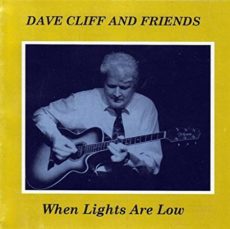
Dave Cliff was born David John Cliff on June 25, 1944 in Hexham, Northumberland, United Kingdom. He began his music career playing rhythm and blues in the Newcastle area. In 1967 he matriculated through Leeds College of Music with a degree in jazz studies, while studying with bassist Peter Ind and Bernie Cash.
Moving to London, England in 1971 Cliff established himself on the local scene and during 1976-1977 he toured Holland, Denmark, Italy and the UK with the Lee Konitz/Warne Marsh Quintet. The following year he toured the UK with the Soprano Summit alongside Kenny Davern and Bob Wilber. From the 1980s on he worked increasingly as a freelance.
His debut album as a leader was The Right Time, recorded in 1987, featured alto saxophonist Geoff Simkins and was the first of a number of albums with Simkins, with whom he has collaborated extensively.Dave has also recorded with Warne Marsh, Allan Ganley, Phil DeGreg and Bruce Adams.
Cliff has appeared frequently at Ronnie Scott’s Jazz Club in varied settings including Georgie Fame’s Blue Flames, Mike Carr Trio, Irene Reid and the Dick Pearce Sextet. He has worked extensively with visiting American musicians, including Slide Hampton, Nina Simone, George Masso, Spike Robinson, Herb Geller, Lanny Morgan, Harry Allen, Buddy Childers, Lew Tabackin, Mundell Lowe, Bucky Pizzarelli, Jack McDuff, Eddie “Lockjaw” Davis, Richie Cole, and Ken Peplowski.
As an educator he has been teaching jazz guitar at London Trinity College of Music, The Royal Welsh College of Music and Drama, the Birmingham Conservatoire, as well as at the Original UK Jazz Summer School, and has taught at the Jamie Aebersold Summer School in London and at the Christiansand jazz course in Norway.
Guitarist and educator Dave Cliff, whose influences from Charlie Christian and Wes Montgomery can be heard in his playing, continues to perform, record and teach.
Sponsored By

www.whatissuitetabu.com
#preserving genius
More Posts: guitar
Daily Dose Of Jazz…
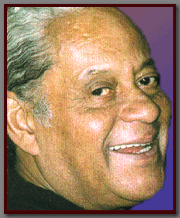
John Parker was born on June 24, 1928 in Queens, New York and began playing jazz trumpet at the age of 16 while attending Flushing High School. Encouraged by the bassist George Duvivier in the late Forties, he began playing in the jazz clubs on Manhattan’s W. 52nd Street where Dixieland, swing and bebop combos held court. It was on 52nd St. that drummer Zooty Singleton nicknamed him Tasty because of his tasty solos.
During the early 1950s, John, who was no relation to the Charlie Parker, began traveling with the Rhythm & Blues band of Roosevelt Sykes. He also played with trumpeter and composer Sy Oliver and vocalist Etta Jones. He also stepped in for trumpeter Cat Anderson in the Duke Ellington band. He would go on to play with Sonny Rollins and Thelonious Monk.
The 1970s saw Parker playing with pianist Brooks Kerr and drummer Sonny Greer in Manhattan venues including the Algonquin Hotel. Over the last 20 years, when Parker was living at Westbeth Artists Community with his wife, the late writer Leslie Gourse, he became a regular at Arthur’s Tavern and played New York City clubs in Little Italy and Chelsea.
Trumpeter John “Tasty” Parker, who never recorded as a leader and had been suffering from emphysema, passed away on Tuesday, March 21, 2006 in his Manhattan apartment at the age of 78.
Sponsored By

#preserving genius
More Posts: trumpet
Daily Dose Of Jazz…
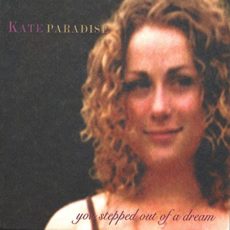
Kate Paradise was born in Fort Worth, Texas on June 23, 1981 but spent a majority of her childhood in southern New Hampshire, about an hour outside of Boston. Her interest in music began at an early age, singing with her mom in church and taking piano lessons from her pastor. Excelling in small but supportive music programs, taking on leadership roles in the choirs and singing in the high school big band, she auditioned and participated in numerous New Hampshire Music Education Association All-State and Jazz All-State choirs.
The summer of 1998 saw Kate attending the Berklee College of Music Summer Performance Program in Boston, Massachusetts and receiving her first formal voice training. Encouraged to further pursue her interest in jazz, a year later she enrolled at the University of Miami School of Music and spent six years earning her Bachelor of Music and Master of Music in Studio Music and Jazz Vocal Performance.
Paradise has received Downbeat Magazine’s student award for Outstanding Solo Jazz Vocal Performance and Jazz Vocal I, University of Miami’s top jazz choir. She has taught singing as a graduate assistant and began an active performing career as a jazz singer, appearing with Kurt Elling, Kevin Mahogany, Eliane Elias, Carmen Lundy, Claudia Acuna and Will Lee.
In 2005 she moved to Vermont accepting the position of jazz vocal educator at the Flynn Center for the Performing Arts, Johnson State College and Saint Michael’s College. Continuing her performance career she quickly became a local favorite and in 2006 Kate released her debut CD, You Stepped Out of a Dream, on Sonic Mirage label. She is accompanied by pianist Joseph Davidian, bassist John Rivers, Geza Carr on drums, guitarist Nicholas Cassarino and John McKenna playing tenor saxophone.
In 2007, the track Mean To Me from You Stepped Out of a Dream was selected for Putumayo’s international release Women of Jazz. Currently resides in Nashville, Tennessee, vocalist and educator Kate Paradise continues to perform, pursue her DMA, hold down a full time instructor of commercial voice position and is the director of the Downbeat award winning jazz vocal group, Jazzmin, at Belmont University.
Sponsored By

#preserving genius
More Posts: vocal