

Daily Dose Of Jazz…
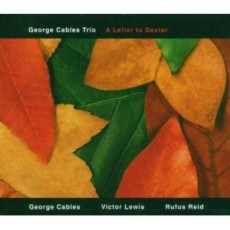
George Andrew Cables was born November 14, 1944 in New York City and was classically trained as a youth. He discovered jazz while attending the New York High School for Performing Arts, smitten by the freedom of expression. But unlike most musicians who are influenced by a single pianist, George listened to the whole bands of Miles and Trane and how they held together.
By 1964 he was playing in a band called The Jazz Samaritans that included Billy Cobham, Lenny White and Clint Houston. Playing gigs around New York at the Top of the Gate, Slugs, and other clubs attracted attention to Cables’ versatility and before long he had recorded with tenor saxophonist Paul Jeffrey, played with Max Roach and earned a brief 1969 tenure at the piano bench with Art Blakey and the Jazz Messengers and later with Sarah Vaughan, Tony Williams, Roy Haynes and Dizzy Gillespie.
A 1969 tour with tenor titan Sonny Rollins took Cables to the West Coast and by 1971 he became a significant figure in the jazz scenes of Los Angeles, where he first resided, and San Francisco, where he also lived. Collaborations and recordings with tenor saxophonists Sonny Rollins and Joe Henderson, trumpeters Freddie Hubbard and Woody Shaw, and vibist Bobby Hutcherson made Cables’ wide-ranging keyboard skills, often on electric piano, amply evident. Demand for his sensitive accompaniment increased and by the end of the 1970s, Cables was garnering a reputation as everyone’s favorite sideman.
Perhaps the most pivotal turn came when Dexter Gordon invited Cables into his quartet in 1977. The two years he spent with the tenor giant ignited Cables’ passion for the acoustic piano and immersed him in the bebop vocabulary. But the longest standing relationship Cables developed in the late seventies was with alto saxophonist Art Pepper, becoming his favorite pianist.
George Cables has emerged as a major voice in modern jazz and currently performs and records as a soloist, with trio and larger ensembles, and as a clinician in college jazz programs in addition to composing and arranging for his own albums and others.
More Posts: piano
Daily Dose Of Jazz…
Hampton Hawes was born November 13, 1928 in Los Angeles, California and his first experience at the piano was as a toddler sitting on his mother’s lap while she practiced. He was reportedly able to pick out fairly complex tunes by the age of three. Entirely self-taught and influenced by Earl Hines, Bud Powell and Nat King Cole, by his teens Hawes was playing with the leading jazz musicians on the West Coast, including Dexter Gordon, Wardell Gray, Art Pepper, Shorty Rogers and Teddy Edwards. His second professional job, at 19, was playing for eight months with Howard McGhee’s Quintet at the Hi De Ho Club, in a group that included Charlie Parker, who became a great influence on his playing.
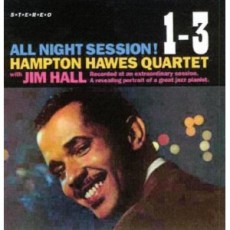
After serving in the U.S. army in Japan from 1952–1954, Hampton formed his own trio, with the bassist Red Mitchell and drummer Chuck Thompson. The subsequent three-record “Trio” sessions made by this group in 1955 for Contemporary Records were considered some of the finest records to come out of the West Coast at the time. The following year he added guitarist Jim Hall for the “All Night Sessions” that produced three records made during a non-stop recording session at the Contemporary Studios in Los Angeles.
In 1956, Hawes won the “New Star of the Year” award in Down Beat magazine, “Arrival of the Year” in Metronome magazine and the following year Hawes recorded in New York City with Charles Mingus on the album “Mingus Three”.
Struggled for many years with a heroin addiction and became the target of a federal undercover operation in Los Angeles in 1958. The DEA bargained that Hawes would inform on dealers in L.A. rather than risk a successful career. Coerced into selling a small amount of heroin to an undercover agent, he was arrested on his 30th birthday. Refusing to talk landed him a twice the mandatory minimum, ten-year sentence at Fort Worth Medical Facility, a federal prison hospital. However, after serving three years, in 1963 he was granted Executive Clemency by President Kennedy in 1963, the 42nd of only 43 such pardons given in the final year of Kennedy’s presidency.
After his release from prison, Hampton resumed playing and recording and during a world tour in 1967-68, the pianist was surprised to discover that he had become a legend among jazz listeners in Europe, Asia and the Middle East. During a ten-month period overseas he recorded nine albums, played sold out shows and concert halls in ten countries, and was covered widely in the press, appearing on European television and radio.
As a pianist Hawes’s style is instantly recognizable – for its almost unparalleled swing, unique approach to time and harmony, and its depth of emotional expression, particularly in a blues context. Hawes influenced a great number of other pianists including Andre Previn, Oscar Peterson, Horace Silver, Claude Williamson, Pete Jolly, Toshiko Akiyoshi and others.
Pianist Hampton Hawes died suddenly of a brain hemorrhage on May 22, 1977 at 48 years old. In 2004, the City Council of Los Angeles passed a resolution declaring November 13th “Hampton Hawes Day”.
More Posts: piano
Daily Dose Of Jazz…
Samuel Jones was born on November 12, 1924 in Jacksonville, Florida. He started his career playing in local bands but by 1953 he was playing with Tiny Bradshaw. Moving to New York City in 1955 he joined up with the groups of Kenny Dorham, Cannonball Adderley, Dizzy Gillespie, and Thelonious Monk. But it would be with the Cannonball’s quintet from 1959 to 1966 that would establish his reputation.
Pairing up with stellar drummer Louis Hayes, the association proved to be a benchmark rhythm section for being “in the pocket”. Jones went on to replace Ray Brown in the Oscar Peterson Trio from 1966 to 1970. After this tenure he teamed up with Cedar Walton and Billy Higgins.
Known for playing the bass and cello with impeccable technique he could also swing and groove with the best of them. Sam fronted his own bands and left a reputable recorded legacy as a leader, recording solo projects during the early sixties and released some wonderful sides for Riverside, where he was able to stretch out on some of his cello oriented pieces.
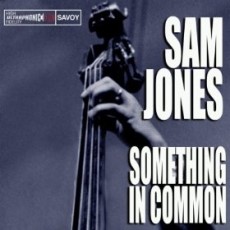
From 1977 to 1981 Jones remained very active both as leader and sought after session player with two of his landmark recordings “Something New” and Something In Common” being produced during this period. He has played with Bobby Timmons, Tiny Bradshaw, Freddie Hubbard, Bill Evans and Illinois Jacquet as well as many others who revolved around the New York City jazz scene that was fertile ground for his career.
Sam Jones, double bassist, cellist and composer of the jazz standard, “Del Sasser”, passed away on December 15, 1981 at the age of 57.

Daily Dose Of Jazz…
Ernestine Anderson was born November 11, 1928 in Houston, Texas. By age three she was singing along with the raw tunes of the legendary Bessie Smith and soon moved on to the more refined environs of her local church, singing solos in its gospel choir. She grew up listening to John Lee Hooker, Muddy Waters and other blues greats while listening to the live performances of the Jimmy Lunceford, Billy Eckstine, Erskine Hawkins and Count Basie big bands. At twelve she entered into a local talent contest and singing around the melody in the wrong key was told she was a jazz singer.
Moving to Seattle with her family when she was sixteen, Ernestine graduated from Garfield High and at eighteen went on the road with the Johnny Otis band. By 1952 she was with Lionel Hampton, then settled in New York working with Gigi Gryce, touring Europe with Rolf Ericson. She recorded her debut album “Hot Cargo” in Sweden and released by Mercury Records. She won Down Beat’s “New Star” award in ’59, continued to record for Mercury to sensational acclaim, splitting her time between the States and Europe.
Anderson stepped out of the limelight as the Sixties ushered in rock and roll but re-emerged in the mid 1970’s with Ray Brown as her manager. Her appearance at the Concord Jazz Festival led to a string of albums for the label working into the ‘90s with the Clayton-Hamilton Jazz Orchestra among others.
In 2008 she fell on hard times and her family home facing foreclosure, was saved by an outpouring of donations by friends and colleagues like Quincy Jones and Dianne Schuur. Ernestine Anderson, a jazz and blues singer has enjoyed a career that has spanned over half a century has recorded over 30 albums, been nominated four times for a Grammy Award, has performed at Carnegie Hall, the Kennedy Center and the Monterey Jazz Festival six times during her prolific career as well as jazz festivals and clubs all over the world.
More Posts: vocal
Daily Dose Of Jazz…
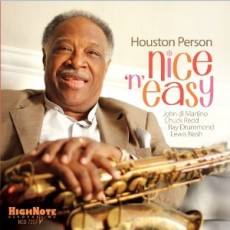
Houston Person, born November 10, 1934, grew up in Florence, South Carolina, first playing the piano before switching to tenor sax. He studied at South Carolina State College, went on to join the Air Force, became a member of a service band stationed in West Germany and played with Don Ellis, Eddie Harris, Cedar Walton and Leo Wright.
After his discharge he continued his studies at Hartt College of Music in Hartford, Connecticut. He first became known for a series of albums for Prestige Records in the 1960s, met Etta Jones while both were with Johnny Hammond’s band and spent many years as her musical partner, recording, performing and touring, and for much of his career this association was what he was best known for. Contrary to popular belief, they were never married.
Houston has performed in the hard bop and swing genres but is best known for his soul-jazz work. He has recorded more than seventy-five albums as a leader for Prestige, Westbound, Mercury, Savoy, and Muse Records. He is currently in residence as a leader and record producer at HighNote and has recorded with Charles Brown, Bill Charlap, Charles Earland, Lena Horne, Etta Jones, Lou Rawls, Horace Silver, Dakota Staton, Billy Butler and Richard “Groove” Holmes among others.
He received the Eubie Blake Jazz Award in 1982 and was inducted into the South Carolina State College Hall of Fame in 1999. He continues to produce, record, perform and tour.

More Posts: saxophone