

Daily Dose Of Jazz…
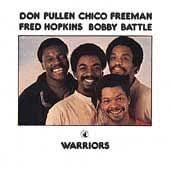
Fred Hopkins was born on October 11, 1947 in Chicago, Illinois and grew up in a musical family, listening to a wide variety of music from an early age. Attending DuSable High School, he studied music under Walter Dyett, who became well-known for mentoring and training musicians. Originally inspired to learn the cello, without one at the school Dyett steered him to the bass. After graduating from high school, while working at a grocery store he was encouraged to pursue music more seriously.
Hopkins soon began playing with the Civic Orchestra of Chicago, where he was the first recipient of the Charles Clark Memorial Scholarship, and studying with Joseph Gustafeste, principal bassist for the Chicago Symphony Orchestra at the time, as well as picking up piano duo gigs. He also began playing with Kalaparusha Maurice McIntyre, with whom he made his debut recording in 1970 Forces and Feelings. At that point he started becoming more serious about improvisation, playing with Muhal Richard Abrams’s Experimental Band and other related groups.
The early 1970s saw him forming a trio called Reflection with saxophonist Henry Threadgill and drummer Steve McCall. In 1975, he left Chicago, moved to New York City, regrouped with Threadgill and McCall, renamed their trio Air, and went on to tour and record extensively. He also joined the AACM, immersed himself in New York’s loft scene. Over the following decades, he increasingly gained recognition, gigging with Roy Haynes.
He performed and recorded with Muhal Richard Abrams, Hamiet Bluiett, Anthony Braxton, Marion Brown, Arthur Blythe, Oliver Lake, David Murray, Diedre Murray, and Don Pullen, as well as with various groups led by Threadgill. Moving back to Chicago in 1997, he continued to perform, tour, and record with a wide variety of musicians. Double bassist Fred Hopkins passed away on January 7, 1999 at age 51 of heart disease at the University of Chicago Hospital.

More Posts: bandleader,bass,history,instrumental,jazz,music
Daily Dose Of Jazz…
Douglas Ewart was born on September 13, 1946 in Kingston, Jamaica and emigrated to the United States in 1963. Settling in Chicago, Illinois he became associated with the Association for the Advancement of Creative Musicians (AACM) in 1967, studying with Joseph Jarman and Roscoe Mitchell. He served as that organization’s president from 1979 to 1986.
Douglas recorded eight albums as a leader and has performed or recorded fifteen with J. D. Parran, Muhal Richard Abrams, Art Ensemble of Chicago, Anthony Braxton, Alvin Curran, Anthony Davis, Robert Dick, Von Freeman, Joseph Jarman, Amina Claudine Myers, Roscoe Mitchell, James Newton, Rufus Reid, Wadada Leo Smith, Cecil Taylor, Richard Teitelbaum, Henry Threadgill, Hamid Drake, Don Byron, Malachi Favors Maghostut, Muhal Richard Abrams, Spencer Barefield, Tani Tabbal, Jean-Luc Cappozzo, Joëlle Léandre, Bernard Santacruz, Michael Zerang, Chico Freeman, Dennis González, Yusef Lateef, Adam Rudolph,
In 1992 he collaborated with Canadian artist Stan Douglas on the video installation Hors-champs which was featured at Documenta 9 in Kassel, Germany. The installation features Ewart in improvisation of Albert Ayler’s Spirits Rejoice with musicians George Lewis, Kent Carter, and Oliver Johnson.
Douglas Ewart has lived in Minneapolis, Minnesota since 1990 and plays sopranino and alto saxophones, clarinets, bassoon, flute, bamboo flutes, panpipes, and didgeridoo; as well as Rastafarian hand drums.

More Posts: bamboo flute,bassoon,clarinet,didgeridoo,flute,hand drums,history,instrumental,jazz,music,panpipe,saxophone

Daily Dose Of Jazz…
Phillip Sanford Wilson was born on September 8, 1941 in St. Louis, Missouri and was a third-generation musician. His grandfather, Ira Kimball, was a riverboat percussionist on the Mississippi to New Orleans.
His recording debut was with Sam Lazar, noted for having one of the first interracial bands in the St. Louis area. After moving to Chicago, Illinois he became a member of the Association for the Advancement of Creative Musicians (AACM) and performed with the Art Ensemble of Chicago.
He joined up with the Paul Butterfield Blues Band in 1967 at a time when the band membership changed greatly, including an added horn section. He recorded three albums with the group. Wilson’s song Love March, written with Gene Dinwiddie, was performed at Woodstock and released in 1970 on the live album from the festival.
Wilson, along with Dinwiddie and fellow former Butterfield Band member Buzz Feiten, formed the jazz-rock band Full Moon in the early 1970s. They recorded a self-titled album which is considered one of the finest early examples of jazz fusion. He was part of the loft jazz scene in 1970s New York City, worked as a session musician for Stax Records in Memphis, Tennessee and with Jimi Hendrix at the Cafe Au Go Go and Generation Club in 1968. They recorded with The Last Poets, Fontella Bass, Olu Dara, David Murray, Anthony Braxton, and Carla Bley. He worked extensively with Lester Bowie. In 1985, along with Bill Laswell co-produced the album Down by Law under the group name Deadline.
He recorded four albums as a leader and as a sideman recorded twenty-one albums with Hamiet Bluiett, Lester Bowie, Anthony Braxton, Paul Butterfield, Julius Hemphill, Sam Lazar, Frank Lowe, Roscoe Mitchell, and David Murray.
Drummer Phillip Wilson, while pursuing his musical career, was stalked and murdered in New York City on March 25, 1992. As a result of America’s Most Wanted television program, Marvin Slater was convicted for premeditated murder in 1997 and sentenced to 33 1/3 years in state prison. The reason for his murder has never been revealed.
More Posts: bandleader,drums,history,instrumental,jazz,music
Daily Dose Of Jazz…
Clifford Edward Thornton III was born on September 6, 1936 in Philadelphia, Pennsylvania into a musical family, his uncle pianist Jimmy Golden and his cousin, drummer J. C. Moses. He began piano lessons when he was seven-years-old, and studied with trumpeter Donald Byrd during 1957 after Byrd had left Art Blakey’s Jazz Messengers, and also that he worked with 17-year-old tuba player Ray Draper and Webster Young. Following a late 1950s stint in the U.S. Army bands, he moved to New York City.
In the early 1960s, Clifford lived in the Williamsburg area of Brooklyn, New York in an apartment building with other young musicians, including Rashied Ali, Marion Brown, and Don Cherry. He performed with numerous avant-garde jazz bands, recording as a sideman with Sun Ra, Archie Shepp, Pharoah Sanders, and Sam Rivers.
During the Seventies, Thornton and others were affected by the compositional ideas of Cecil Taylor, was active in the Black Arts Movement, and associated with Amiri Baraka and Jayne Cortez. This musical and artistic network provided him with a variety of perspectives on ideas such as black self-determination, performance forms, outside playing, and textural rhythm; and giving him access to performers who would provide the abilities some of his later compositions required.
He was included in the dialogue around the developing thought of political artists, including Shepp, Askia M. Touré, and Nathan Hare, as well as the journals Freedomways and Umbra. As an educator, he taught world music at Wesleyan University and created an Artists-in-Residence on campus, giving the academic world-music community exposure to Sam Rivers, Jimmy Garrison, Ed Blackwell, and Marion Brown. He arranged performances by Rashied Ali, Horace Silver, McCoy Tyner, and numerous others
Trumpeter, trombonist, activist, and educator Clifford Thornton, who played free and avant~garde jazz in the 1960 and ‘70s, passed away on November 25, 1989.
More Posts: bandleader,educator,history,instrumental,jazz,music,trombone,trumpet

Daily Dose Of Jazz…
Huey “Sonny” Simmons was born on August 4, 1933 in Sicily Island, Louisiana and grew up in Oakland, California, where he began playing the English horn. At age 16 he took up the alto saxophone, which became his primary instrument, playing primarily in an avant-garde style, often delving into free jazz.
His then-wife, Barbara Donald, played trumpet on several of his early records, Staying on the Watch and Music from the Spheres; Arhoolie Manhattan Egos, and Contemporary titles Rumasuma and the double album Burning Spirits.
Partnering with Prince Lasha on several recordings, two of which, The Cry! and Firebirds were also released by Contemporary.
Personal problems derailed both his music career and home life, leading to divorce and homelessness. He busked on the streets of San Francisco for many years, until he resurrected his career in the early 1990s and began playing in night clubs again.
His resurgence in the mid-1990s was marked by two albums, Ancient Ritual and American Jungle, for Quincy Jones’ Qwest Records. Along with appearances in European jazz festivals, Sonny has since remained a regular performer at European festivals.
Since 2000 he has been co-leader of The Cosmosamatics with reed player Michael Marcus and is among the few musicians to play the English Horn in a jazz context. Alto saxophone Sonny Simmons died on April 6, 2021 in New York.
More Posts: bandleader,english horn,history,instrumental,jazz,music,saxophone