

Daily Dose Of Jazz…
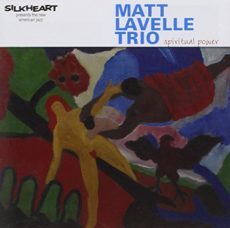
Matt Lavelle was born on April 11, born 1970 in Paterson, New Jersey and began his music career with a high school big band tour of the Soviet Union in 1988. He followed this with a five-year period of study with Hildred Humphries, a Swing era veteran who played with Count Basie, Billie Holiday and others.
During this period of study he played trumpet in Hildred’s band, then made his move on New York City and played straight-ahead jazz until 1995 when he relocated to Kingston, New York and studied the bass clarinet. Four years later Lavelle returned to New York seeking out what is known as the Downtown community. He has studied with Ornette Coleman adding alto clarinet to his instrumental arsenal.
Lavelle has played and toured with William Parker, Sabir Mateen, as well as with his own trio, an improvisation collective known as Eye Contact. He was key in the resurgence and return of avant jazz man Giuseppi Logan, helping him return to playing after a 45-year absence, and recording a new record released in spring 2010.
trumpet, flugelhorn and bass clarinet player Matt Lavelle, who has released a dozen albums as a leader or in duo and has recorded another ten as a sideman, continues to perform, record and tour.

#preserving genius
More Posts: clarinet,flugelhorn,trumpet
Daily Dose Of Jazz…
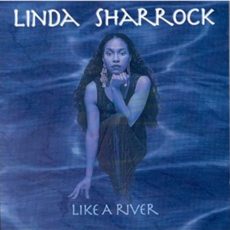
Linda Sharrock was born Linda Chambers on April 2, 1947 in Philadelphia, Pennsylvania and began singing in church choirs as a child. Interested in both folk music and jazz, she studied art while in college and became interested in avant-garde music.
She performed with Pharoah Sanders in the mid-1960s and late in 1966 she married Sonny Sharrock and professionally began using the spelling Lynda. She worked with him and Sanders into the early 1970s, as well as with Herbie Mann.
One of her best-known performances is on the 1969 Sonny Sharrock album Black Woman, released on Vortex Records. She toured Istanbul, Turkey in 1973 and recorded with Joe Bonner in 1974. After her divorce in 1978 she returned to using Linda, though she kept his surname.
A move to Vienna, Austria saw Sharrock working with Franz Koglmann, Eric Watson, and Wolfgang Puschnig well into the 1990s. She worked with ensembles such as the Pat Brothers, Red Sun, and AM4 in the 1980s, and with Harry Pepl in 1992.
Suffering a stroke in 2009 which left her partially disabled and aphasic, she briefly withdrew from the scene before returning in 2012. Since then the avant-garde and free jazz vocalist Linda Sharrock has appeared and recorded in France, Austria, the United Kingdom, the Netherlands, Slovenia, with various ensembles under the Linda Sharrock Network label.
Sponsored By

www.whatissuitetabu.com

#preserving genius
More Posts: vocal
Daily Dose Of Jazz…
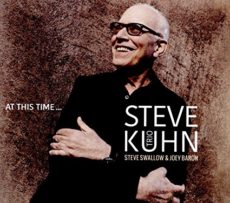
Steve Kuhn was born on March 24, 1938 in Brooklyn, New York City and began studying piano at the age of five. He studied under Boston, Massachusetts piano teacher Margaret Chaloff, mother of jazz baritone saxophonist Serge Chaloff. She taught him the Russian style of piano playing and at an early age he began improvising classical music.
As a teenager Steve appeared in jazz clubs in the Boston area with Coleman Hawkins, Vic Dickenson, Chet Baker, and Serge Chaloff. After graduating from Harvard University, he attended the Lenox School of Music where he became associated with Ornette Coleman, Don Cherry, and Gary McFarland. His professors included Bill Evans, George Russell, Gunther Schuller, and the members of the Modern Jazz Quartet. This experience with some of the most forward-thinking innovators of jazz improvisation and composition culminated with his joining trumpeter Kenny Dorham’s group for an extended time and for a brief time in John Coltrane’s quartet at New York’s Jazz Gallery club.
Kuhn has appeared or recorded with Stan Getz, Art Farmer, Oliver Nelson, Gary McFarland, Art Farmer, Joe Henderson, Scott LaFaro, Harvie Swartz, Pete LaRoca, Sheila Jordan, Billy Drummond, David Finck, and Miroslav Vitous. In 1967 he moved to Stockholm, Sweden where he worked with his own trio throughout Europe until 1971. Moving back to New York City he formed a quartet while continuing to play European gigs and appearing at the Newport Jazz Festival.
Known as an avant-garde pianist in his early career, he was associated with bassist Steve Swallow and drummer Pete La Roca during the Sixties that produced several notable recordings. He was part of the quartet on the landmark recording Sound Pieces led by saxophonist, composer, and arranger Oliver Nelson with bassist Ron Carter and drummer Grady Tate. Among other critically acclaimed recordings there was The October Suite composed by Gary McFarland for Kuhn and an ensemble which included strings, woodwinds, and reeds.
For decades he has led all-star trios that have included such players as bassists Ron Carter and David Finck, and with drummers Al Foster, Jack DeJohnette, and Joey Baron. Pianist Steve Kuhn is the composer of the jazz standard The Saga of Harrison Crabfeathers, has recorded several live albums at New York City jazz clubs and continues to lead a trio and compose.
Sponsored By

#preserving genius
More Posts: piano

Daily Dose Of Jazz…
Fred Anderson was born on March 22, 1929 in Monroe, Louisiana and learned to play the saxophone by himself when he was a teenager. Moving with his family to Evanston, Illinois in the 1940s he studied music formally at the Roy Knapp Conservatory in Chicago, Illinois and had a private teacher for a short time.
He was one of the founders of the Association for the Advancement of Creative Musicians (AACM) and an important member of the musical collective. In the early 1960s Fred formed his own group and performed his original compositions with drummer Vernon Thomas, bassist Bill Fletcher, and his partner for many years, trumpeter Billy Brimfield.
During this period he recorded several notable avant garde albums as a sideman with saxophonist Joseph Jarman, As If It Were the Seasons and Song For which included one of his composition Little Fox Run. By 1972 he put together the Fred Anderson Sextet, with trombonist George Lewis, reedist Douglas Ewart, bassist Felix Blackman, drummer Hamid Drake and Iqua Colson on vocals. Throughout the Seventies he toured Europe, recorded in Austria, and recorded his first record as leader, Another Place in Germany.
He opened the short-lived performance-workshop space Birdhouse in honor of Charlie Parker, and in 1983 took over ownership of the Velvet Lounge in Chicago, which quickly became a center for the city’s jazz and experimental music scenes. The club expanded and relocated in the summer of 2006. Before that, his eclectic Beehive bar in west Chicago was a draw where musicians from around the world drank beer and played, mostly for each other.
Though remaining active as a performer, Anderson rarely recorded for about a decade beginning in the mid-1980s but by the Nineties he resumed a more active recording schedule, both as a solo artist, and as a collaborator with younger performers. He mentored a host of young musicians not limited to Hamid Drake, Harrison Bankhead, David Boykin, Nicole Mitchell, Justin Dillard, Aaron Getsug, Josh Abrams, Fred Jackson, Jr., George Lewis, Karl E. H. Seigfried, Isaiah Sharkey, and Isaiah Spencer.
Chicago avant-garde tenor saxophonist Fred Anderson, who was rooted in the swing and hard bop idioms but incorporated innovations from free jazz, passed away on June 24, 2010.
Sponsored By

#preserving genius
More Posts: saxophone
Daily Dose Of Jazz…
Jan Garbarek was born March 4, 1947 in Mysen, Norway and grew up in Oslo, the only child of a former Polish prisoner of war and a Norwegian farmer’s daughter. He began his recording career in the late 1960s featured on recordings by jazz composer George Russell. Initially influenced by Albert Ayler and Peter Brötzmann, by 1973 he left avant-garde jazz, and gained wider recognition working with pianist Keith Jarrett’s European Quartet, recording on six Jarrett albums between 1974 and 1979.
As a composer, he draws from Scandinavian folk melodies and his Ayler influence, as well as being a pioneer of ambient jazz composition, exhibited on his Dis album with guitarist Ralph Towner. Jan has ventured into new-age music, set a collection of Olav H. Hauge poems to music, solo saxophone complemented a full mixed choir and incorporated synthesizers and elements of world music.
Garbarek has recorded more than two-dozen albums as a leader and another 45 to date as a sideman with Karin Krog, Terje Rypdal, George Russell, Art Lande, Ralph Towner, Bill Connors, David Darling, Keith Jarrett, Egberto Gismonti, Charlie Haden, Zakir Hussain, Trilok Gurtu, Manu Katché, Eleni Karaindrou, Kim Kashkashian, Marilyn Mazur, Gary Peacock, L. Shankar, Paul Giger, Giya Kancheli, Miroslav Vitous, Eberhard Weber and Kenny Wheeler
His album Officium, a collaboration with early music vocal performers the Hilliard Ensemble, became one of ECM’s biggest-selling albums of all time. Saxophonist Jan Garbarek, who received a Grammy nomination in 2005 for his album In Praise of Dreams, He is also active in classical and world music and continues to perform, record and tour.
Sponsored By

#preserving genius
More Posts: saxophone