

Daily Dose Of Jazz…
John Gilmore was born on September 28, 1931. Growing up in Chicago, Illinois he played clarinet from the age of 14 and took up the tenor saxophone while serving in the United States Air Force from 1948 to 1952. He then pursued a musical career, playing briefly with pianist Earl Hines before encountering Sun Ra in 1953.
For the next four decades, he recorded and performed almost exclusively with Sun Ra. This was puzzling to some, who noted Gilmore’s talent, and thought he could be a major star like John Coltrane or Sonny Rollins. Despite being five years older than Gilmore, Coltrane was impressed with his playing, and took informal lessons from him in the late 1950s. His epochal, proto-free jazz “Chasin’ the Trane” was inspired partly by Gilmore’s sound.
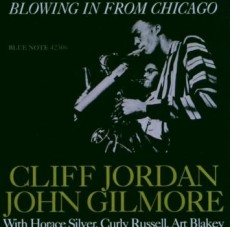
In 1957 he co-led with Clifford Jordan a hard bop Blue Note date Blowing In from Chicago with Horace Silver, Curly Russell and Art Blakey providing the rhythm section. In the mid-1960s John toured with the Jazz Messengers and participated in recording sessions with Paul Bley, Andrew Hill, Pete La Roca, McCoy Tyner, Freddie Hubbard, Elmo Hope, Phil Upchurch and others. By 1970 he was co-leading a recording with Jamaican trumpeter Dizzy Reece. Throughout his years of playing he mainly focused on the avant-garde with the Sun Ra Arkestra.
Gilmore’s devotion to Sun Ra was due, in part, to the latter’s use of harmony which he considered both unique and a logical extension of bebop. He occasionally doubled on drums and also played bass clarinet until Sun Ra hired Robert Cummings as a clarinet specialist in the mid-1950s. However, the tenor saxophonist made a huge contribution to Sun Ra’s recordings and was the Arkestra’s leading sideman, being given solos on almost every track on which he appeared.
John is known for his straight ahead post-bop running changes and fluency with a rhythmic and motive approach in addition to his long passages based exclusively on high-register squeals in the more abstract. His fame shrouded in the relative anonymity of Sun Ra’s Arkestra membership, his straight ahead post-bop talents are exemplified in his solo on the Arkestra’s rendition of “Blue Lou,” as seen on Mystery, Mr. Ra. Avant-garde tenor saxophonist John Gilmore led the Arkestra for a few years after SunRa’s death and up until his own of August 19, 1995.

Take A Dose On The Road
More Posts: saxophone
Daily Dose Of jazz…
Hank Levy was born Henry Jacob Levy September 27, 1927 in Baltimore, Maryland. He studied composition with George Thaddeus Jones at Catholic University in Washington, DC. He became interested in odd meters used by Maurice Ravel, Paul Hindemith and Igor Stravinsky, pre-dating Dave Brubeck’s 1959 Time Out album.
A prolific arranger of jazz standards, though few of them were published during his lifetime, Hank was especially fond of the music of the Broadway stage as it came through bebop by composers Cole Porter, George Gershwin and Jerome Kern. However, in his last years, he more frequently turned to bebop originals by Charlie Parker, Dizzy Gillespie and Tadd Dameron, sans odd meters but displaying distinctive creativity.
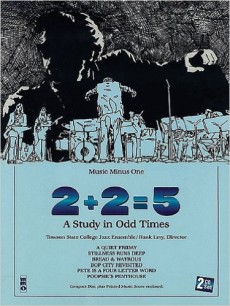
Levy began his full-time college teaching career at Towson State University in late 1967 creating The Towson State Jazz Ensemble. By 1970, his hard work and passion for teaching brought the band to national prominence when his Towson State Jazz Ensemble competed and won the outstanding band honors at the Notre Dame Jazz Festival. They recorded “2 + 2 = 5”, an album of six of his compositions and would go on to recorded several others over the years. Upon retirement in 1992 he founded the Hank Levy Legacy Band and recorded two albums for Sonority Records, Hank At Home and An Odd Time Was Had By All.
The 2014 jazz film Whiplash takes its title from Levy’s composition which originally appeared on the 1973 album Soaring by Don Ellis and portions of which are played several times during the course of the picture by the classroom Big Band ensemble. Composer, arranger and saxophonist Hank Levy, best known for his work with Stan Kenton and Don Ellis Orchestras, passed away in Parkville, Maryland on September 18, 2001.
Give The Gift Of Knowledge
More Posts: saxophone
Daily Dose Of Jazz…
Arthur Edward Pepper, Jr. was born on September 1, 1925 in Gardena, California to a mother who was a fourteen year old runaway and a merchant seaman father, both of whom were violent alcoholics. He was sent to live with his paternal grandmother where he exhibited musical interest and talent while still very young. He began playing the clarinet at nine, switching to the alto saxophone by 13 and immediately started jamming on Carnegie Avenue, the Black nightclub district of Los Angeles.
By the age of 17 he began playing professionally with Benny Carter and then became part of the Stan Kenton Orchestra, touring with that band, until he was drafted in 1943. After the war he returned to Los Angeles and joined the Kenton Innovations Orchestra. In the 1950s Pepper was recognized as one of the leading alto saxophonists in jazz, epitomized by his finishing second only to Charlie Parker as Best Alto Saxophonist in the Down Beat magazine Readers Poll of 1952. Along with Chet Baker, Gerry Mulligan and Shelly Manne, he is often associated with the musical movement known as West Coast jazz, more so for geography than playing style.
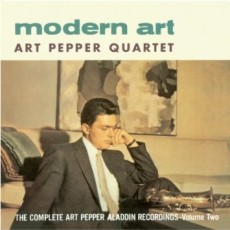
Art recorded profusely and some of his most famous albums from the 1950s are Art Pepper Meets The Rhythm Section, Art Pepper + Elven-Modern Jazz Classics, Getting’ Together and Smack Up. During this period he also recorded for Aladdin Records – The Early Show, The Late Show, The Complete Surf Ride, and The Way It Was!, which features a session recorded with Warne Marsh.
His career was repeatedly interrupted by several prison stints stemming from his addiction to heroin from the mid-Fifties to the mid-Sixties and during his last incarcerations at San Quentin played in an ensemble with Frank Morgan. Pepper managed to have several memorable and productive comebacks. Remarkably, his substance abuse and legal travails did not affect the quality of his recordings, which maintained a high level of musicianship throughout his career. During the late 1960s he spent time in Synanon, a drug rehabilitation group and began methadone therapy in the mid-1970s.
His last comeback saw him as a member of Buddy Rich’s Big Band from 1968 to 1969. During the mid-1970s and early 1980s he toured Europe and Japan with his own groups and recorded dozens of albums, mostly for Fantasy Records. He authored an autobiography with his third wife Laurie titled Straight Life that focused on the jazz music world and the drug and criminal subcultures of mid-20th century California. Alto saxophonist and clarinetist Art Pepper recorded sixty-four albums as a leader, three with Ceht Baker and another seventeen as a sideman leaving the world a admirable catalogue of music before his death from a stroke due to a brain hemorrhage in Los Angeles, California on June 15, 1982 at the age of 56.
Dose A Day – Blues Away
Daily Dose Of Jazz…
Charles Parker, Jr. was born on August 29, 1920 in Kansas City, Kansas but was raised in Kansas City Missouri, the only child of Adelaide and Charles Parker. He began playing the saxophone at age 11 and by age 14 he joined his school’s band using a rented school instrument. His father, a pianist, dancer and singer on the Theater Owners Booking Association (T.O.B.A.) circuit, was often absent but provided some musical influence. His biggest influence at that time was a young trombone player who taught him the basics of improvisation.
By the late 1930s Parker began to practice diligently. During this period he mastered improvisation and developed some of the ideas that led to bebop. He played with local bands in jazz clubs around his hometown perfecting his technique, with the assistance of Buster Smith, whose dynamic transitions to double and triple time influenced the young man’s developing style.
In 1938, he joined pianist Jay McShann’s territory band touring nightclubs and other venues in the Southwest, Chicago and New York City. During this stint with McShann he made his professional recording debut. As a teenager, Charlie developed a morphine addiction while hospitalized after an automobile accident, and subsequently became addicted to heroin.
In 1939 Parker moved to New York City, to pursue a career in music. He held several other jobs as well. He worked for nine dollars a week as a dishwasher at Jimmie’s Chicken Shack, where pianist Art Tatum performed. In 1942 he left McShann and played with Earl Hines for one year alongside Dizzy Gillespie. A strike by the American Federation of Musicians unfortunately resulted in few recordings documenting this period of his playing. He played in after-hours clubs in Harlem with other young cats at the time, such as, Thelonious Monk, Charlie Christian, Mary Lou Williams and Kenny Clarke, creating a music that white bandleaders couldn’t usurp and profit from like they did with swing.
It was while playing Cherokee in a jam session with William “Biddy” Fleet that he hit upon a method for developing his solos that enabled one of his main musical innovations, the 12 semitones of the Chromatic scale could lead melodically to any key, breaking some of the confines of simpler jazz soloing.
By 1945 after the lifting of the recording ban that Charlie’s collaboration with Dizzy Gillespie, Max Roach, Bud Powell and others would have a substantial effect on the jazz world beginning with their June 22, 1945 Town Hall performance. Bebop soon gained wider appeal among musicians and fans alike.
On November 26th of that same year he led a record date for Savoy Records that is arguably the “greatest jazz session ever” with Miles Davis, Curly Russell, and Max Roach. Shortly afterward, the Parker/Gillespie band traveled to an unsuccessful engagement at Billy Berg’s club in Los Angeles. However staying in California he spiraled down into great hardship due to his heroin addiction, ultimately being committed to Camarillo State Mental Hospital for six months.
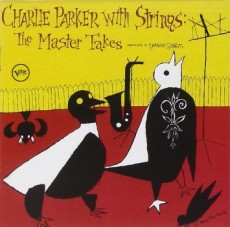
Although he produced many brilliant recordings during this period, Parker’s addiction led to increasingly erratic behavior. Recording sessions were hard, but he recorded the classic Relaxin’ at Camarillo before his return to New York. He would record a series of sessions with Savoy and Dial record labels, innovate by fusing jazz and classical elements into what would become known as Third Stream, releasing Charlie Parker with Strings.
The influential jazz musician who was at the gate of bebop and the man affectionately known as Yardbird or simply Bird, Charlie Parker died on March 12, 1955, in the suite of his friend and patroness Baroness Pannonica de Koenigswarter at the Stanhope Hotel in New York City while watching The Dorsey Brothers Stage Show on television. The official causes of death were lobar pneumonia and a bleeding ulcer but also an advanced case of cirrhosis and he had suffered a heart attack. The coroner who performed his autopsy mistakenly estimated Parker’s 34-year-old body to be between 50 and 60 years of age. His friend Dizzy Gillespie paid for the funeral arrangements and organized a lying-in-state, a Harlem procession officiated by Congressman and Reverend Adam Clayton Powell Jr., as well as a memorial concert.
He left the world classic jazz compositions, arrangements and versions of tunes such as Ornithology, How High The Moon, Yardbird Suite, Billie’s Bounce, Now’s The Time, Au Privave, Barbados, Relaxin’ at Camarillo, Bloomdido, Blues for Alice, Laird Baird, Si Si, Constellation, Donna Lee, Scrapple From The Apple, Cheryl, Ah-Leu-Cha, Anthropology and Cool Blues among others.
He was posthumously awarded a Grammy for Best Performance by a Soloist in 1974, a Grammy Lifetime Achievement Award in 1984, had two albums Jazz At Massey hall and Charlie Parker with Strings and two singles Ornithology and Billie’s Bounce inducted into the Grammy Hall of Fame. He has been inducted into the Big Band and Jazz Hall of Fame and the Jazz at Lincoln Center: Nesuhi Ertegun Jazz Hall of Fame and had a 32 cent stamp commissioned and issued by the United State Post Office.
Put A Dose In Your Pocket
More Posts: saxophone
Daily Dose Of Jazz…
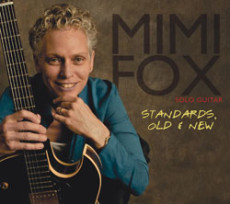
Mimi Fox was born of August 24, 1956 in New York City and started playing drums at nine and guitar when she was ten. She was inspired by a wide variety of music in her house from show tunes, classical, Dixieland, Motown pop, folk, and R&B. By fourteen she bought her first jazz album, John Coltrane’s classic Giant Steps and her course of her musical life changed. She began touring right out of high school and eventually settled in the San Francisco Bay area where she became a sought after player.
Fox has performed and recorded with Charlie Byrd, Stanley Jordan, Charlie Hunter, Mundell Lowe, Branford Marsalis, David Sanchez, Houston Person, Don Lanphere, Abbey Lincoln, Diana Krall, Kevin Mahogany, Janis Siegel, Joey DeFrancesco, Barbara Denerlein, Dr. Lonnie Smith, Terri Lyne Carrington, Stevie Wonder and John Sebastian and the list continues to grow.
Mimi has been named a winner in 6 consecutive Downbeat Magazine international critic’s polls, hit #23 on the Billboard Top Jazz Albums chart, recognized by the IAJE for her outstanding service to jazz education, has released ten albums as a leader, published several instructional books and interactive CD-Roms.
As a composer she has written and performed original scores for orchestras, documentary films and dance projects. As an educator she teaches master classes worldwide, is currently the Chair of the Guitar Department, a faculty advisor and instructor at the Jazz School for Musical Study and Performance in Berkeley, California. Guitarist Mimi Fox continues to composer, record, teach and perform at festivals around the world.
Take A Dose On The Road
More Posts: guitar