

Daily Dose Of Jazz…
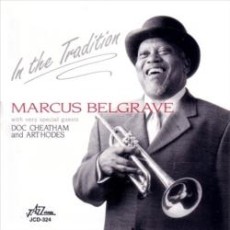
Marcus Belgrave was born June 12, 1936 in Chester, Pennsylvania and was tutored on trumpet by Clifford Brown when he was 17. Belgrave toured with Ray Charles from 1954-59 and later played with Charles Mingus and Max Roach.
In 1963 Marcus moved to Detroit and established himself as an educator and studio musician. He has recorded with Motown and Blue Note Record labels, The Lincoln Center Jazz Orchestra, Tony Bennett, Sammy Davis Jr., Dizzy Gillespie, Ella Fitzgerald and a host of other luminaries in jazz.
His reputation as a clinician and instructor led Marcus to cultivate young jazz talent over the years like Regina Carter, Rodney Whitaker, Kenny Garrett, James Carter, Geri Allen, Bob Hurst, Carlos McKinney and Karriem Riggins.
In 2006 he lent his expertise to the Young Musicians Program (YMP) summer program at the University of California Berkeley helping out student with coaching and private lessons. He was a frequent faculty member at Stanford Jazz Workshop and was a visiting professor of jazz trumpet at the Oberlin Conservatory.
Trumpeter Marcus Belgrave transitioned on May 23, 2015, in Ann Arbor, Michigan of heart failure after being hospitalized since April with complications of chronic obstructive pulmonary disease and congestive heart failure.
More Posts: trumpet

Daily Dose Of Jazz…
Tina Brooks was born Harold Floyd Brooks on June 7, 1932 in Fayetteville, North Carolina, the brother of tenor saxophonist David “Bubba” Brooks. He initially studied the C-melody saxophone, which he began playing in 1944 shortly after his family relocated to New York.
His first professional work came in 1951 with rhythm and blues pianist Sonny Thompson and Lionel Hampton four years later. His friendship with trumpeter and composer Little Benny Harris led to his first recording as a leader. Harris played a key role in Brooks’ acquiring a contract with Blue Note Records in 1958.
Best known for his work for Blue Note Records, between 1958 and 1961, Tina led four recording sessions and worked as a sideman on record sessions with Kenny Burrell, Freddie Hubbard, Jackie McLean, Freddie Redd and Jimmy Smith. Appearing on Brooks’ albums, McLean and Brooks’ also gave highly regarded performances of the music composed by Redd in Jack Gelber’s play “The Connection”, from which came a recording of the music from the play.
Declining health problems due to heroin dependency, his recording career ceased after 1961. Tina Brooks, the hard bop tenor saxophonist and composer whose strong, smooth tone and amazing flow of fresh ideas are indelibly imprinted on seventeen sessions in the Blue Note catalogue, died at age 42 of liver failure on August 13, 1974.
More Posts: saxophone

Daily Dose Of Jazz…
Oliver Edward Nelson was born on June 4, 1932 in St. Louis, Missouri. His brother played sax with Cootie Williams and his sister sang and played piano. He began playing the piano when he was six, the saxophone by eleven and by age 15 he was playing in territory bands around St. Louis. In 1950 he joined Louis Jordan’s big band, playing alto saxophone and arranging.
After military service Nelson returned to Missouri to study music composition and theory at Washington and Lincoln University graduating in 1958. He married, had a son, divorced, moved to New York City, and began playing with Erskine Hawkins and Wild Bill Davis, and arranged for the ApolloTheatre. In 1959 he briefly worked the West coast with Louie Bellson’s big band and played tenor for Quincy Jones.
After six albums as leader between 1959 and 1961 for Prestige with Kenny Dorham, Johnny Hammond Smith, Eric Dolphy, Roy Haynes and others. Oliver’s big break came with his Impulse album The Blues and The Abstract Truth featuring his now classic standard “Stolen Moments”. Propelling him into prominence as a composer and arranger, it opened up opportunities to arrange for Cannonball Adderley, Irene Reid, Sonny Rollins, Billy Taylor, Wes Montgomery, Johnny Hodges and many others.
Moving to Los Angeles in 1967 Nelson spent a great deal of time composing for television shows like Colombo, Ironside, Bionic Woman and films like Death of a Gunfighter and Last Tango In Paris. He produced for Nancy Wilson, James Brown, the Temptations and Diana Ross.
Less well-known is the fact that Nelson composed several symphonic works, and was also deeply involved in jazz education, returning to his alma mater, Washington University, in the summer of 1969 to lead a five-week long clinic that also featured such performers as Phil Woods, Mel Lewis, Thad Jones, Sir Roland Hanna, and Ron Carter.
Oliver Nelson, saxophonist, clarinetist, pianist, arranger and composer died of a heart attack on October 28, 1975, aged 43.

Daily Dose Of Jazz…
Hilton Ruiz was born in New York City on May 29, 1952 of Puerto Rican heritage. He began playing piano at the age of eight, and gigged with Freddie Hubbard and Joe Newman when he was young. Later, he was Rahsaan Roland Kirk’s main pianist from 1974 to 1977 and was featured on such records as The Case of the 3 Sided Dream in Audio Color and The Return of the 5000 Lb. Man.
Hilton recorded several solo albums between the 1980s and 2000s. On May 19, 2006, found unconscious on Bourbon Street in New Orleans, police concluded that he stumbled and fell and was not attacked. As a result of the accident, he remained in a coma until eventually passing away on June 6, 2006 at the age of 54.
Hilton Ruiz, jazz pianist steeped in Afro-Cuban music, was also a talented bebop musician.
More Posts: piano

Daily Dose Of Jazz…
Allen “Al” Tinney was born on May 28, 1921 in Ansonia, Connecticut. As a child he was taught piano, worked in local dance bands and as a stage actor/dancer in several Broadway plays and was an original cast member in the production of George Gershwin’s Porgy and Bess. His piano playing was so good that he became rehearsal pianist and assistant to Gershwin.
From 1939 to 1943 he held sway in the house band at Monroe’s Uptown House playing with young musicians who gravitated to him like Charlie Parker, Max Roach, Little Bennie Harris, George Treadwell and Victor Coulsen. An influential bebop pianist his playing was light, flowing and occasionally percussive, while his improvisations were harmonically advanced for the period and his style can be heard in the playing of Bud Powell, George Wallington, Al Haig, and Duke Jordan.
Abhorring the connection between jazz and drugs, by 1946 Tinney began to play less jazz and more in other styles. He was a member of The Jive Bombers who were one hit wonders with “Bad Boy” in 1957. He moved to Buffalo in 1968, played local jazz clubs, worked in the state prison music program, and lectured at SUNY Buffalo. He recorded one album as a leader with Peggy Farrell titled Peg & Al in 2000.
Pianist Allen Tinney passed away on December 11, 2002 in Buffalo, New York at age 81.
More Posts: piano