

Daily Dose Of Jazz…
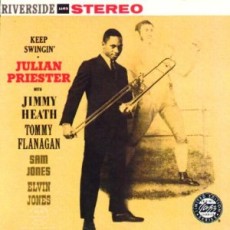
Julian Priester was born on June 29,1935 in Chicago, Illinois. He attended DuSable High School studying under Walter Dyett and during his teens he played trombone with Muddy Waters, Dinah Washington, and Bo Diddley and jammed with jazz greats Max Roach, Clifford Brown and Sonny Stitt.
By the early 1950s Priester was a member of Sun Ra’s big band, recording several albums with the group before leaving Chicago in 1956 to tour with Lionel Hampton. Settling in New York in ’58 Julian joined Max Roach’s band and during his tenure recorded two albums as a leader for Riverside Records titled Spiritsville and Keep Swingin’.
In 1961 Priester left Max Roach and for the next eight years took a sideman gig on albums by Freddie Hubbard, Stanley Turrentine, Blue Mitchell, Art Blakey, Joe Henderson, McCoy Tyner, Johnny Griffin and Sam Rivers. During that period he also took part in Coltrane’s Africa/Brass ensemble, which played with Coltrane’s quartet on the album by the same name recorded in 1961. Accepting an invitation to play with Ellington’s big band, he stayed for six months and by 1970 Priester was playing fusion in Herbie Hancock’s sextet.
In 1973, Priester moved to San Francisco, recorded two more albums as a leader, joined the faculty of Cornish College of the Arts in Seattle in 1979 teaching jazz composition, performance and history. Over the course of the next three decades Julian has been a member of the Dave Holland band, returned to play with Sun Ra’s band, became a member of Charlie Haden’s Liberation Music Orchestra, co-led with drummer Jimmy Bennington “Portraits and Silhouettes”, played the 30th Annual Chicago Jazz Festival and made significant contribution to “Alice”, a tribute album to Alice Coltrane.
Trombonist Julian Priester’s musical experience spans to the borders of jazz and beyond, encompassing R&B, bebop, hard bop, and progressive and free jazz.
More Posts: trombone
Daily Dose Of Jazz…
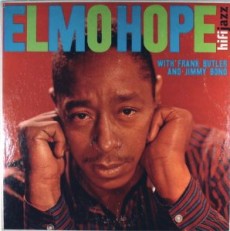
Elmo Hope was born St. Elmo Sylvester Hope on June 27, 1923 in New York City, he began his career with the Joe Morris band. From 1953 he recorded in New York as a leader and as a sideman with Sonny Rollins, Lou Donaldson, Clifford Brown and Jackie McLean. Losing his cabaret card in New York for drug use he moved to Los Angeles in 1957. On the West Coast he performed with Chet Baker before moving, followed with a stint with Lionel Hampton, then recorded with Harold Land and Curtis Counce.
Elmo led recording sessions with Frank Foster, John Coltrane, Hank Mobley, Art Blakey, Paul Chambers, and Philly Joe Jones. On a number of occasions Hope recorded in the trio format and more rarely as a leader of a quintet for Blue Note, Prestige, Riverside and other labels.
Disillusioned with the West Coast scene, Hope returned to New York in 1961, where he went to prison briefly on drug charges then returned to playing, recording duet albums with his pianist wife Bertha but recorded more rarely. Pianist Elmo Hope died of an overdose on May 19, 1967.
Though overshadowed by his contemporaries Bud Powell and Thelonious Monk, with his highly individual playing Hope holds a significant place alongside them, cited by later pianists Frank Hewitt and Sasha Perry, guitarist Kurt Rosenwinkel as their main influence, and Roswell Rudd composed “Hope No. 2” in his honor and during a concert with Archie Shepp, called Elmo Hope “ A great and fine composer and remains one of America’s well kept secrets”.
More Posts: piano

Daily Dose Of Jazz…
Eric Allan Dolphy was born on June 20, 1928 in Los Angeles, California and received his musical education at Los Angeles City College. Performing locally in the big bands of Gerald Wilson and Roy Porter, he played soprano clarinet, baritone saxophone and his main instrument, the alto, on early recordings. But his big break came when he joined Chico Hamilton’s quintet, gaining wider audience recognition.
By 1959 Dolphy had moved to New York City and his early association with then established John Coltrane brought him acclaim amongst jazz lovers. During this period, Dolphy also played in a number of challenging settings, notably in key recordings by Ornette Coleman’s Free Jazz: A Collective Improvisation; Oliver Nelson’s The Blues and the Abstract Truth; and George Russell’s Ezz-thetics. He also worked with Max Roach, Gunther Schuller, Ron Carter, Ken McIntyre and Abbey Lincoln among others.
His first two albums as leader produced Outward Bound and Out There that were deeply rooted in hard bop with trumpeter Freddie Hubbard. This was followed with Far Cry with Booker Little, with whom he would record a series of legendary sets at the Five Spot before Little’s death at 23. In 1964, Dolphy signed with Blue Note and recorded Out To Lunch! with Hubbard, Bobby Hutcherson, Richard Davis and Tony Williams. This record was rooted in the avant-garde, his solos unpredictable and is considered his magnum opus.
Eric Dolphy died in Berlin while touring with Charles Mingus on June 29, 1964. The circumstances are sketchy as to where he died and the cause, though he was a diabetic. Whatever the cause, the jazz world lost an alto saxophonist, flautist, clarinetist who contributed profusely to the genre of jazz during his short-lived 36 years.
Daily Dose Of Jazz…
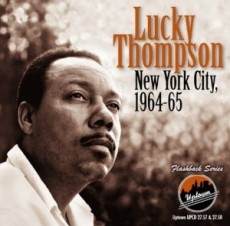
Lucky Thompson was born Eli Thompson on June 16, 1924 in Columbia, South Carolina but the family moved to Detroit, Michigan during his childhood. Raising his siblings after his mother died, he practiced his saxophone fingerings daily on a broomstick prior to acquiring his first instrument. After graduating from high school in 1942 he joined the Erskine Hawkins band.
Lucky went on to play with the swing orchestras of Lionel Hampton, Don Redman, Billy Eckstine, Lucky Millinder and Count Basie, he worked in rhythm and blues, later establishing a career in bop and hard bop working with Kenny Clarke, Miles Davis, Dizzy Gillespie and Milt Jackson.
An inspired soloist playing in a more advanced bebop format in the early 60s and capable of a very personal style in which the tradition of Coleman Hawkins, Ben Webster and Don Byas was intelligently mixed with a modern grasp of harmony. He showed these capabilities as sideman on many albums recorded during the mid-1950s, such as Stan Kenton’s Cuban Fire and those under his own name.
He appeared on Charlie Parker’s Los Angeles Dial Records sessions and on Miles Davis’s hard bop Walkin’ session. Thompson recorded albums as a leader for ABC Paramount, Prestige and as a sideman on records for Savoy with Milt Jackson as leader.
In the late 60’s Thompson lived in Lausanne, Switzerland and recorded several albums there including A Lucky Songbook in Europe. He taught at Dartmouth College in 1973 and 1974, and then left the music business completely, because of the racist treatment he received from record companies and clubs.
In his last years he lived in the Pacific Northwest suffering from Alzheimer’s disease and on July 30, 2005, hard bop saxophonist Lucky Thompson passed away in Seattle, Washington.

More Posts: saxophone
Daily Dose Of Jazz…
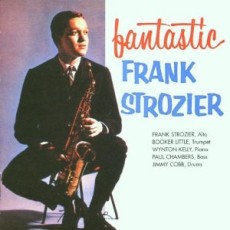
Frank Strozier was born on June 13, 1937 in Memphis, Tennessee. He played with other hometown musicians in his youth and continued even after his move to Chicago in 1954 including Harold Mabern, Booker Little and George Coleman.
A renowned hard bop alto saxophonist who never got the recognition he deserved he did lead recording sessions for Vee-Jay Records and recorded with the MJT+3 from 1959-1960. After moving to New York, Frank was briefly with the Miles Davis Quintet in 1963, between the tenures of Hank Mobley and George Coleman. During this period he also gigged with Roy Haynes.
Strozier relocated to Los Angeles working with Chet Baker, Shelly Manne and most notably with the Don Ellis big band where he executed a memorable solo on “K.C. Blues” on the “Autumn” album. Returned to New York in 1971 he worked with the Jazz Contemporaries, the New York Jazz Repertory Company, Horace Parlan and Woody Shaw among others,.
Frustrated with lack of work, Frank would reappear from time to time as a piano player but with little results. His last recordings were in 1977 and he left a limited catalogue of seven albums as a leader and another 15 as a sideman.
More Posts: saxophone