


Daily Dose Of Jazz…
Buddy Clark was born Samuel Goldberg on July 26, 1912 in Dorchester, Massachusetts, He made his big band singing debut in 1932 as a tenor, with Gus Arnheim’s orchestra, but was not successful. Singing baritone he gained wider notice in 1934 with Benny Goodman on the Let’s Dance radio program. From 1936 to 1938 he performed on the show Your Hit Parade.
In the mid-1930s he signed with Vocalion Records, having a top-20 hit with Spring Is Here. He continued recording, appearing in movies, and dubbing other actors’ voices until he entered the military, but did not have another hit until the late 1940s. In 1946 he signed with Columbia Records, scoring his biggest hit with the song Linda. 1947 saw hits for Clark with How Are Things in Glocca Morra?”, Peg O’ My Heart, An Apple Blossom Wedding, and I’ll Dance at Your Wedding. A duet with Doris Day, Love Somebody, sold a million recordsand reaching #1 on the charts. Through the Forties decade he had nine more chart hits untilhis death.
Vocalist Buddy Clark, who was a popular crooner during the big band era, passed away in a plane crash on Beverly Boulevard in West Los Angeles, California on October 1, 1949.

More Posts: history,instrumental,jazz,music,vocal
Daily Dose Of Jazz..
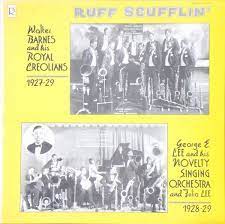
Walter Barnes was born on July 8, 1905 in Vicksburg, Mississippi but grew up in Chicago, Illinois. He studied under Franz Schoepp and attended the Chicago Musical College and the American Conservatory of Music.
Leading his own bands from the early 1920s, he also played with Detroit Shannon and his Royal Creolians. After Shannon’s retinue became dissatisfied with his leadership, Barnes took control of this group as well. He played mostly in Chicago, though the band did hold a residency at the Savoy Ballroom in New York City as well. His band recorded in 1928-29 for Brunswick Records.
He toured the American South in the 1930s to considerable success, touring there yearly and by 1938 the ensemble grew to sixteen members. Around this time, Barnes also worked as a columnist for the Chicago Defender newspaper, and used his position to advertise his own tours and promote other entertainers on the same touring trail to Black audiences. Barnes is thus credited as an early originator of what was known as the “Chitlin’ Circuit”; a network of entertainment venues where it was safe and acceptable for Black entertainers to perform.
Barnes was one of the victims of the Rhythm Club Fire in Natchez, Mississippi, on April 23, 1940. When the club caught fire, he had the group continue playing the song “Marie” in order to keep the crowd from stampeding out of the building. All of the band members except for drummer Walter Brown and bassist Arthur Edward were among the 201 victims of the fire.
Clarinetist, saxophonist and bandleader Walter Barnes, whose death was repeatedly immortalized in song, passed away on April 23, 1940.
More Posts: bandleader,clarinet,history,instrumental,jazz,music,saxophone

Daily Dose Of Jazz…
Charles Redland was born Carl Gustaf Mauritz Nilsson, on July 7, 1911 in Södertälje, Sweden. The son of a musician, he learned several instruments when he was young. By the 1930s he was a member of bands in which he played alto saxophone, clarinet, trumpet, and trombone.
During that decade he doubled as a leader. On clarinet he recorded with Benny Carter in Sweden in 1936. He composed and arranged jazz and popular music, as well as more than eighty films, in addition for radio and television programs.
Saxophonist, composer and bandleader Charles Redland passed away on August 18, 1994 in Stockholm, Sweden.
More Posts: bandleader,composer,history,instrumental,music,saxophone

Daily Dose Of Jazz…
Born on July 6, 1920 in Abany, New York, Dick Kenney was one of a circle of big-band trombonists influenced by Bill Harris. Anxious to get to the jazz center once his chops were together, cello had been his initial introduction to music, but it was as a trombonist that he got into the Toots Mondello band in the early ’40s.
It was a bandleader named Paul Villepigue who took the budding trombonist from Albany to New York City. From 1946 there ensued two years of education with Johnny Bothwell, then Kenney headed for the West Coast and a return to college studies prior to seriously hitting the big band circuit. His first outing was with Charlie Barnet, then moved to Les Brown in 1957, migrating to Brown’s New England stomping or rather fox-trotting.
The trombonist’s big band work is well documented having recorded as a featured artist on more than one hundred sides, many in the late ’60s. The list includes Stan Kenton’s visionary City of Glass as well as addresses from forgotten artists, a good example being the Bothwell collection entitled Street of Dreams. Tromonist Dick Kenney, who played in the jazz and pop genres as well as on soundtracks, retired from music.
More Posts: history,instrumental,jazz,music,trombone

Daily Dose Of Jazz…
Duncan Lamont was born on July 4, 1931 in Greenock, Scotland and started out as a trumpet player, leading his own band in Scotland, which won recognition in Melody Maker in 1951. Spending time in London, England he played with Kenny Graham’s Afro-Cubists. During the early 1950s he continued to be active in Scotland and when he switched to tenor saxophone and became a jazz studio player.
He worked with numerous popular British dance bands and jazz groups led by Basil and Ivor Kirchin, Ken Mackintosh, Jack Parnell, Geraldo, Eric Delaney and Vic Lewis, with whom he toured the US. During the 1960s he played with Pat Smythe, Kenny Baker and freelanced extensively. Over the years Lamont led his own small bands and played in big bands and studio orchestras led by Kenny Wheeler, Gil Evans, Bobby Lamb and Raymond Premru, Nelson Riddle, Henry Mancini, Benny Carter and Bill Holman.
Lamont has accompanied on tour or studio orchestras with Frank Sinatra, Rosemary Clooney and Paul McCartney. He composed many songs that were recorded by Trudy Kerr, Nancy Marano, Cleo Laine, Joyce Breach and Norma Winstone. He wrote music for children’s television, was nominated for a Grammy, won the John Dankworth Jazz Award, and for more than a decade led a big band to raise money for cancer research. His activities as a composer have long been greatly respected by his professional peers and, at the start of the new century, are starting to receive the wider recognition they so richly deserve.
Tenor saxophonist Duncan Lamont, who gave masterclasses in improvisation and big band sessions at Brunel University, passed away on July 2, 2019 just two day shy of his 88th birthday.
More Posts: bandleader,composer,history,instrumental,jazz,music,saxophone