

Daily Dose Of Jazz…
Pops Mohamed was born Ismail Mohamed-Jan on December 10, 1949 in Benoni, Gauteng, South Africa. His career in music was the logical outcome of an early exposure at Dorkay House to the likes of Abdullah Ibrahim and Kippie Moeketsi. He started his first band The Valiants at 14.
Known by fans as the Minister of Music, Pops plays a wide variety of instruments, African mouth bow, bird whistle, berimbau, didgeridoo, guitar, keyboard, kora, and the thumb piano. He is also known for his wide range of musical styles which include jazz, kwela, pop, and soul. He produced Finding One’s Self, the late Moses Taiwa Molelekwa’s award-winning album.
His recorded his debut album Kalamazoo in 1991 and has since recorded eleven more, his last to date being 205’s Mood Africa. He performs regularly with and sits on the board of the Johannesburg Youth Orchestra Company. Multi-instrumentalist, jazz musician and producer Pops Mohamed, who plays the African mouth bow, bird whistle, berimbau, didgeridoo, guitar, keyboard, kora, and the thumb piano, continues to pursue his career in music.

More Posts: African mouth bow,berimbau,bird whistle,didgeridoo,guitar,keyboard,kora,thumb piano
Daily Dose Of Jazz…
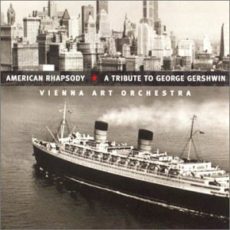
Mathias Rüegg was born on December 8, 1952 in Zurich, Switzerland and began playing jazz in secondary school. Trained as a schoolteacher, he taught for a while in special-needs schools. From 1973 to 1975 he attended the Musikhochschule in Graz, Austria, studying classical composition and jazz piano. In Vienna, Austria he performed in a nightclub as a solo jazz pianist, joined later by saxophonist Wolfgang Puschnig. The duo formed the core of an ensemble that became the Vienna Art Orchestra in 1977.
Rüegg’s distinctive, often humorous compositions have drawn on a range of influences from traditional folk music to classics. He has also led the VAO to explore the big band repertory of American jazz composers such as Duke Ellington. Beyond the traditional big-band complement, his orchestrations have prominently featured such instruments as the tuba, piccolo, bass clarinet, alphorn, exotic percussion, and wordless vocals.
Mathia has composed hundreds of pieces for the Vienna Art Orchestra, other European big bands, and classical orchestras, as well as theatre music and film music. Since 1994 he has composed several works for soloist and chamber orchestra.
Besides managing the VAO, Rüegg has conducted workshops in Europe, worked as artistic director for music festivals, and headed multimedia and music-related projects. From 1983 to 1987 he was the director of the Vienna Art Choir. He founded the Porgy & Bess music club in Vienna and the Hans Koller Prize for Austrian jazz.
Pianist, composer, director and bandleader Mathias Rüegg continues to pursue his career in a variety of musical endeavors.

More Posts: piano
Daily Dose Of Jazz…
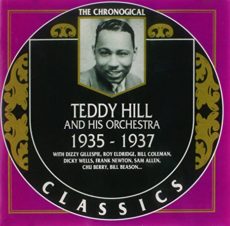
Teddy Hill was was born on December 7, 1909 in Birmingham, Alabama. After moving to New York City, he had early gigs with the Whitman Sisters, George Howe and Luis Russell’s orchestra in the Twenties. He later put together his own band in 1934, which found steady work over the NBC radio network.
Over several years it featured such major young musicians as Dizzy Gillespie, Bill Coleman, Roy Eldridge, Bill Dillard, Dicky Wells, Russell Procope, Howard E. Johnson, Chu Berry, Sam Allen, John Smith, Richard Fullbright, Bill Beason, Shad Collins, Bill Dillard, Frank Newton, Kenneth Hollon, Cecil Scott, Beatrice Douglas and Robert Carroll.
They played at the Savoy Ballroom regularly, and toured England and France in the summer of 1937. In 1935, he recorded a four song session for the American Record Corporation. In 1936, he recorded two sessions for Vocalion, then signed with Bluebird the following year and recorded 18 songs over three sessions.
After leaving the band business, Hill began managing Minton’s Playhouse in 1940, which became a Harlem hub for the bebop style, featuring such major musicians as Thelonious Monk and Kenny Clarke. Leaving Minton’s in 1969, long after its musical significance had waned, he then became the manager of Baron’s Lounge.
Married twice, Teddy had two daughters, Gwendolyn and Beatrice, one by each wife. Beatrice would later emerge as the successful actress and singer known by her stage name, Melba Moore.
Drummer, clarinetist, soprano and tenor saxophonist Teddy Hill, who was also a big band leader and the manager of Minton’s Playhouse in Harlem, passed away on May 19, 1978 in Cleveland, Ohio.

Daily Dose Of Jazz…
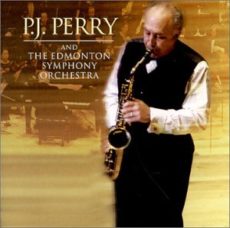
P. J. Perry CM was born Paul John Guloien to saxophonist Paul Guloien, who performed under the name Paul Perry and Margaret Yeo, on December 2, 1941 in Calgary, Alberta, Canada. Early in life they moved around Canada between Medicine Hat, Regina, Sylvan Lake and Vancouver. He learned to play the clarinet and piano before becoming a saxophonist for his father’s band when he was 14.
Spending most of his time in Canada, as a young man, Perry played at Sylvan Lake and in various Vancouver night clubs. Her recorded and released his debut album My Ideal on the Unity label in 1989, following with his sophomore project Worth Waiting For on Jazz Alliance. He has gone on to record for Unity/Page, Cellar Live, Royalty record labels, and for Justin Time Records he has twice recorded with the Edmonton Symphony Orchestra.
He has received several accolades and honors among others, two Juno awards, an honorary doctorate of law from the University of Alberta and is a member of the Order of Canada. Alto saxophonist P. J. Perry continues to perform, record and tour.

More Posts: saxophone
Daily Dose Of Jazz…
William Frank Reichenbach Jr. was born November 30, 1949 in Takoma Park, Maryland, the son of Bill Reichenbach, drummer for Charlie Byrd. He began playing in high school bands in the Washington, D.C. area, sat in with his father’s group, and played with Milt Jackson, Zoot Sims, and others.
Reichenbach went on to study at the Eastman School of Music and after graduating joined the Buddy Rich band. He would also work in the Toshiko Akiyoshi – Lew Tabackin Big Band in Los Angeles, California during the mid to late Seventies. After that move to the West Coast, he became known for music for television and film.
Not limiting himself to jazz, Bill played trombone on The Wiz and, with the Seawind Horns including Jerry Hey on Michael Jackson’s albums Off the Wall, Thriller, and HIStory. He was also the composer for Cartoon All-Stars to the Rescue.
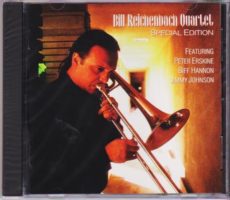
Trombonist and composer Bill Reichenbach is best known in jazz circles as a session musician for television, films, cartoons, and commercials. He recorded a solo album, Special Edition, where he is featured on tenor as well as bass trombone. He continues to compose, record and perform.
More Posts: trombone