

Daily Dose Of Jazz…
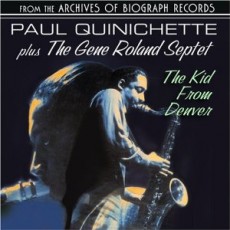
Gene M. Roland was born September 15, 1921 in Dallas, Texas and learned to play several instruments, such as trumpet and piano. He received a degree in music from the University of North Texas College of Music, first hooked up with Stan Kenton in 1944, playing fifth trumpet and contributing arrangements. He worked briefly with Lionel Hampton and Lucky Millinder, and then rejoined Kenton in 1945 as a trombonist and writer, arranging the hit “Tampico”.
In 1946 Roland played piano and wrote for a group that included Stan Getz, Zoot Sims, Jimmy Giuffre and Herbie Steward , and would lead Woody Herman‘s Four Brothers Second Herd. By the late 40s, he played trombone with Georgie Auld, trumpet with Count Basie, Charlie Barnet and Lucky Millinder and contributed charts for the big bands of Claude Thornhill and Artie Shaw. He led a giant rehearsal band in 1950 that included Dizzy Gillespie and Charlie Parker, wrote for Kenton in 1951, Dan Terry in 1954, and Woody Herman from 1956-58, for whom he contributed 65 arrangements.
Gene was a major force in Kenton’s mellophonium band of the early 1960s, not only writing for the ensemble, but also performing as one of the mellophoniums, occasionally doubling on soprano sax with the orchestra. He provided the robust vocal on “Hawaiian Teenage Girl”, and remained active as a writer in the 1960s and 70s, working with Copenhagen’s Radiohus Orchestra and playing trumpet, piano and tenor with his own groups.
Arranger, composer, vocalist and multi-instrumentalist Gene Roland, who was the only arranger to write for Kenton in all four decades of the band’s existence, passed away on August 11, 1982 in New York City.

Daily Dose Of Jazz…
Oscar Perez was born on August 21, 1974 in Queens, New York City and from the age of seven he has been expressing himself on a piano. Raised on his father’s Cuban folk music, his piano lessons and playing in the church band made his commitment to the music his life before the ninth grade. Attending LaGuardia High School for the Performing Arts, jazz would take him on his musical and personal journey.
He studied with Robert Harris of Juilliard and Edgar Roberts of New York University before matriculating through the University of North Florida. Under the American Music Scholarship, he studied with jazz pianists Harry Pickens and Kevin Bales, and it was here that he began composing for small group and big band. He went on to study with Danilo Perez at the New England Conservatory in Boston, Massachusetts, weekend gigging in New York City, and a Master’s Degree at the Aaron Copland School of Music at Queens College in New York under the guidance of Sir Roland Hanna. While studying composition and arranging with Phillip Michael Mossman, he got many writing and arranging opportunities.
By his early twenties he was sharing the stage with Bunky Green, George Russell, Curtis Fuller and George Garzone and has played with Wycliffe Gordon, Christian McBride, Eddie Allen, Mike Lee, Steve Turre, Dave Stryker, Melissa Walker, Phoebe Snow and Charenee Wade. With saxophonist Adrian Cunningham he recorded Professor Cunningham And His Old School.
He was appointed music director for St Edward’s Church in Harlem, and the accompanist for the Nightingale/Bamford Gospel Choir. He recorded his debut CD Nuevo Comienzo in 2016 with his quintet, Afropean Affair, featuring guest artists trombonist Wycliffe Gordon and guitarist Peter Bernstein.
As an educator and performer he has taught and played at the Kupferberg Center at Queens College, the Juilliard School, Jazz Connections Camp at Montclair St. University, Carnegie Hall, the New York Pops, JazzHouse Kids and Jazz at Lincoln Center. He received the 2006 ASCAP/IAJE Commission in honor of Billy Strayhorn and premiered the work at the 2007 International Association of Jazz Education Convention. He was a finalist in the 2014 Jacksonville Jazz Piano Competition. Pianist Oscar Perez continues to compose, perform and record.
More Posts: piano
Daily Dose Of Jazz…
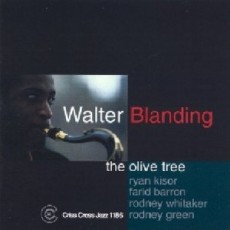
Walter Blanding Jr. was born on August 14, 1971 in Cleveland, Ohio to a musical family and began playing the saxophone at age six. In 1981, he moved with his family to New York City, and by age 16, he was performing regularly with his parents at the Village Gate.
Blanding attended LaGuardia High School for Music & Art and continued his studies at the New School for Social Research. Living in Israel for 4 years he had a major impact on the music scene, inviting great artists such as Louis Hayes, Eric Reed and others to perform. He also taught in several Israeli schools and toured the country with his ensemble.
Walter’s first recording, Tough Young Tenors, was acclaimed as one of the best jazz albums of 1991. He has performed or recorded with numerous musicians, such as Cab Calloway, the Wynton Marsalis Septet, Marcus Roberts, Illinois Jacquet, Eric Reed and Roy Hargrove among others. His last release, The Olive Tree, features fellow members of the Jazz at Lincoln Center Orchestra.
Clarinetist, tenor and soprano saxophonist Walter Blanding Jr. has taught at the Shanghai branch of Jazz At Lincoln Center, and continues to record as a sideman with a variety of musicians and perform as a member of the Jazz at Lincoln Center Orchestra.
Daily Dose Of Jazz…
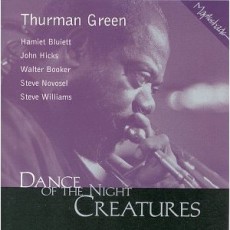
Thurman Green was born on August 12, 1940 in Texas. A jazz trombonist, who primary performed in the bebop orientation, spent time playing in Los Angeles with swinging big bands, such as, the Clayton-Hamilton Jazz Orchestra. He an occasional member of the Horace Tapscott Quintet, one of many groups headed by the late pianist that no one bothered to record. Thurman was open-eared enough to play quite credibly in free settings now and then.
Thurman recorded as a sideman with Willie Bobo, Donald Byrd and Bobby Hutcherson on the Blue Note label. In 1962, Green and baritone saxophonist Hamiet Bluiett were jamming buddies at the Navy School of Music in Washington D.C. They soon went their separate ways but hoped to team up again some day.
It was thirty-two years later, in 1994, that Bluiett was able to give his old friend his first opportunity to lead his own record date with Dance of the Night Creatures that had pianist John Hicks, bassist Walter Booker or Steve Novosel and drummer Steve Williams. It is a shame that it took over four years for the music to finally come out because Green suddenly died at age 57 on June 19, 1997.
More Posts: trombone
Daily Dose Of jazz…
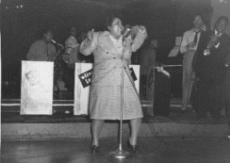
Ernestine Davis was born on August 5, 1907 in Memphis Tennessee. Little is known about her early life but along the way to becoming a vocalist and trumpeter. In 1937, the Piney Woods Country Life School of Mississippi founded to educate black children, created a 16-piece band known as The International Sweethearts of Rhythm to financially support the school.
In 1941, the International Sweethearts of Rhythm severed their ties with the school, moved to Virginia and recruited seasoned professionals of all ethnicities to join their band such as singer Anna Mae Winburn, Ernestine “Tiny” Davis, and alto saxophonist Roz Cron.
Holding their own during the Swing Era, the ladies toured the United States extensively up until 1945 with the end of the war and opportunities dried up as the men returned home. Their high points of touring were the Apollo Theater in New York, the Regal Theater in Chicago, and the Howard Theater in Washington, D. C., where their debut set a box office record of 35,000 patrons in one week.
One such engagement was at The Apollo where the audience was on their feet, Louis Armstrong and Eddie Durham stood in the wings, smiling broadly as Ernestine “Tiny” Davis took off in a riveting solo. The band pushed the fevered audience to new levels as Edna Williams, Willie Mae Wong, and Ruby Lucas upped the ante on the song “Swing Shift.”
Admired by the likes of Count Basie and Louis Armstrong, the later unsuccessfully attempted to lure Davis away at ten times her salary when she was at the height of notoriety. They recorded “The Jubilee Sessions” for radio broadcasts aimed toward America’s black soldiers serving during 1943 to 1946. However, because of the racial makeup of the Sweethearts, they did not get as much exposure to mainstream audiences in the South.
While their exposure to white audiences was somewhat limited, they were extremely popular with black audiences. Tiny and her partner Ruby Lucas owned Tiny and Ruby’s Gay Spot in Chicago during the 1950s.
In 1988, a short film titled “Tiny & Ruby: Hell Divin’ Women” was made as a tribute to Davis, and her lesbian partner of 40 years, drummer Ruby Lucas. Trumpeter and vocalist Ernestine “Tiny” Davis died in 1994.