

Daily Dose Of Jazz…
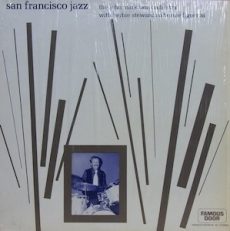
John Gordon Markham was born on November 1, 1922 in Oakland, California. After graduating from Piedmont High School he served in the Army during World War II, performing for troops in the Pacific.
A mainstay in countless San Francisco ensembles, John worked with Chuck Travis, Johnny Coppola, and Larry Vuckovich. He worked on the Tennessee Ernie Ford Show in the 49er band and for many years he performed with Jimmy Diamond at the New Orleans Room of the Fairmont Hotel.
He performed and recorded with Charlie Barnet 1950-1952 and then with Billy May 1952-1953. From 1955 mostly working in television, with the occasional tour or recording session. He is noted for his work with many greats, including Frank Sinatra, Benny Goodman, Ella Fitzgerald, Peggy Lee, Bill Perkins, Red Norvo, Vince Guaraldi and other prominent musicians with whom he toured.
Drummer and bandleader John Markham, who led an orchestra under his own name, died October 4, 1998 at the age of 76 years old.

More Posts: bandleader,drums,history,instrumental,jazz,music
Daily Dose Of Jazz…
Theodore Malcolm Nash Sr. was born on October 31, 1922 in the Boston suburb of Somerville, Massachusetts. His goal was to become a classical flutist until he began playing saxophone in his early teens. He started playing professionally when he went on the road with a succession of dance bands. In 1944, he became tenor saxophonist for the Les Brown big band.
The late 1940s had him married and settling in Los Angeles, California where he became an active session musician in the Hollywood movie and television studios. In 1956, he recorded with Paul Weston’s orchestra the album Day by Day, with vocals by his former colleague and close friend, Doris Day.
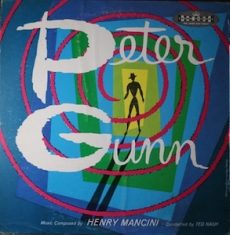
He was the featured soloist on The Music from Peter Gunn soundtrack, performing the alto saxophone solo on the theme and on the second bridge of Dreamsville. Through the 1950s and 1960s, he worked as a sideman for June Christy, Nat King Cole, Bing Crosby, Billy Eckstine, Ella Fitzgerald, Frank Sinatra, and Nancy Wilson. During the 1970s, he worked with Judy Collins and Quincy Jones.
Retiring in the 1980s, saxophonist, flutist and clarinetist Ted Nash Sr. died on May 12, 2011.

More Posts: clarinet,flute,history,instrumental,jazz,music,saxophone
Daily Dose Of Jazz…
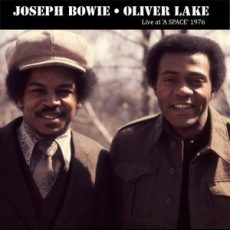
Joseph Bowie was born October 17, 1953 in St. Louis, Missouri and was greatly influenced by his older brothers, saxophonist Byron and trumpeter Lester. His first international tour was with Oliver Lake of the Black Artists Group in 1971. During this time in Paris, France he worked with Alan Silva, Frank Wright, and Bobby Few. He also worked with Dr. John in Montreux, Switzerland in 1973.
Moving to New York City, and with the help of Off Broadway Theater impresario Ellen Stewart he established La Mama children’s theater. He performed with Cecil Taylor, Human Arts Ensemble, Nona Hendryx, Leroy Jenkins, Vernon Reid, Stanley Cowell, Sam Rivers, Philippe Gaillot, Dominique Gaumont and Ornette Coleman.
In 1976 Joseph relocated to Chicago, Illinois where he led bands for Tyrone Davis and other R&B artists. Returning to New York City in 1978 he began singing with punk and funk musician James Chance and the Contortions. Defunkt was born during that time and over the next 25 years, Defunkt recorded 15 albums.
Bowie has collaborated with Jean-Paul Bourelly and Jamaaladeen Tacuma. He has performed “big band funk” arrangements with Ed Partyka at Music School Lucerne, Barbary Coast Ensemble at Dartmouth College, JazzArt Orchestra, and the HR Frankfurt Radio Big Band. The first Defunkt Big Band debuted in 1999 in New York City at the Texaco Jazz Festival sponsored by the Knitting Factory.
In 2003, he moved to the Netherlands where he met Hans Dulfer and was introduced to the Dutch music scene. He has performed with Hans, Candy Dulfer, Saskia Laroo Band, Naked Ears, Monsieur Dubois, Emergency Room, Funkateer, Seven Eleven, and Almost Three.
In 2014 he produced Sax Pistols Allergy for the U.S (ZIP Records) with lyricist Hilarius Hofstede. The album Defunkt Mastervolt was released in 2015 on ZIP Records. Robin van Erven Dorens directed the documentary In Groove We Trust about Bowie’s life.
Trombonist and vocalist Joseph Bowie continues to perform and record.
More Posts: bandleader,history,instrumental,jazz,music,trombone,vocal

Daily Dose Of Jazz…
Fred Norman was born on October 5, 1910 in Leesburg, Florida. After attending Howard University, in Washington, DC he joined the Claude Hopkins band in 1932. Touring with the group as both a trombonist and singer for much of the 1930s, he notably recorded his own composition, Church Street Sobbin’ Blues, as the trombone soloist with the band in 1937 for Decca Records. He also appeared in short films with the Hopkins band during the 1930s.
Moving away from performance in 1938 he went on to work as a full-time music arranger. The late Thirties and 1940s saw him writing arrangements for Bunny Berigan, Tommy Dorsey, Benny Goodman, Lionel Hampton, Gene Krupa, Teddy Powell, Artie Shaw, Charlie Spivak, and Jack Teagarden.
In the 1950s he was the music director and arranger for multiple records made by the singers Sarah Vaughan and Dinah Washington. He continued to work as an arranger until his retirement in the 1970s.
Composer, arranger, trombonist, and vocalist Fred Norman died on February 19, 1993 in New York City.
More Posts: arranger,bandleader,composer,history,instrumental,jazz,music,trombone,vocal
Daily Dose Of Jazz…
Cecil Norman was born on September 29, 1897 in Oldham, Lancashire, United Kingdom. Considered a child prodigy, by the age of 11 he was playing concertos, at 15 he appeared at London’s Aeolian Hall. He was the son of music hall artists, billed as Olga and Otto, with his mother playing trumpet, trombone, concertina and piano.
Cecil stayed in London during World War II, with many engagements to entertain the troops, accompanying Vera Lynn as well as Inga Anderson, who sang with the George Melachrino Orchestra. After serving in World War I, he switched from classical to popular music, partly due to developing neuritis in the right hand, which forced him to give up the piano for a couple of years. Thereafter Cecil specialised in dance music, it being less likely to aggravate his condition.
He played in so many popular bands it’s hard to list them all, however in 1924 along with his alto saxophonist brother Leslie began their own band at the Savoy Hotel for tea dances and the Bekeley Hotel in the evenings. They soon moved to the Empress Rooms where they played seven days a week plus tea dances. At times, either he or his brother were in charge and arranging for the Savoy Plaza Band and Savoy Dance Band. In 1927, the Norman Brothers Band moved to Carlton Hotel. In 1928, Cecil went to America and had Rudy Vallee introduce him around, including to Bert Lown, whom he joined in New York.
Moving back to London in 1929, Cecil played and recorded with Fred Elizalde Band in 1930 before moving to Jerry Hoey’s band and Melville Gideon’s band in 1931. He went on to join several other bands in London and Australia, including the BBC Dance Orchestra. He stayed in London during World War II, with many engagements to entertain the troops, accompanying Vera Lynn as well as Inga Anderson, who sang with the George Melachrino Orchestra.
After the war, Norman formed the Rhythm Players that became the cornerstone of the BBC’s Music While You Work program in the 1950’s. Over the course of his career he composed several instrumental numbers. He retired in 1962 when he was 65 after suffering an accident. He returned one last time for a 15-minute spot in 1970, ending his more than sixty years in music.
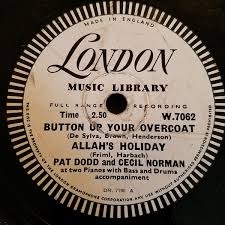
Dance pianist & composer Cecil Norman, who used the pseudonym Norman Sissel for some Norman Sissel And His Rhythm Twisters recordings, died February 8, 1988 aged 91 in East Sussex, England.
 </p
</p
More Posts: bandleader,history,instrumental,jazz,music,piano