Daily Dose Of Jazz…
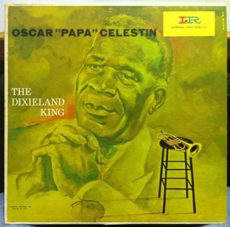
Oscar “Papa” Celestin was born on January 1, 1884 in Napoleonville, Louisiana to a Creole family. As a youth he worked on rural Louisiana plantations but eager for a better life, he worked as a cook for the Texas & Pacific Railroad, saved up money and bought used musical instruments. He played guitar and trombone before deciding on cornet as his main instrument. He took music lessons from Claiborne Williams, who traveled down the Bayou Lafourche from Donaldsonville.
Celestin played with the Algiers Brass Band by the early 1900s, and with various small town bands before moving to New Orleans in 1904, at age 20. There he played with the Imperial, Indiana, Henry Allen senior’s Olympia Brass Band, and Jack Carey’s dance band. Early in his career he was sometimes known as Sonny Celestin. Around 1910 he landed a job as leader of the house band at the Tuxedo Dance Hall on North Franklin St. at the edge of Storyville.
Keeping the name Tuxedo as the band’s name after the Dance Hall closed, they dressed in tuxedos and became one of the most popular bands hired for society functions, both black and white. He co-led the Tuxedo Band with trombonist William Ridgely and made their first recordings during the Okeh Records field trip to New Orleans in 1925. Following a fallout with Ridgely, the two led competing Tuxedo bands for about five years. Celestin’s Original Tuxedo Orchestra had Louis Armstrong, Bill Mathews, Octave Crosby, Christopher Goldston, Joe Oliver, Mutt Carey, Alphonse Picou and Ricard Alexis as a members over the years and made an additional series of recordings for Columbia Records through the 1920s. He also led the Tuxedo Brass Band, one of the top brass bands in the city.
Forced out of the business by depression economics, Papa worked in a shipyard until putting together another band after the World War II. The new Tuxedo Brass Band was tremendously popular and became a New Orleans tourist attraction. By 1953 he appeared in the travelogue Cinerama Holiday, became a regular feature at the Paddock Lounge on Bourbon Street and gave a command performance for President Eisenhower at the White House. He made regular radio broadcasts, television appearance, and more recordings with his last recording was singing on Marie LaVeau in 1954.
Bandleader, trumpeter, cornetist and vocalist Papa Celestin passed away in New Orleans, Louisiana on December 15, 1954, amassing 4000 people who marched in his funeral parade. The Jazz Foundation of New Orleans had a bust made and donated to the Delgado Museum in New Orleans, in honor of his contributions to the genre. #preserving genius

Give A Gift Of Jazz – Share

Daily Dose Of Jazz…
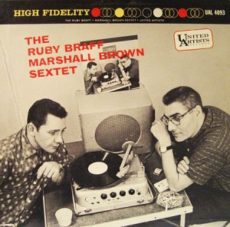
Marshall Brown was born on December 21, 1920 in Framingham, Massachusetts. Little recorded, he devoted most of his career to education, earning a music degree from New York University, as a member of the Zeta Psi Fraternity.
He was also a high school band director leading the Farmingdale New York Daler Band from the early 1950s through 1957. Brown was the first high school band director to initiate a jazz education program, which he did in his tenure at Farmingdale High. By 1956 his stage band, the Daler Dance Band, a jazz big band with an average age of 14 years old, was so formidable and impressive, boasted future jazz stars pianist Michael Abene, saxophonist Andrew Marsala, and whiz drummer Larry Ramsden. One night at the 1957 Newport Jazz Festival, Count Basie, who was late for his appearance as he entered the festival grounds heard the Daler Band performing their set and exclaimed, “Damn, they started already”, mistaking the Dalers for his band.
Marshall received some attention for performing and recording in a quartet with Pee Wee Russell in the early 1960s. While Russell was most often associated with Dixieland or swing, their quartet performed more adventurous, free jazz-oriented pieces, including pieces by Ornette Coleman and John Coltrane.
During the Sixties he was the resident trombonist at Jimmy Ryan’s, a noted dixieland venue. He also club dated with Luke O’Malley’s Irish band during this time. Brown also performed or recorded at one time or another with Ruby Braff, Beaver Harris, Lee Konitz, George Wein and Basie.
Conductor, arranger and educator Marshall Brown, who also played the valve trombone, trumpet, euphonium, electric bass and the banjo, passed away on December 13, 1983 in New York City.
Uplift Someone’s World
More Posts: banjo,bass,euphonium,trombone,trumpet,valve trombone
Daily Dose Of Jazz…
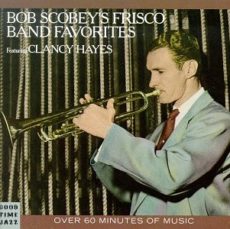
Robert Alexander Scobey, Jr. was born on December 9, 1916 in Tucumcari, New Mexico. He began his career playing in dance orchestras and nightclubs in the 1930s and by 1938 was working as second trumpeter for Lu Watters in the Yerba Buena Jazz Band. 1949 saw him leading his own band under the name Bob Scobey’s Frisco Band and the following year secured a three-year residency at the Victor & Roxie’s, which expanded their popularity.
Clancy Hayes joined the band to sing, play banjo bringing his own compositions such as Huggin’ and a Chalkin‘. The collaboration recorded over two hundred tracks until he left in 1959 to follow a solo career. The Frisco Band broadcasted in 1952 and 1953 on Rusty Draper’s television show. In 1953 Louis Armstrong sang with the band and the following year blues singer Lizzie Miles began recording and touring with the band, a relationship that lasted three years.
Beginning in 1955 Scobey and his band played San Quentin Prison, the roadhouse Rancho Grande, recorded for Verve Records and RCA Victor,. and toured colleges and universities, recorded many student favorites on the album College Classics.
Bob opened the Club Bourbon Street in Chicago, Illinois in 1959, and began suffering with stomach issues while touring in 1960. Trumpeter Bob Scobey passed away of cancer on June 12, 1963. His wife produced a biography titled He Rambled!, arranged for his band to form again and record some blues songs, and saw to the reissuing of his albums.

More Posts: trumpet
Daily Dose Of Jazz…
Ben Thigpen was born Benjamin F. Thigpen on November 16, 1908 in Laurel, Mississippi. He played piano as a child and was trained by his sister Eva. He played in South Bend, Indiana with Bobby Boswell in the 1920s before moving to Chicago, Illinois to study under Jimmy Bertrand.
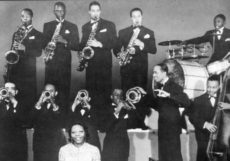
Chicago saw Ben playing with many noted Chicago bandleaders and performers, including Doc Cheatham. He played with Charlie Elgar’s Creole Band from 1927 to 1929 but never recorded with them. Following this he spent time in Cleveland, Ohio with J. Frank Terry, and then became the drummer for Andy Kirk’s Clouds of Joy, where he stayed from 1930 to 1947.
Much of his work is available on collections highlighting the piano work of Mary Lou Williams, who also played in this ensemble. After his time performing and recording with Kirk, his career was not well documented and it appears that he never recorded as a leader. He did however, lead his own quintet in St. Louis, Missouri, recorded with Mary Lou Williams, Booker Collins and Ted Robinson and also recorded Dixieland with Singleton Palmer in the 1960s.
Drummer Ben Thigpen, father of Ed Thigpen, who followed in his footsteps, passed away on October 5, 1971.
Take A Dose On The Road
More Posts: drums
Daily Dose Of Jazz…
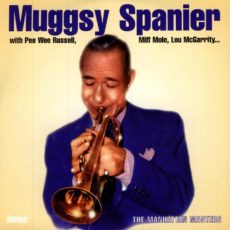
Muggsy Spanier was born Francis Joseph Julian Spanier on November 9, 1906 in Chicago, Illinois. He borrowed the nickname from the manager of the NY Giants, John “Muggsy” McGraw. In the early 1920s, he was playing cornet with The Bucktown Five in Chicago.
He led several traditional hot jazz bands, most notably Muggsy Spanier and His Ragtime Band, that actually played Dixieland. This band set the style for all later attempts to play traditional jazz with a swing rhythm section of key members George Brunies on trombone and vocals, clarinetist Rod Cless, pianists George Zack or Joe Bushkin, Ray McKinstry, Nick Ciazza or Bernie Billings playing tenor saxophone, and Bob Casey on bass.
Muggsy’s theme song was Relaxin’ at the Touro, named for the infirmary in the New Orleans, Louisiana hospital where Spanier was treated for a perforated ulcer in 1938. Saved by Dr. Alton Ochsner he homaged a song titled Oh Doctor Ochsner.
Spanier made numerous Dixieland recordings, co-led a quartet, the Big Four, with Sidney Bechet in 1940 and co-led a traditional band with pianist Earl Hines at the Club Hangover in San Francisco, California in the 1950s. He followed this engagement up playing with the Bob Crosby band. Winding down his career in the late 1950’s and early 1960’s by 1959 he was leading a small band at the College Inn in the Sherman Hotel, then appeared in the Blue Note, Jazz Ltd. and in the Empire Room of the Palmer House, all in Chicago. His last appearance was at the Newport Rhode Island Jazz Festival in 1964.
Cornetist, composer and bandleader Muggsy Spanier passed away on February 12, 1967.
Jazz Is Global – Share
More Posts: cornet