

Daily Dose Of Jazz…
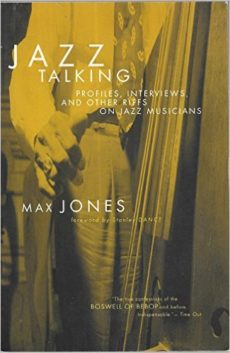
Ronald Maxwell Jones was born on February 28, 1917 in London, England and together with his brother Cliff, taught himself to play the saxophone, before the two of them founded the semi-professional Campus Club Dance Band in 1930. Dissolved in 1935 he tried to establish himself as a professional musician, becoming a member of a combo led by trumpeter Johnny Claes, with musicians who played in the style of Coleman Hawkins.
In 1942 and 1943, Max worked for the BBC radio program Radio Rhythm Club; and in 1942, together with authors Albert McCarthy and Charles Fox, founded the magazine Jazz Music, which became meritorious as it set out to reassert the pioneering role of the African-American, to emphasize the music’s social dimensions, and to attack the glossy commercialism of big-band swing.
Since 1944, Jones had a full-time job writing features for the Melody Maker in the column Collectors’ Corner. In the following years he gained more and more high recognition as a proven expert of New Orleans Jazz, swing, and mainstream jazz.
In 1971 Jones published a Louis Armstrong biography, Louis: The Louis Armstrong Story, together with John Chilton. He also wrote a number of liner notes, such as for the CD edition of the Kenny Clarke/Francy Boland Big Band, the Spirits of Rhythm, and wrote the preface for the Lee Collins, Mary Spriggs Collins, Frank Gillis, John W. Miner book Oh, Didn’t He Ramble: The Life Story of Lee Collins. A collection of his articles on musicians such as Coleman Hawkins, Johnny Hodges, Billie Holiday, and Mary Lou Williams was published as a book entitled Talking Jazz in 1987.
Jones was the first jazz musician to become a professional journalist and exclusively dealt with jazz in his publications. He was a model and a mentor for a younger generation of rock music critics and authors. Author, radio host, and journalist Max Jones passed away on August 1, 1993 in Chichester, England.

#preserving genius
More Posts: saxophone
Daily Dose Of Jazz…
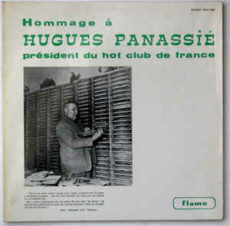
Hugues Panassié was born on February 27, 1912 in Paris, France and when he was fourteen, he was stricken with polio, limiting extracurricular physical activities. So he took-up the saxophone and fell in love with jazz in the late Twenties. In 1932 he was the founding president of the Hot Club de France.
During the Germans occupation of northern France the Nazi’sbanned American jazz because they regarded jazz as low music from an inferior people. However Hugues got past the censors by submitting alternate and obscure French titles and continue to broadcast. One example was La Tristesse de Saint Louis, which translates to Sadness of Saint Louis, but in reality it was Louis Armstrong’s The Saint Louis Blues.
Panassié would go on to produce several jazz records by artists that include Sidney Bechet and Tommy Ladnier, author thirteen books about jazz, was an ardent exponent of Dixieland and Black players and a controversial critic of bad musicians such as Benny Goodman’s clarinet being inferior to the likes of Jimmy Noone and Omer Simeon. He dismissed bebop as a form of music distinct from jazz and held in esteem a lone example of a white musician who played jazz authentically in Mezz Mezzrow.
But he was not without his critics and historians who saw him creating a wedge between Black and Caucasian musicians by insisting that Black jazz was superior. He penned the liner notes for a 1956 RCA Victor compilation Guide to Jazz that included 16 recording by prominent jazz artists. After spending five months in New York City, critic, record producer and impresario Hugues Panassié met his assistant Madeleine Gautier, married, returned and settled in Montauban, France until his passing away on December 8, 1974.
Sponsored By

Voices From The Community

#preserving genius
More Posts: saxophone
Daily Dose Of Jazz…
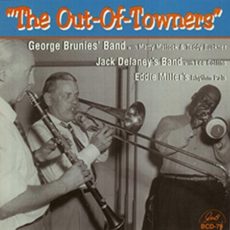
George Clarence Brunies, a.k.a. Georg Brunis was born into a musical family on February 6, 1902 in New Orleans, Louisiana.. His father led a family band with his brothers Henry, Merritt, Richard, and Albert who all became noted professional musicians. By the age of 8 he was already playing alto saxophone professionally in Papa Jack Laine’s band, but a few years later he switched to trombone.
Though Brunies never learned to read music, he played with many jazz, dance, and parade bands in New Orleans, quickly picking up tunes and inventing a part for his instrument. He first went to Chicago, Illinois in 1919 with a band led by Ragbaby Stevens, then worked the riverboats up and down the Mississippi River.
By 1921 he returned to Chicago and joined a band of his New Orleans friends playing at the Friar’s Inn, and this band eventually became famous as the New Orleans Rhythm Kings. His trombone style was influential to the young Chicago players, and his records were much copied. In this era Brunies was never bested as he could play anything any other trombonist could play as well or better. He would often end battles of the bands or cutting contests by outplaying other trombonists while operating the slide with his foot.
In 1924 after the Rhythm Kings broke up in Chicago, George joined the Ted Lewis band, which he played with through 1934. He spent some time with Louis Prima’s band, then landed a steady gig at the New York City jazz club Nick’s through 1938. In 1939 he joined Muggsy Spanier, with whom he made some of his most famous recordings. The following year he returned to Nick’s, where he remained through 1946 and then worked with Eddie Condon.
In 1949 Brunies returned to Chicago and landed at the 1111 Club leading his own band. Often showing off his unusual technical abilities and bizarre sense of humor at the same time, for example, he would lie on the floor and invite the largest person in the audience to sit on his chest while he played trombone. Believing that this name change would increase his good luck, on the advice of a numerologist, he changed his name to Georg Brunis in the late 1940s. While in residence every now and then other well-known jazz musicians would sit in and play until the wee hours.
Trombonist George Brunies, known as the King of the Tailgate Trombone, passed away in Chicago on November 19, 1974.
Sponsored By
Voices From The Community
#preserving genius
More Posts: trombone
Daily Dose Of Jazz…
Edward Bertram Garland was born January 9, 1895 in New Orleans, Louisiana. By 1910 he was playing bass drum with brass bands including Frankie Duson’s Eagle Band. He then took up tuba and string bass, doubling on the two instruments which filled similar roles in different types of bands.
He played with the Excelsior Brass Band, Manuel Perez’s Imperial Orchestra and then joined other early New Orleans bands playing in Chicago, Illinois and California, such as Lawrence Duhé and Freddie Keppard. In 1916 Garland joined King Oliver and went to California and during the Depression he led his own One-Eleven Jazz Band.
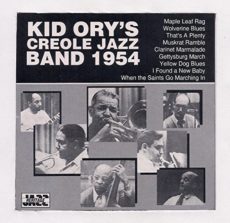
1944 saw Ed gaining notoriety as a member of a traditional New Orleans band that was a leader of the West Coast revival, put together for the CBS Radio series The Orson Welles Almanac. The all-star band also included Mutt Carey, Jimmie Noone (succeeded by Barney Bigard), Kid Ory, Bud Scott, Zutty Singleton and Buster Wilson. Renamed Kid Ory’s Creole Jazz Band, the group then made a significant series of recordings on the Crescent Records label.
Garland appeared in the 1959 film Imitation of Life, performing with Andrew Blakeney, Teddy Buckner, George Orendorf and Joe Darensbourg in the funeral sequence Trouble of the World featuring Mahalia Jackson.
String bassist Ed Garland, sometimes known as Montudie Garland, a nickname he much disliked, passed away in London, England on January 22, 1980.
Sponsored By

#preserving genius
More Posts: bass
Daily Dose Of Jazz…
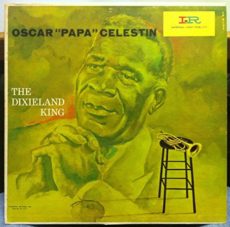
Oscar “Papa” Celestin was born on January 1, 1884 in Napoleonville, Louisiana to a Creole family. As a youth he worked on rural Louisiana plantations but eager for a better life, he worked as a cook for the Texas & Pacific Railroad, saved up money and bought used musical instruments. He played guitar and trombone before deciding on cornet as his main instrument. He took music lessons from Claiborne Williams, who traveled down the Bayou Lafourche from Donaldsonville.
Celestin played with the Algiers Brass Band by the early 1900s, and with various small town bands before moving to New Orleans in 1904, at age 20. There he played with the Imperial, Indiana, Henry Allen senior’s Olympia Brass Band, and Jack Carey’s dance band. Early in his career he was sometimes known as Sonny Celestin. Around 1910 he landed a job as leader of the house band at the Tuxedo Dance Hall on North Franklin St. at the edge of Storyville.
Keeping the name Tuxedo as the band’s name after the Dance Hall closed, they dressed in tuxedos and became one of the most popular bands hired for society functions, both black and white. He co-led the Tuxedo Band with trombonist William Ridgely and made their first recordings during the Okeh Records field trip to New Orleans in 1925. Following a fallout with Ridgely, the two led competing Tuxedo bands for about five years. Celestin’s Original Tuxedo Orchestra had Louis Armstrong, Bill Mathews, Octave Crosby, Christopher Goldston, Joe Oliver, Mutt Carey, Alphonse Picou and Ricard Alexis as a members over the years and made an additional series of recordings for Columbia Records through the 1920s. He also led the Tuxedo Brass Band, one of the top brass bands in the city.
Forced out of the business by depression economics, Papa worked in a shipyard until putting together another band after the World War II. The new Tuxedo Brass Band was tremendously popular and became a New Orleans tourist attraction. By 1953 he appeared in the travelogue Cinerama Holiday, became a regular feature at the Paddock Lounge on Bourbon Street and gave a command performance for President Eisenhower at the White House. He made regular radio broadcasts, television appearance, and more recordings with his last recording was singing on Marie LaVeau in 1954.
Bandleader, trumpeter, cornetist and vocalist Papa Celestin passed away in New Orleans, Louisiana on December 15, 1954, amassing 4000 people who marched in his funeral parade. The Jazz Foundation of New Orleans had a bust made and donated to the Delgado Museum in New Orleans, in honor of his contributions to the genre. #preserving genius

Give A Gift Of Jazz – Share