


Daily Dose Of Jazz…
Paul Wesley “Doc” Evans was born on June 20, 1907 in Spring Valley, Minnesota and learned piano and drums as a child. He went on to play saxophone in high school and during his college years played with the Carleton Collegians. By the late Twenties gave up saxophone for the cornet to play Dixieland in Minneapolis.
Doc played through the Great Depression, turning down offers to play outside of the Midwest. In 1947 he recorded for Disc Records and led the band that played for the opening of Chicago Jazz Limited club. He stayed in Chicago until 1952, and then embarked on nationwide tours, recording frequently along the way, particularly for Audiophile Records.
He returned to Minneapolis and continued playing jazz up until his last recordings in 1975. He founded the Bloomington Symphony Orchestra and conducted it until his death on January 10, 1977 in Minneapolis, Minnesota. His legacy was marked in 1999 with the yearly Doc Evans Jazz Festival, founded in Minnesota.

Inspire A Young Mind
More Posts: cornet
Daily Dose Of Jazz…
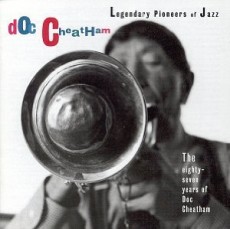
Adolphus Anthony Cheatham, better known as Doc Cheatham was born on June 13, 1905 in Nashville, Tennessee. Growing up without jazz, he was introduced by early recordings and touring bands of the late 1910s. Abandoning family plans to be a pharmacist to play music, he retained the name Doc and started with the soprano and tenor saxophone in addition to trumpet in the African American Vaudeville theatre.
He toured the TOBA circuit (Theatre Owners Booking Association) accompanying blues singers but it wasn’t until his move to Chicago and hearing King Oliver that his focus turned to jazz. A year later Louis Armstrong added his influence on Doc’s playing. Cheatham went on to play with Ma Rainey, worked in the big bands of Bobby Lee, Wilbur de Paris, Chick Webb, Sam Wooding, Cab Calloway, Fletcher Henderson, Benny Carter, Claude Hopkins and Teddy Wilson through the 30s and 40s.
By the late 40s into the 50s Doc play in New York City Latin bands of Ricardo Ray, Marcelino Guerra, Perez Prado and Machito. In the 60s he led his own band for five years then worked with Benny Goodman. In the 70s he began singing after scatting during a Paris recording session, was well received and he continued to sing for the rest of his life.
Cheatham created his best work after the age of 70, winning a Grammy with Nicholas Payton and Butch Thompson for the Verve Record release of “Doc Cheatham and Nicholas Payton”. Trumpeter, singer and bandleader Doc Cheatham continued playing until two days before his passing on June 2, 1997, eleven days shy of his 92nd birthday.
Dose A Day – Blues Away
More Posts: trumpet
Daily Dose Of Jazz…
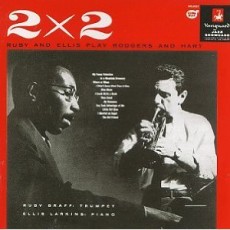
Reuben “Ruby” Braff was born on March 16, 1927 in Boston, Massachusetts He began playing in local clubs in the 1940s and in 1949, and he was hired to play with the Edmond Hall Orchestra at Boston’s Savoy Cafe. Ruby teamed up with Pee Wee Russell when the clarinet was making a comeback and they recorded several sessions for Savoy Records.
Relocating to New York in 1953 Braff easily fit into a variety of Dixieland and mainstream settings becoming in demand for band dates and recordings. He recorded as both leader and sideman working with such names as Vic Dickinson, Buck Clayton, Urbie Green, Ellis Larkins and Benny Goodman.
In the Sixties he was a member of George Wein’s Newport All-Stars but for a number of years work was hard to come by for the Dixieland player until the 70s when he formed a quartet in 1973. Following this he freelanced in different small combos and duets ultimately recording with Scott Hamilton’s quintet and sparring with guitarist Howard Alden.
Ruby Braff, cornetist and trumpeter who played in the genres of Dixieland, mainstream jazz and swing passed away on February 10, 2003 in Chatham, Massachusetts.
Daily Dose Of Jazz…
Jason Marsalis was born on March 4, 1977 in New Orleans, Louisiana and is the youngest son of pianist Ellis Marsalis. Inheriting the virtuosity and compositional skills associated with the Marsalis family, Jason developed a distinctive, polyrhythmic drumming style. His first professional gig was with his father at the age of twelve, he studied classical percussion at Loyola University in New Orleans, and has worked as a sideman with straight-ahead combos, funk fusion bands, with Casa Samba, a Brazilian percussion ensemble and even a Celtic group.
Jason introduced percussionist Bill Summers to trumpeter Irvin Mayfield and together they co-founded the wildly successful Los Hombres Calientes. Then, at the height of that band’s popularity he left to join up with acclaimed pianist Marcus Roberts.
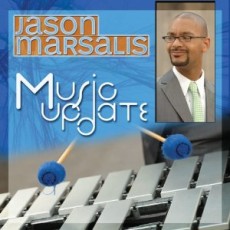
Most recently, Jason has been playing vibraphone, releasing his first album as a leader on vibes in 2009 titled “Music Update”. Earning 4.5 out of 5 stars in Downbeat Magazine, it showcases Jason playing the vibes with his working quartet as well as several over-dubbed drum ensembles titled the “Disciplines”.
Jason also continues to work as a sideman with among others Marcus Roberts, Ellis and Delfeayo Marsalis, John Ellis, Dr. Michael White and Shannon Powell. Along with his father and brothers, he is a recipient of the 2011 NEA Jazz Masters Award and is featured in the non-fiction film on New Orleans jazz culture, “Tradition Is A Temple”.
More Posts: drums,vibraphone
Daily Dose Of Jazz…
Herbie Nichols was born in San Juan Hill, Manhattan, New York City on January 3, 1919. His first known work was with the Royal Barons in 1937, a few years later performing at Minton’s Playhouse but he did not find a very happy experience due to a competitive atmosphere that did not suit his personality.
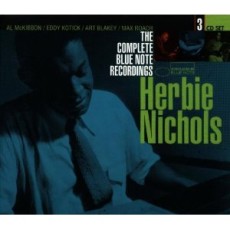
Nichols was drafted into the Infantry in 1941. After the war he worked in various setting, beginning to achieve some recognition when Mary Lou Williams recorded some of his songs in 1952. He befriended Thelonious Monk and from about 1947 persisted in trying to persuade Alfred Lion at Blue Note to sign him. Lion finally acquiesced and between 1955 and 1956 Herbie recorded less than half his 170 compositions that produced three albums, with other tracks from these sessions not being issued until the 1980s.
As a player he was capable not only of dark lyricism but also of writing melodies so harmonically adventurous that placed his music in a rhythmic league of its own. Nichols was indeed fortunate in the drummers with whom he worked Art Blakey and Max Roach. As a composer he penned such notable standards as “Serenade” that had lyrics added as well as “Lady Sings The Blues” that became synonymous with Billie Holiday, to which she set lyrics and adopted the title for her autobiography.
Jazz pianist and composer Herbie Nichols died from leukemia at the age of 44 on April 12, 1963 in New York City. Although he lived most of his life in relative obscurity, he is now highly regarded by many musicians and critics.