

Daily Dose Of Jazz…
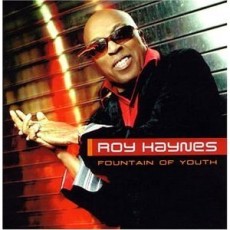
Roy Owen Haynes was born March 13, 1925 in the Roxbury section of Boston, Massachusetts and made his professional debut at the age of seventeen in his native Boston. He began his full time professional career in 1945. From 1947 to 1949 he worked with Lester Young, and from 1949 to 1952 was a member of Charlie Parker’s quintet. He recorded at the time with Bud Powell, Wardell Gray and Stan Getz.
In 1953 Roy toured with Sarah Vaughan for the next five years and then went on to work with more experimental musicians, like John Coltrane, Eric Dolphy, Andrew Hill and Chick Corea.
Haynes extracted the rhythmic qualities from melodies and created unique new drum and cymbal patterns in an idiosyncratic, now instantly recognizable style. Rather than using cymbals strictly for effect, Haynes brought them to the forefront of his unique rhythmic approach. He also established a distinctively crisp and rapid-fire sound on the snare; this was the inspiration for his nickname, “Snap Crackle”.
Over the course of his 60+ career of hard swinging since 1944, Roy is among the most recorded drummers in jazz playing in a wide range of styles ranging from swing and bebop to jazz-fusion and avant-garde. He has recorded or performed with Gary Burton, Miles Davis, Dizzy Gillespie, Christian McBride, Jackie McLean, Pat Metheny, Thelonious Monk, Gerry Mulligan, Art Pepper, Sonny Rollins, Horace Tapscott and many, many others.
As a bandleader Haynes has also led his own groups, some performing under the name Hip Ensemble and his most recent recordings as a leader are “Fountain of Youth” and “Whereas”, both of which have garnered Gammy nominations. In 2010, the National Academy of Recording Arts and Sciences bestowed upon him a Grammy Lifetime Achievement Award. Drummer, percussionist and bandleader Roy Haynes continues to record and perform worldwide.
More Posts: composer,drums,percussion
Daily Dose Of Jazz…
Jimmy Garrison was born on March 3, 1933 in Miami, Florida but grew up in Philadelphia where he learned to play the bass, coming of age during that city’s thriving jazz scene that including McCoy Tyner, Reggie Workman, Henry Grimes and Lee Morgan. He played around Philadelphia with local groups until 1958 when Philly Joe Jones brought him to New York City.
During the time he would freelance with Lennie Tristano, Benny Golson, Bill Evans and Kenny Dorham but got seriously noticed when he joined Ornette Coleman at the Five Spot. Garrison’s long association with Ornette Coleman produced his first recording with him on “Ornette on Tenor” and “Art of the Improvisers”.
Jimmy would go on to play and record with Archie Shepp and Pharoah Sanders but his greatest collaboration was his six-year collaboration with the John Coltrane Quartet when he replaced Reggie Workman. In concert with Trane he would play unaccompanied solos, sometimes as a prelude to a song before the other musicians joined in.
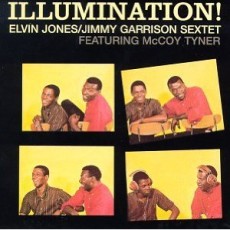
He and drummer Elvin Jones have been credited with eliciting more forceful playing than usual from Coleman on the albums “New York Is Now” and “Love Call”. Before his passing he would play with Kenny Dorham, Curtis Fuller, Jackie McLean, Lee Konitz, Hampton Hawes, Benny Golson and Tony Scott. Bassist Jimmy Garrison passed away on April 7, 1976.
More Posts: bass
Daily Dose Of Jazz…
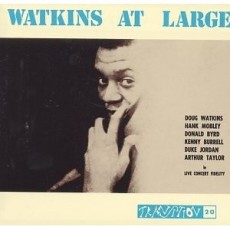
Douglas Watkins was born on March 2, 1934 in Detroit Michigan. After gaining experience and a reputation as one of many very talented jazzmen on the local Detroit scene, Watkins began touring with James Moody in 1953 followed by a stint with the Barry Harris Trio. In 1954 he settled in New York City and was an original member of the Jazz Messengers from 1955 – 56.
Doug went on to spend a year with Horace Silver and then freelanced with a who’s who list of the hard boppers such as Art Farmer, Kenny Burrell, Phil Woods and Hank Mobley. In 1956 at just 21 years old he was a sideman on Sonny Rollins’ “Saxophone Colossus” alongside Max Roach and Tommy Flanagan, showcasing examples of his fine work on Blue 7 and St. Thomas.
In 1958 Watkins joined Donald Byrd for a European tour, taking up extended residence at Le Chat Qui Peche, a jazz club on Paris’ Left Bank. Along with Byrd, tenor saxophonist Bobby Jaspar, pianist Walter Davis, Jr. and drummer Art Taylor, Watkins made two albums with Byrd during this period, one recorded in the club and another at a formal concert featuring Byrd’s quintet. In 1961 he joined Charles Mingus’ group when Mingus temporarily ventured onto the piano stool, producing such gems as “Oh Yeah!!!” and “Tonight At Noon”.
Doug was known for his superb walking tone and distinct phrasing that was right on the beat, forming an organic, indivisible relationship with his instrument as he swayed with it in perfect time. Throughout his short but prolific career Watkins produced only two sessions as a leader but became the bassist of choice when his cousin by marriage, Paul Chambers was unavailable. He appeared on over 350 recordings working with Red Garland, Yusef Lateef, Philly Joe Jones, Bill Hardman, Gene Ammons and Lee Morgan just to name a few giants.
The hard bop jazz bassist Doug Watkins died in a head-on automobile crash on February 5, 1962 when he fell asleep behind the wheel while driving from Arizona to San Francisco to play a gig with Philly Joe Jones. He was just 27 years old but his legacy as a superb musician, unselfish and enabling ensemble player and a bassist-walker with few peers remains today.
More Posts: bass
Daily Dose Of Jazz…
Donald Rafael Garrett was born on February 28, 1932 in El Dorado, Arkansas but was raised in Chicago, Illinois. While in high school he first studied clarinet and then bass under Captain Walter Dyett. By the late 50s he was working closely with Muhal Richard Abrams, becoming a member of his Experimental Band in the Sixties.
It was during this time that he worked with Ira Sullivan, Eddie Harris, Dewey Redman and Rahsaan Roland Kirk but by the mid-sixties he relocated to San Francisco and formed a band called Sound Circus. He stayed on the West coast into the 70s working with such jazz greats as Archie Shepp, Sonny Rollins, Pharoah Sanders and numerous more including performing and recording on four John Coltrane albums – Om, Kulu Se Mama, Selflessness and Live In Seattle.
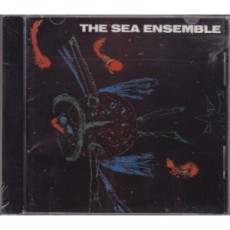
In 1971 he formed the Sea Ensemble with Zusaan Kali Fasteau and embarked on a world tour for the next several years, the duo funding their travels with Fasteau giving music lessons and Garrett skillfully making bamboo flutes. Throughout his career he studied Turkish music, added flute to his instrumental repertoire, became an educator, writer, researcher and continued to perform and record with Johnny Griffin, Sonny Stitt, Joe Henderson, Billy Bang and other great jazz musicians.
Donald Garrett, multi-instrumentalist best known for his work with John Coltrane and the free jazz musicians and improvisers of the 60s and 70s, passed away on August 17, 1989.
More Posts: saxophone

Daily Dose Of Jazz…
Harold de Vance Land was born on February 18, 1928 in Houston, Texas but was raised in San Diego, California. He started playing tenor saxophone at 16 and made his first recording as leader of the Harold Land All-Stars in 1949 for Savoy Records. By 1954 he had joined the Clifford Brown/Max Roach Quintet but due to family problems he moved to Los Angeles in 1955. There he led his own groups, played with Curtis Counce, and co-led groups with Bobby Hutcherson, Blue Mitchell and Red Mitchell.
Harold developed his hard bop playing with the Max Roach/Clifford Brown band into a personal, modern style. His tone was strong and emotional, yet displayed a certain fragility that made him easy to recognize. From the 1970s onwards his style showed the influence of John Coltrane.
In the early 1980s through to the early 1990s he worked regularly with the Timeless All Stars, a group consisting of Cedar Walton, Buster Williams, Billy Higgins, Curtis Fuller, and Bobby Hutcherson and sponsored by the Timeless jazz record label. Land also toured with his own band during this time, often including his son on piano and usually featuring Bobby Hutcherson and Billy Higgins as well. During these years he played regularly at Hop Singh’s in Marina Del Ray in the L.A area and the Keystone Korner in San Francisco.
As an educator he was a professor at the University of California, Los Angeles joining the Jazz Studies Program in 1996 teaching instrumental jazz combo. Tenor saxophonist Harold Land became a major contributor to hard bop and post bop jazz history, passing away from a stroke on July 27, 2001 at age 73.
More Posts: saxophone