

Daily Dose Of Jazz…
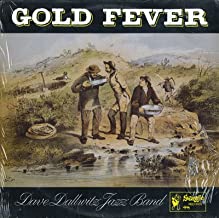
David Friedrich Dallwitz was born on October 25, 1914 in Freeling, South Australia. He studied violin as a child and after moving with his family to Adelaide, South Australia in 1930, he developed an aptitude for jazz piano. Beginning in 1933 for two years he studied concurrently at the South Australian School of Art and the North Adelaide School of Fine Art.
He led the Southern Jazz Group, a Dixieland band that performed at the first Australian Jazz Convention. Abandoning jazz for a period, he studied at the Elder Conservatorium of Music, composing symphonic and chamber music and taking up bassoon and cello. He became involved in composing and arranging music for revues, leading to the formation of the Flinders Street Revue Company, for which he also directed and played piano.
Returning to jazz in 1970, he resumed recording. He worked with Australian progressive musicians such as John Sangster, Bob Barnard, and Len Barnard. He led the Dave Dallwitz Ragtime Ensemble.
Pianist, bandleader, composer, and arranger, painter, and art teacher Dave Dallwitz, who led jazz, Dixieland and ragtime bands, passed away on March 24, 2003 in Adelaide after finishing the artwork for his album The Dave Dallwitz Big Band live at Wollongong, December 1984.

More Posts: arranger,bandleader,composer,educator,history,instrumental,jazz,music,painter,piano
Daily Dose Of Jazz…
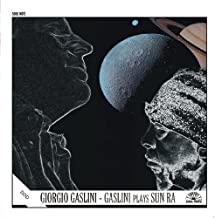
Giorgio Gaslini was born on October 22, 1929 in Milan, Italy and began performing aged 13 and recorded with his jazz trio at 16. In the 1950s and 1960s, Gaslini performed with his own quartet. He was the first Italian musician mentioned as a “new talent” in the Down Beat poll and the first Italian officially invited to the New Orleans Jazz Festival in 1976-77. He collaborated with leading American soloists, such as Anthony Braxton, Steve Lacy, Don Cherry, Roswell Rudd, Max Roach, but also with the Argentinian Gato Barbieri and Frenchman Jean-Luc Ponty.
Adapting the compositions of Albert Ayler and Sun Ra for solo piano, issued on the Soul Note label, he also composed the soundtrack of Michelangelo Antonioni’s La Notte, The Night, in 1961. In the early Seventies, he was the first holder of jazz courses at the Santa Cecilia Academy of Music in Rome.
As to contemporary music, he composed symphonic works, operas and ballets represented at the Scala Theatre in Milan and other Italian theatres. In addition from 1970 to 1977 he scored nine films, including Your Hands On My Body, Cross Current, and Kleinhoff Hotel. From 1991 to 1995, Gaslini composed works for Carlo Actis Dato’s Italian Instabile Orchestra.
Pianist, composer and conductor Giorgio Gaslini passed away on July 29, 2014 at age 84 in Borgo Val di Taro, Parma, Italy, where he had been living for years together with his longtime wife and fourteen dogs and cats.
More Posts: composer,conductor,history,instrumental,jazz,music,piano
Daily Dose Of Jazz…
Skip Hall was born Archie Hall on September 27, 1909 in Portsmouth, Virginia and studied piano under his father. He lived in New York from age eight and in the late twenties, he relocated to Cleveland, Ohio where he led his own band for most of the 1930s.
He worked as an arranger on contract, arranging for Jay McShann from 1940 to 1944. During World War II he played with Don Redman and in 1943 he entered military service and played in a band while stationed in England.
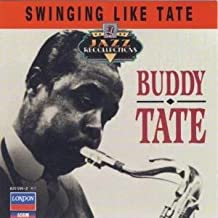
He would eventually work with Hot Lips Page around the year 1945 and then joined the Sy Oliver band, who was his brother-in-law. Following this he worked with Wynonie Harris, Thelma Houston, and Jimmy Rushing before joining Buddy Tate’s group in 1948. He worked with Tate for twenty years both as a performer and arranger.
In the 1950s and 1960s, he performed with Dicky Wells, Emmett Berry, and George James, as well as working solo and with his own small groups. Arranger, pianist, and organist Skip Hall passed away in November 1980, Ottawa, Ontario, Canada.

More Posts: arranger,bandleader,history,instrumental,jazz,music,organist,pianist
Daily Dose Of Jazz…
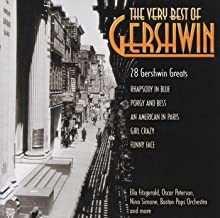
George Gershwin was born Jacob Bruskin Gershowitz on September 26, 1898 in Brooklyn, New York. When his parents bought his older brother Ira a piano, it was the younger George who spent most of his time playing it. He studied piano under Charles Hambitzer and composition with Rubin Goldmark, Henry Cowell, and Joseph Brody.
He began his career as a song plugger but soon started composing Broadway theater works with his brother Ira Gershwin and with Buddy DeSylva. In 1919 he scored his first big national hit with his song Swanee, with words by Irving Caesar.
In the late 1910s, Gershwin met songwriter and music director William Daly and the two collaborated on the Broadway musicals Piccadilly to Broadway in 1920 and For Goodness’ Sake in 1922, and jointly composed the score for Our Nell the following year. This was the beginning of a long friendship and collaboration as Daly was a frequent arranger, orchestrator, and conductor of Gershwin’s music.
Moving to Paris, France intending to study with Nadia Boulanger. Refusing him, he subsequently composed An American in Paris, before returning to New York City and writing Porgy and Bess with Ira and DuBose Heyward. Unfortunately for them, it was initially a commercial failure, however, years later it came to be one of the most important American classic operas of the twentieth century.
After the commercial failure of Porgy and Bess, George moved to Hollywood, California. In 1936, with a commission from RKO Pictures, he wrote the music for the Fred Astaire/Ginger Rogers film Shall We Dance. His extended score, which would marry ballet with jazz in a new way, runs over an hour in length. It took Gershwin several months to compose and orchestrate.
Gershwin had a ten-year affair with composer Kay Swift, whom he frequently consulted about his music. The two never married, but he titled his 1926 musical Oh, Kay for her. His compositions have been adapted for use in film and television, with several becoming jazz standards recorded and covered in many variations.
Composer and pianist George Gershwin, whose compositions spanned both popular and classical genres, passed away at 38 from a malignant brain tumor on July 11, 1937 in Los Angeles, California.
Daily Dose Of Jazz…
William Overton Smith was born on September 22, 1926 in Sacramento, California and grew up in Oakland, California where he began playing clarinet at the age of ten. Putting together a jazz group to play for dances at 13, by 15 he joined the Oakland Symphony. Idolizing Benny Goodman, after high school and a brief cross-country tour with a dance band, he ended his romance for the road. Giving notice when the band reached Washington, D.C., he was encouraged by an older band member to get the best education he could, so he headed to New York.
He started his formal music studies at the Juilliard School of Music, playing in New York jazz clubs at night. Uninspired at Juilliard, he returned to California after hearing the music of Darius Milhaud, who was then teaching at Mills College in Oakland. At Mills, Smith met pianist Dave Brubeck, with whom he often played, was a member of the Dave Brubeck Octet, and later occasionally subbed for saxophonist Paul Desmond in the Dave Brubeck Quartet. Brubeck’s 1960 album Brubeck à la mode that featured ten of his own compositions. Rejoining Brubeck’s group in the 1990s.
Bill went on to study composition with Roger Sessions at the University of California, Berkeley, where he was graduated with a bachelor’s and a master’s degree. He won the Prix de Paris, study at the Paris Conservatory, was awarded the prestigious Prix de Rome in 1957, and spent six years in Italy. After a teaching stint at the University of Southern California, he went on to a thirty-year career at the University of Washington School of Music in Seattle, Washington. He co-led the forward-thinking Contemporary Group, first with Robert Suderburg, and then with trombonist Stuart Dempster, from 1966 to 1997.
Clarinetist and composer Bill Smith, who recorded in jazz, classical and third stream genres, passed away at age 93 in his home from complications of prostate cancer on February 29, 2020.
More Posts: bandleader,clarinet,educator,history,instrumental,jazz,music