

Daily Dose Of Jazz…
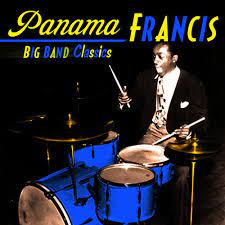
Panama Francis was born David Albert Francis on December 21, 1918 in Miami, Florida to a Haitian father and an English property-owning mother in the Bahamas. He began playing the drums even before attending school and initially played in marching bands and local drum and bugle corps.
His first professional playing was in the 1930s as part of George Kelly’s band from 1934 to 1938. He then became a member of the Florida Collegians in 1938. After his move to New York City that year, he worked with Tab Smith, Billy Hicks, and Roy Eldridge before the 1940s. Francis acquired his nickname from Eldridge at a moment when he was wearing a panama hat and Eldridge could not remember his new drummer’s name.
Joining Lucky Millinder’s big band in 1940, he often played at the Savoy Ballroom. After leaving Millinder he was with Willie Bryant’s band in 1946 and then Cab Calloway from 1947 to 1952. He performed in three short films alongside the latter. For much of the 1950s, Panama was a studio musician in New York, accompanying the likes of Bobby Darin, the Four Seasons, the Platters, Dion DiMucci, Neil Sedaka, and Jackie Wilson.
He went on to tour with Dinah Shore, then moved to California where he struggled to find work. The early Seventies saw him touring Japan with Sam “The Man” Taylor, then appeared on film in 1972, in Lady Sings the Blues. Back in New York in 1973, Francis was part of Sy Oliver’s nonet for two years and during this period he played jazz festivals and toured internationally with other bands.
He revived the Savoy Sultans jazz and dance band in 1979, and he appeared regularly at the Rainbow Room in New York City for eight years from 1980. Panama became drummer in the Benny Goodman Quartet for concerts in 1982. He appeared in the 1994 film The Statesmen of Jazz as a member of the Statesmen of Jazz.
Over his career he recorded with Ray Bryant, Eddie Barefield, Arnett Cobb, Earl Hines, Ray Conniff, Eubie Blake, Oscar Brown Jr., Dorothy Donegan, Roy Eldridge, Dizzy Gillespie and numerous others.Drummer Panama Francis, who mainly played swing jazz, transitioned in Orlando, Florida on November 13, 2001 following a stroke at age 82.

More Posts: bandleader,drums,history,instrumental,jazz,music
Daily Dose Of Jazz…
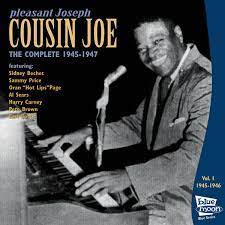
Cousin Joe was born Pleasant Joseph on December 20, 1907 in Wallace, Louisiana. He worked at Whitney Plantation throughout his childhood. Until 1945, he toured Louisiana, but that year he was asked to take part in the King Jazz recording sessions organized by Mezz Mezzrow and Sindey Bechet.
In the 1970s, Cousin Joe toured extensively throughout the United Kingdom and Europe, both individually and as part of the American Blues Legends ’74 revue organised by Big Bear Music. He also recorded the album Gospel-Wailing, Jazz-Playing, Rock’n’Rolling, Soul-Shouting, Tap-Dancing Bluesman From New Orleans for Big Bear.
Vocalist and pianist Cousin Joe transitioned in his sleep from natural causes in New Orleans, Louisiana at the age of 81 on October 2, 1989.
More Posts: bandleader,history,instrumental,jazz,music,piano,vocal

Daily Dose Of Jazz…
Eric Marienthal was born on December 19, 1957 in Sacramento, California but moved with his family to San Mateo, California when he was two years old. He was taught music while in school and picked up the saxophone in the fourth grade. His father bought him a $400 Selmer saxophone and enrolled him in Corona Del Mar High School. Throughout his education, he learned to play guitar, flute, clarinet and piano.
After graduating from high school he studied saxophone at the Berklee College of Music. By the time he left Berklee, Eric had achieved the highest proficiency rating given by the school. He began his professional career in 1980 with New Orleans trumpeter Al Hirt. Heading west he settled in Los Angeles, California and became a member of the Chick Corea Elektric Band. He recorded six albums with that band and two of them won Grammy Awards.
Marienthal has also written instructional books, including Comprehensive Jazz Studies & Exercises, The Ultimate Jazz Play Along, and The Music of Eric Marienthal. He has made instructional videos, Play Sax From Day One, Modern Sax and Tricks of the Trade. He occupies the lead alto chair of Gordon Goodwin’s Big Phat Band, playing alto saxophone, soprano saxophone, flute, and piccolo.
Grammy Award-nominated alto saxophonist Eric Marienthal continues to perform and record.
More Posts: bandleader,flute,history,instrumental,jazz,music,piccolo,saxophone
Daily Dose Of Jazz…
William Frank Reichenbach Sr. was born on December 18, 1923 in Washington, D.C. and started his musical career even before he graduated from the McKinley Tech High School. During World War II, he played in a band of the Navy before he toured with the big bands of Tommy Dorsey, Jimmy Dorsey, and Art Mooney. Later he worked in the jazz clubs of his hometown, where he accompanied Frank Sinatra, Patti Page, Teddy Wilson, and Zoot Sims.
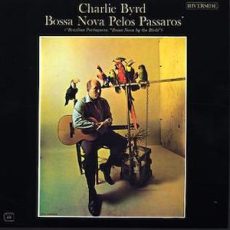
Charlie Byrd hired Reichenbach as an additional drummer for the Stan Getz album Jazz Samba, recorded in 1962. This recording provoked a wave of enthusiasm for bossa nova in the United States. That same year he replaced Buddy Deppenschmidt in the Byrd trio, and stayed as a member for twelve years. Departing from Byrd, he returned to work in Washington D.C., as the house drummer at the Blues Alley.
Drummer and percussionist Bill Reichenbach, who co-developed the jazz-samba drumming style, transitioned following a series of strokes in Los Angeles, California, at the age of 84 on May 16, 2008.
More Posts: bandleader,drums,history,instrumental,jazz,music,percussion
Daily Dose Of Jazz…
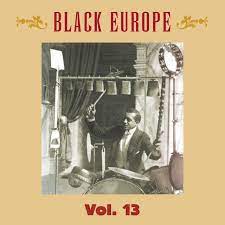
Louis A. Mitchell was born December 17, 1885 in Philadelphia, Pennsylvania and began performing in vaudeville revues and minstrel shows from around the turn of the century, playing drums and bandoline. After a move to New York City in 1912, he founded his own group, the Southern Symphonists’ Quartet.
He sang and drummed for James Reese Europe in 1918, and the following year founded a new group, which he called Louis Mitchell’s Jazz Kings. By the end of the decade, Mitchell began touring the United States, as well as, Europe, concentrating on the United Kingdom and France. He did solo percussion shows in addition to ensemble programs, and his drum solos were greeted harshly by French audiences. Nevertheless, his ensemble spent five years as the house band of the Casino de Paris.
He recorded for Pathe Records in 1922 and 1923, with Sidney Bechet playing with him at this time, however, Bechet did not appear on the recordings. Louis remained in France until 1930, branching into restaurant and nightclub management in addition to music. He renamed one of his clubs Chez Florence due to the popularity of performer Florence Embry Jones.
Moving back to the United States in 1930 after the failure of The Plantation, his last club, but he played little in his last decades. Drummer and bandleader Louis Mitchell transitioned on September 12, 1957.
More Posts: bandleader,drums,history,instrumental,jazz,music