

Daily Dose Of Jazz…
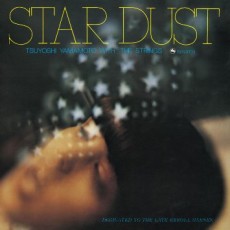
Tsuyoshi Yamamoto was born on March 23, 1948 in Niigata, Japan. He started to play the piano when he was in primary school. In junior high school, he played the trumpet. His interest in jazz began when he first heard Art Blakey’s tunes in the French movie, “Les Liaisons Dangereuses”. It inspired him to return to the piano, to perfect his technique.
Yamamoto was largely self-taught as a pianist, although he did have piano lessons as a child. He attended Nihon University and as a student there, he played professionally, first as an accompanist to pop singer Micky Curtis and the Samurais touring Europe in 1967.
In 1973 Tsuyoshi formed his own band while polishing his piano skills and gleaning influence from Bobby Timmons, Wynton Kelly, Red Garland and Randy Weston. The next year, he became house pianist at Misty, a Tokyo jazz club and recorded his debut as leader.
He played major international festivals in the late 1970s. While living in New York for a year he performed with Dizzy Gillespie, Carmen McRae, Sam Jones, Billy Higgins, Sonny Stitt and Elvin Jones (his favorite drummer) among others. He has recorded fourteen albums as a leader and sideman and continues to perform and record.
Tsuyoshi Yamamoto has a very melodic technique and phrasing with a use of block chords in ballads. The composer and pianist continues to perform and record.

Jazz Is Global – Share
More Posts: piano
Daily Dose OF Jazz…
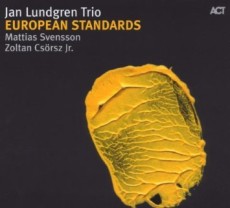
Jan Lundgren was born on March 22, 1966 in Olofstrom, Sweden and raised in Ronneby in the south of the country. He began learning the piano at the age of five and moved to Malmo in 1986 to study at the Academy of Music. He graduated in 1990, later becoming a lecturer at the Academy.
His group, the Jan Lundgren Trio broke through in 1997 with the album Swedish Standards, winning Orkesterjournalen’s Golden Record prize in the same year. In 2007, he became the first Scandinavian jazz pianist to be named an International Steinway Artist.
Since the early ‘90s, Jan has worked with a variety of Sweden’s leading artists both in the studio and/or at concerts such as Povel Ramel, Putte Wickman, Bengan Janson, Jason Diakité, Peter Asplund and Monica Zetterlund to name a few. He has also worked with Johnny Griffin, Mark Murphy, Herb Geller, Joe LaBarbera, Scott Hamilton, Andy Martin, Bill Perkins, Peter Washington, Billy Drummond, Deborah Brown, Lee Konitz, and Stacey Kent among numerous others.
Lundgren has recorded some 40 discs as a leader, under his own name since 1994 on labels including ACT, Fresh Sound, Marshmallow, Sittel, Four Leaf Clover, Volenza, Alfa, Gemini and Bee Jazz. As a sideman, Lundgren has been involved in dozens of other recordings across a broad range of labels.
In 2010, together with Thomas Lantz, Jan founded the annual Ystad Sweden Jazz Festival, for which he is Artistic Director. YSJF, has hosted Quincy Jones, Hugh Masekela, Dee Dee Bridgewater, Hiromi, Pat Martino, Youn Sun Nah, Benny Golson, Enrico Pieranunzi, Tomasz Stanko, Kenny Barron, Elina Duni, Fabrizio Bosso, Kurt Rosenwinkel, Bobo Stenson, Nils Landgren, Benny Green and Eliane Elias, Charles Lloyd, John Scofied, Abdullah Ibrahim, Dianne Schuur, Joshua Redman, Enrico Rava and Roy Hargrove. Pianist Jan Lundgren continues to perform, record and tour.
Put A Dose In Your Pocket
More Posts: piano

Daily Dose Of Jazz…
Bill Anschell was born on March 12, 1959 in Seattle, Washington and after leaving high school he went on to study for two years at Oberlin College, then transferring to Wesleyan University in Connecticut, where he graduated Phi Beta Kappa with a degree in Music. At Wesleyan, he worked closely with saxophonist Bill Barron and studied semi-privately with South Indian mridangum master T Ranganathan, kindling a passion for rhythmic experimentation that has driven his music ever since.
After leading the life of a jazz vagabond for several years, Bill settled in Atlanta in 1989. He was initially drawn there by the opportunity to serve as Jazz Coordinator for the Southern Arts Federation (SAF), that he fired up virtually from scratch. He launched a host of high-profile programs, published a book on grant writing, and created “JazzSouth,” an internationally syndicated radio show. At night he dove headlong into the city’s thriving jazz scene, working as a sideman with various groups and leading his own trio.
By 1992, Anschell’s left SAF, continuing to produce “JazzSouth” out of his home while focusing on playing and composing. Ascended the jazz ranks he led his trio at major festivals, became a first-call accompanist for visiting jazz greats and enjoyed a lengthy association with vocalist Nnenna Freelon, serving as her pianist, arranger and musical director. His piano work and arrangements were featured throughout Freelon’s 1996 Concord release “Shaking Free,” nominated for a Grammy as the year’s best jazz vocal recording.
Bill has played and/or recorded with a host of jazz greats including Richard Davis, Ron Carter, Benny Golsen and Russell Malone. In 2001, he was selected by the American Composers Forum for its “Composer-in-the-Schools” program; his residency included a commissioned piece for chamber orchestra. Since 2003, his original compositions have been heard on NBC’s “The West Wing,” CBS’s “The Defenders” and “NCIS: LA,” and HBO’s “The Wire.”
He has performed with the symphony, ventured into electronica, is well-known as a jazz humorist, writing jazz vignettes and a monthly jazz etiquette column. His satirical essay, “Careers in Jazz,” is the all-time most-read piece on leading jazz website allaboutjazz.com, and was prominently featured in a Wall Street Journal story on jazz audiences. He has won numerous awards such as 2005 Northwest Jazz Instrumentalist of the Year 2006 & 2001; Northwest Acoustic Jazz Ensemble of the Year (Bill Anschell Trio) 2010 and Northwest Jazz Recording of the Year for his 2011 “Figments”. He continues to perform, tour and record.
Inspire A Young Mind
More Posts: piano
Daily Dose Of Jazz…
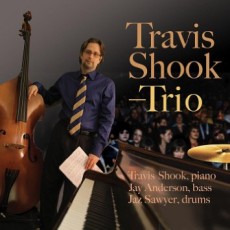
Travis Shook was born on March 10, 1969 in Oroville, California and started learning to play the piano at age seven. His family moved to Olympia, Washington when he was ten, spending his adolescent years in the Pacific Northwest. For a period of time he played rock guitar but soon realized jazz improvisation was his passion. At eighteen he enrolled at William Patterson College and studied under Mabern. After graduating he returned to Washington and joined bassist Buddy Catlett’s band where he learned a lot about the history of jazz.
In 1991 he won the Jacksonville Festival’s Great American Piano Competition that led to a contract with Columbia Records/Sony Music. Two years later he moved to New York City and recorded his debut with a quartet that included tony Williams and Bunky Green. Though receiving critical acclaim both in the U.S. and France for this first effort, it was a short-lived relationship when Sony purged a large percentage of the Columbia jazz roster upon acquiring the label in 1993.
After spending some time in obscurity after being attacked by New York Times critic Peter Watrous who criticized one of his performances, he entered a dark period in his life: alcoholism. A year later he got picked up by Betty Carter and went on tour through Europe, but he sunk deeper and added drugs to his plate of demons. Unemployable, he dropped out of the public eye for a number of years. Travis met, moved in with and ultimately married jazz singer Veronica Nunn who helped him overcome his demons and since 1998 he has been sober.
In 1999 Shook and his wife started their own record label, Dead Horse Records, which has released four recordings to date. Over the years he has performed with Reggie Workman, Eddie Harris, Joe Lovano, toots Thielemans, Rufus Reid, Chuck Israels, Ernestine Anderson, Branford Marsalis, Benny Golson and Clifford Jordan as well as Sonny Simmons, Michael Franks, Gino Vanelli, Bob Hope and Chris Botti among others.
His influences were Ahmad Jamal, McCoy Tyner, Duke Ellington, Harold Mabern, Herbie Hancock and Bill Evans but also John Coltrane, Miles Davis and Elvin Jones.Pianist Travis Shook continues to perform and record while building the catalogue of Dead Horse Records.
Jazz Is Global – Share
More Posts: piano
Daily Dose Of Jazz…
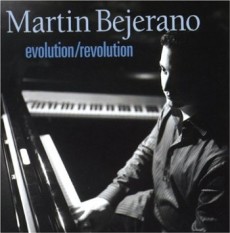
Martin Bejerano was born in Miami, Florida on March 9th of Afro-Cuban heritage and began his professional music career at age fifteen, when he began playing George Gershwin’s “Rhapsody in Blue” concerto with the Mexican-American Bi-National Symphony while still in high school. He went on to graduate from the New World School of the Arts, Florida State University and the University of Miami with a Masters in jazz performance.
In 2000 Martin moved to New York City and in less than a year joined drummer Roy Haynes’ band and two years later was a part of guitarist Russell Malone’s quartet. He released his debut album as leader, titled Evolution/Revolution in 2007, followed by Potential Energy in 2013. He has done sideman duties as well on six projects.
In 2010 he was awarded a Chamber Music America commission for a new jazz work, has had several compositions published in Ignacio Berroa’s “Groovin’ in Clave” instructional drum book and has attended the Thelonious Monk Institute Jazz Colony.
Martin has also performed with Kenny Garrett, James Moody, Lonnie Plaxico, Jimmy Heath, Ignacio Berroa, Mingus Big Band, Marcus Printup, Marcus Strickland, and even trading choruses with the legendary Chick Corea. In between performing and recording with the Haynes and Malone bands, pianist Martin Bejerano is an Assistant Professor of jazz piano at the University of Miami Frost School of Music.
Put A Dose In Your Pocket
More Posts: piano