

Daily Dose Of Jazz…
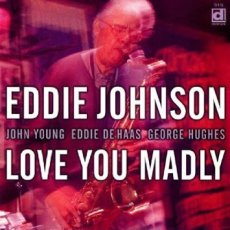
Eddie Johnson was born Edwin Lawrence Johnson on December 11, 1920 in Napoleonville, Louisiana. Gleaning his style from the pre-war tenor greats like Coleman Hawkins and Lester Young, he combined the big brawling sound with romantic lyricism to come into his own.
Settling in Chicago in 1941 the tenor saxophonist freelanced around town until joining Cootie Williams and His Orchestra in 1946, appearing on several Capitol and Majestic recordings. Leaving Williams to join the Louis Jordan outfit he would go on to play with Ella Fitzgerald and Duke Ellington, and regretfully turning down an offer to join the latter’s orchestra.
By the end of the 40’s Eddie retired from music, took a 9-5 job with the city to raise his family and didn’t pick up his horn until some 30 years later when he retired to music. He started playing at Andy’s in Chicago with a quintet and become a member of the Chicago Jazz Orchestra.
He soon became one of the city’s enduring tenor icons alongside Fred Anderson and Von Freeman. As a leader he released two albums, “Indian Summer” on the Nessa label and “Love You Madly” for Delmark. Tenor saxophonist Eddie Johnson passed away on April 7, 2010 at age 89.

Put A Dose In Your Pocket
More Posts: saxophone
Daily Dose Of Jazz…
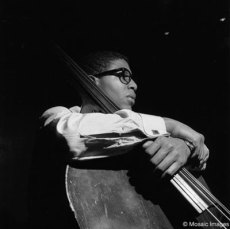
Bob Cranshaw was born Melbourne R. Cranshaw on December 10, 1932 in Evanston, Illinois and started on drums and piano before switching to the tuba and bass in high school. He was a founding member of Walter Perkins’ MJT +3 band in 1957 and it was Perkins who recommended Bob to Sonny Rollins as a replacement bassist for a gig at the first Playboy Jazz Festival in Chicago in 1959.
His long association with Rollins has spanned over five decades with their first recording of the album The Bridge in 1962. From the heyday of Blue Note Records to the present, though never a leader, Cranshaw has a long list of accolades performing and recording with such giants as Lee Morgan, Ella Fitzgerald, Dexter Gordon, Duke Pearson, Grant Green, Coleman Hawkins, Jimmy Heath, Joe Henderson, Shirley Scott, Horace Silver, Wayne Shorter, Hank Mobley, Wes Montgomery, Thelonious Monk, Oscar Peterson and the list goes on and on.
One of the early jazz bassists to trade his upright bass for an electric bass, Bob was criticized for this by jazz purists, who either never knew or cared that he was forced to switch due to a back injury incurred in a serious auto accident. Never stopping, he served as the sole session bassist for Sesame Street and The Electric Company and played on all songs, tracks, buttons and cue recorded by The Children’s Television Workshop under the tenure of songwriter and composer Joe Raposo.
Cranshaw has performed on Broadway, on hundreds of television shows such as the David Frost Show band under Dr. Billy Taylor and the original 70s Saturday Night Live, has worked on film and television scores, and appeared on The Blue Note Story documentary of the famous label. He has also recorded for Vee Jay, Prestige and other labels throughout his career as a sought after sideman. He remains an active performer and member of the New York Musicians Union.
More Posts: bass
Daily Dose Of Jazz…
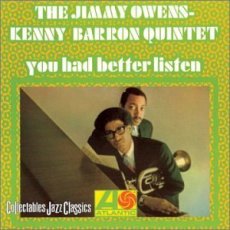
Jimmy Owens was born December 9, 1943 in New York City. In the 1960s, he was a member of the hybrid classical and rock band Ars Nova, and then became a member of the New York Jazz Sextet playing with at times were Sir Roland Hanna, Ron Carter, Billy Cobham, Benny Golson, Hubert Laws, and Tom McIntosh.
Between 1969 and 1972, Jimmy was a sideman on the David Frost Show under musical director Dr. Billy Taylor. During this stint he played alongside Frank Wess, Seldon Powell Barry Galbraith and Bob Cranshaw.
As an educator Jimmy is an active member of the jazz education community, sitting on the board of the Jazz Foundation of America and the Jazz Musicians’ Emergency Fund to help individual musicians.
Over the course of his career the trumpeter, composer, arranger, lecturer and music education consultant has performed and recorded as a leader and sideman with Lionel Hampton, Charles Mingus, Archie Shepp, Joe Zawinul, Gerald Wilson, Duke Ellington, Hank Crawford, Dizzy Gillespie, Count Basie and Herbie Mann among many others. Since 1969, he has led his own group, Jimmy Owens Plus.
Give The Gift Of Knowledge
More Posts: flugelhorn,trumpet
Daily Dose Of Jazz…
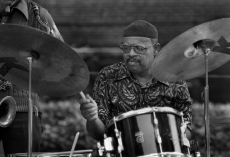
Eddie Gladden was born on December 6, 1937 in Newark, New Jersey and became interested in drums before he was ten years old. He would bet on the furniture around the house until his mother bought him a drum set. He attended Newark’s Arts High School, majored in music, and eventually got into different groups.
As an up-and-comer, Gladden held down a few jobs outside music but by his early ’20s he was working professionally around Newark. He played jam sessions, gigged and recorded with Larry Young, Freddie Roach, Woody Shaw, Johnny Coles, Connie Lester and Buddy Terry. By 1972 he was touring with James Moody, then worked with Kenny Dorham, Jimmy McGriff, Shirley Scott, Richie Cole and Horace Silver prior to joining Dexter Gordon.
Performing, recording and touring worldwide with Gordon was Eddie’s crowning career achievement with performances on such classic albums as “Live at Carnegie Hall” and “Nights at the Keystone”. Suffering a stroke in 1988 he was sidelined from music and it took several years to recuperate but finally returning to play occasionally. His list of who’s who includes but not limited to Eddie Jefferson, Cecil Payne, David “Fathead” Newman, Jimmy McGriff, Richard “Groove” Holmes, Kirk Lightsey, Clifford Jordan, Albert Dailey and Jimmy Ponder to name a few.
Eddie Gladden, the powerful, fiery and creative drummer who was easy to work with, passed away of a heart attack on September 30, 2003.
Inspire A Young Mind
More Posts: drums
Daily Dose Of Jazz…
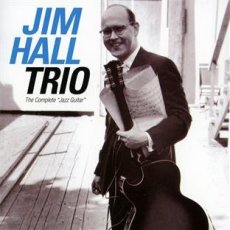
Jim Hall was born James Stanley Hall on December 4, 1930 in Buffalo, New York. Learning to play guitar as a child, he was educated at the Cleveland Institute of Music. After his matriculation he moved to Los Angeles, California and began to attract national then international attention in the late 50s. It was during this period that he further studied classical guitar with Vincente Gomez.
Hall would play with the Chico Hamilton Quintet and Jimmy Guiffre in the Fifties, Ella Fitzgerald in the early 60s, then played with Ben Webster, Hampton Hawes, Bob Brookmeyer, John Lewis, Zoot Sims, and Lee Konitz, among others. A move to New York led him to work with Sonny Rollins and Art Farmer and his live and recorded collaborations there with Bill Evans, Paul Desmond and Ron Carter have become legendary.
Formal recognition as a composer came in 1997, when Jim won the New York Jazz Critics Circle Award for Best Jazz Composer/Arranger. His pieces for string, brass, and vocal ensembles can be heard on his “Textures and By Arrangement” recordings. He has been commissioned to compose for guitar and orchestra, awarded an NEA Jazz Masters Fellowship, was one of the first musicians to join the fan-funded label ArtistShare.
Hall changed the way jazz guitar sounded, with his innovation, composition, and improvisation. Apart from Metheny, he influenced other contemporary artists such as Bill Frisell, Mick Goodrick, John Scofield, and John Abercrombie. He continued to perform, tour and record up until he passed away in his sleep on December 10, 2013 in his Manhattan apartment.
Jazz Is Global – Share
More Posts: guitar