
Daily Dose Of Jazz…
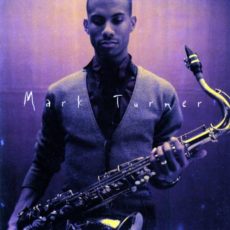
Mark Turner was born November 10, 1965 in Fairborn, Ohio, and raised in the small Southern California town of Palos Verdes Estates. His original intent was to become a commercial artist but in elementary school he played the clarinet, followed by the alto and tenor saxophones in high school. He attended California State University, Long Beach in the 1980s playing in the jazz ensembles, and then transferred to and graduating from Berklee College of Music in 1990.
Moving to New York city, Turner worked at Tower Records for an extended period before working full-time as a jazz musician. His debut release Yam Yam on the Criss Cross label hit the airwaves in 1995 and since he has released seven more for Criss Cross, Waner, Fresh Sound and ECM record labels. He is a member of the trio Fly, with bassist Larry Grenadier, and drummer Jeff Ballard and have released three albums.
Late 2008 Mark was off the jazz scene when a power saw injury injured two fingers on one of his hands sidelined him. Fortunately by late February the next year he was performing again with the Edward Simon Quartet at the Village Vanguard. In 2014 he released his first album as a leader in thirteen years featuring the talents of trumpeter Avishai Cohen, bassist Joe Martin, and drummer Marcus Gilmore.
He has worked with Gilad Hekselman’s Quartet, drummer Billy Hart‘s Quartet, recorded extensively with guitarist Kurt Rosenwinkel, saxophonist David Binney, and pianist Aaron Goldberg, as well as Ryan Kisor, Jonny King, Jimmy Smith, Jon Gordon, George Colligan, Seamus Blake, Lee Konitz, Joshua Redman, Matthias Lupri, Jaleel Shaw, Omer Avital, SF Jazz Collective, Yelena Eckemoff, George Mraz, Joe Locke and Tom Harrell among others. Considered one of the most influential tenor saxophonists of his generation, Mark Turner continues to perform, record and tour.

Uplift Someone’s World

More Posts: saxophone
Daily Dose Of Jazz…
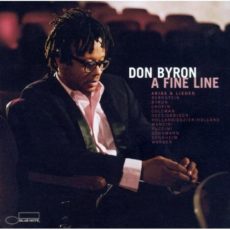
Donald Byron was born November 8, 1958 in The Bronx in New York City. His mother was a pianist and his father played bass in calypso bands. As well as listening to jazz recordings by Dizzy Gillespie, Miles Davis and others, he was exposed to other styles through trips to the ballet and symphony concerts.
He studied clarinet with Joe Allard and studied music at the New England Conservatory in Boston with George Russell. While in Boston, Byron performed and recorded with the Klezmer Conservatory Band, founded by NEC faculty member Hankus Netsky.
A gifted performer on clarinet, bass clarinet and saxophone, but on many of his albums he subordinates his own playing to the exploration of a particular style. Don is representative of a new generation of conservatory-trained jazz musicians who explore and record in a rich array of styles. His debut album in 1992, Tuskegee Experiments, bring classical avant garde and jazz improvisation together, while his albums like Ivey Divey are a more straight-ahead exploration of the traditional jazz, for which he has been nominated for a Grammy Award for his bass clarinet solo on I Want To Be Happy.
A practicing jazz historian and educator Byron recreates in spirit forgotten moments in the history of popular music with albums like Plays the Music of Mickey Katz and Bug Music. He has held professorships at Metropolitan State University of Denver, The University at Albany and MIT teaching composition, improvisation, music history, clarinet, and saxophone.
In 2001, Byron performed for the Red Hot Organization’s compilation album Red Hot + Indigo tribute to Duke Ellington, was named a 2007 USA Prudential Fellow and won a Guggenheim Fellowship. He has won the Rome Prize Fellowship and his Seven Etudes for solo piano made him a finalist for the Pulitzer Prize in Musical Composition.
Byron is a member of the Black Rock Coalition, has recorded with Allen Toussaint, Marc Ribot, Vernon Reid, Bill Frisell, Joe Henry, Hamiet Bluiett, Craig Harris, Mandy Patinkin, Ralph Peterson, Reggie Workman, David Murray, Steve Coleman, Bobby Previs, Anthony Braxton, Marilyn Crispell, Cassandra Wilson, Uri Caine and many others.
Composer and multi-instrumentalist Don Byron, who plays primarily clarinet, bass clarinet and saxophones, continues to perform, tour, record and educate, while venturing outside his jazz roots and into klezmer music, German lieder, cartoon jazz, hard rock/metal and rap.
Sponsored By

Voices From The Community
Daily Dose Of Jazz…
Rudolph “Rudy” Van Gelder was born on November 2, 1924 in Jersey City, New Jersey. His interest in microphones and electronics can be traced to a youthful enthusiasm for amateur radio. Named for his uncle who had been the drummer in Ted Lewis’s band in the mid-1930s, he took trumpet lessons and trained as an optometrist at the Pennsylvania College of Optometry, in Philadelphia, thinking he could not earn a living as a recording engineer.
From 1943, after graduating, Van Gelder had an optometry practice in Teaneck, New Jersey, and moonlighted recording local musicians in the evenings who wanted 78-rpm recordings of their work. From 1946, Van Gelder recorded in his parents’ house in Hackensack, New Jersey, in which a control room was built adjacent to the living room, which served as the musicians’ performing area. The dry acoustics of this working space were partly responsible for Van Gelder’s inimitable recording aesthetic.
Interested in improving the quality of the playback equipment he acquired everything that could play back audio: speakers, turntables and amplifiers. One of Rudy’s friends, baritone saxophonist Gil Mellé, introduced him to Alfred Lion, a producer for Blue Note Records, in 1953. Within a few years he was in demand by many other independent labels based around New York City, such as Bob Weinstock, owner of Prestige Records. To accommodate each label – Blue Note, Prestige, Savoy, Impulse, Verve he assigned them to different days as Lion was more stringent with the sound of original music, Weinstock had essentially blowing sessions for some of the best musicians in jazz history.He also engineered and mastered for the classical label Vox Records in the Fifties.
Van Gelder worked during the day as an optometrist until the summer of 1959, when he moved his operations to a larger studio in Englewood Cliffs, New Jersey and became a full-time recording engineer. The new studio’s design was inspired by the work of Frank Lloyd Wright had high ceilings and fine acoustics with “no food or drink and do not touch microphones” policy as he himself always wore gloves when handling equipment.
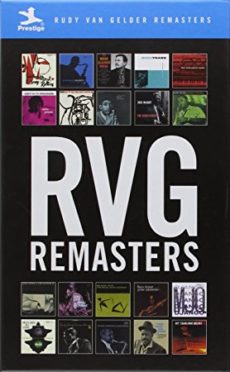
By 1967 the labels were beginning to utilize other engineers more regularly but Rudy remained active engineering nearly all of Creed Taylor’s CTI Records releases, a series of proto-smooth jazz albums that were financially successful, but not always well received by critics. He was not without his detractors. Despite his prominence in the industry, like Lion who didn’t care for the overuse of reverb, and Charles Mingus refused to work with him because he change the sound of his bass. He remastered the analog Blue Note recordings into 24-bit digital recordings in its RVG Edition series and also remasters of some of the Prestige albums, and was happy to see the LP go by the wayside because it was hard for him to get the sound the way he thought it should be.
He received awards and honors being named a fellow of the Audio Engineering Society (AES), received the society’s most prestigious award, the AES Gold Medal, named a Jazz Master by the National Endowment for the Arts, received the Grammy Trustees Award, and Thelonious Monk composed and recorded a tribute to Van Gelder titled Hackensack.
Producer and recording engineer Rudy Van Gelder, who specialized in jazz and regarded as the most important recording engineer of jazz by some observers, passed away at home in Englewood Cliffs, New Jersey on August 25, 2016. Among the several thousand jazz sessions he recorded are the acknowledged classics John Coltrane’s A Love Supreme, Miles Davis’s Walkin’, Herbie Hancock’s Maiden Voyage, Sonny Rollins’s Saxophone Colossus and Horace Silver’s Song for My Father.
Take A Dose On The Road
Daily Dose Of Jazz…
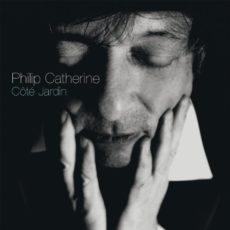
Philip Catherine was born on October 27, 1942 in London, England to English/Belgian parents and a grandfather who was first violinist in the London Symphony Orchestra. Having an ear for music early on, he picked up the guitar after hearing George Brassens and began listening to jazz.
He soon got the opportunity to play with some of those musicians when performing in Belgium, where he was residing at the time. In the 1960s he was a member of the Jean-Luc Ponty Quintet and during this period he was at the forefront on the European jazz scene performing and recording with Lou Bennett, Billy Brooks, Edgar Bateman, John Lee, Gerry Brown, Larry Coryell, Alphonse Mouzon, Charlie Mariano, Kenny Drew and Tom Harrell, among others.
Recording his debut solo album Stream in 1971 for Warner Bros. Records, the following year Philip collaborated with John Scofield, Ran Blake, George Benson and other musicians in Boston, Massachusetts. By early 1976 he replaced Jan Akkerman in the Dutch rock group Focus, recording on one album Focus con Proby, featuring American singer P. J. Proby.
The 1980s Catherine played extensively with the Chet Baker Trio and is featured on several of Baker’s albums. He went on to play with Charles Mingus, who dubbed him “Young Django”, as well as collaborations with Dexter Gordon, Richard Galliano, Niels-Henning Ørsted Pedersen, Stéphane Grappelli, Toots Thielemans, Robert Wyatt, Klaus Doldinger, Buddy Guy, Karin Krog, Carla Bley, Mike Mantler and Joachim Kühn as well as others too numerous to list.
He won the first Belgian Golden Django in 1995 and is considered the grandfather of Belgian jazz for his approach, sound, emotional lyricism and expression that is both important and influential. Guitarist Philip Catherine continues to perform on the now very active Belgian jazz scene as well as record and tour worldwide.
Uplift Someone’s World
More Posts: guitar
Daily Dose Of Jazz…
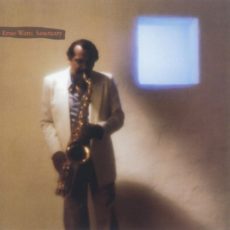
Ernest James Watts was born October 23, 1945 in Norfolk, Virginia. He began playing saxophone at thirteen. After a brief period at West Chester University, he attended Berklee College of Music on a Downbeat scholarship. He toured with Buddy Rich in the mid-1960s, occupying one of the alto saxophone chairs, with Lou Marini sitting the other.
He traveled to Africa on a US State Department tour with Oliver Nelson’s group and played tenor saxophone with The Tonight Show Band under Doc Severinsen for 20 years. During the Seventies he was a featured soloist on many of Marvin Gaye’s Motown albums, as well as on countless other pop and R&B sessions during 25 years as a first-call musician in the studios of Los Angeles, California.
In the mid-1980s Watts decided to rededicate himself to jazz, recording and touring with German guitarist and composer Torsten de Winkel, drummer Steve Smith and keyboardist Tom Coster. He joined bassist Charlie Haden’s Quartet West, played the saxophone on the Grease soundtrack, clarinet on The Color Purple soundtrack and performed on the opening theme song of the popular 80s sitcom Night Court.
Ernie founded Flying Dolphin Records and in early 2008, his Analog Man won the award in the 7th Annual Independent Music Awards for Best Jazz Album, worked with vocalist Kurt Elling, won a Grammy in 2010 for Best Jazz Vocal Album. He tours Europe twice a year with his own Ernie Watts Quartet, as well as Asia and summer jazz festivals the world over.
He has toured with the Rolling Stones, played the mystery horn on Frank Zappa’s album The Grand Wazoo, and has performed and recorded with Richard Groove Holmes, Alphonse Mouzon, Billy Alessi, Bobby Alessi, Gene Ammons, Paul Anka, Eric Martin, Willie Bobo, Brass Fever, Kenny Burrell, Lee Ritenour, David Axelrod, Donald Byrd, Stanley Clarke, Billy Cobham, Gino Vannelli, Randy Crawford, Kurt Elling, Torsten de Winkel, Hellmut Hattler, Dizzy Gillespie, Bobby Hutcherson, Milt Jackson, J. J. Johnson, Carole King, Charles Kynard, John Mayall, Carmen McRae, Blue Mitchell, Helen Reddy, New Stories, Moacir Santos, Lalo Schifrin, Bud Shank, Gábor Szabó, Gerald Wilson, Ndugu Chancler, Alphonso Johnson, Patrice Rushen, Joe Louis Walker, Barry Goldberg, Paul Jones, Chubby Tavares, T. Bone Walker, Big Joe Turner and Otis Span among others.
Tenor, alto and soprano saxophonist and flautist Ernie Watts has won two Grammy Awards as an instrumentalist and continues to perform, record and tour.
Inspire A Young Mind