

Daily Dose Of Jazz…
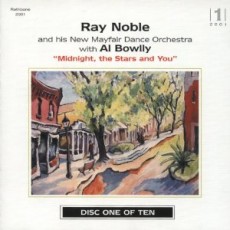
Raymond Stanley Noble was born on December 17, 1903 in Brighton, England and studied music at the Royal Academy. He became the leader of the HMV Records studio band, known as the New Mayfair Dance Orchestra that featured popular vocalist Al Bowlly and many musicians of the top hotel bands.
The Bowlly/Noble recordings achieved popularity in the United States, however, union bans prevented Noble from bringing British musicians to America so he arranged for Glenn Miller to recruit American musicians. Bowlly returned to England but Noble continued to lead bands in America, moving into an acting career portraying a stereotypical upper-class English idiot in films like Top Hat and Slumming On Park Avenue. He also played the “dense” character in love with Gracie Allen, or with his orchestra in an Edgar Bergen vehicle. Noble also provided music for many radio shows of the times like The Charlie McCarthy Show. His last major success as a bandleader came with Buddy Clark in the late 1940s.
Ray Noble arranged hits in the 1930s such as “Easy to Love”, “Mad About the Boy”, “Paris in the Spring”, wrote both lyrics and music for now jazz standards “Love Is The Sweetest Thing”, “Cherokee”, “The Touch of Your Lips”, “I Hadn’t Anyone Till You” and “The Very Thought Of You” and co-wrote “Goodnight, Sweetheart” and “You’re So Desirable”, recorded by Billie Holiday, Teddy Wilson and in 1990 by Robert Palmer.
Ray Noble, bandleader, composer, arranger, pianist, singer and actor passed away on April 3, 1978 at the age of 74.
More Posts: arranger,bandleader,composer
Daily Dose Of Jazz…
Curtis DuBois Fuller was born in Detroit, Michigan on December 15, 1934 to Jamaican parents who died when he was very young and raised in an orphanage. He took up the trombone while in Detroit and became friends with schoolmates Paul Chambers and Donald Byrd and also knew Tommy Flanagan, Thad Jones and Milt Jackson.
After two years of army service ending in 1955, where he played in a band with Chambers and the Adderley brothers, Fuller joined the quintet of another Detroit musician, Yusef Lateef. By 1957 the quintet moved to New York and Curtis recorded his first sessions as a leader for Prestige Records.
Alfred Lion of Blue Note Records heard him playing with Miles Davis in the late Fifties and featured him as a sideman on record dates led by Sonny Clark and John Coltrane. His work on Trane’s “Blue Train” album is probably his best-known recorded performance. This was followed with four Fuller led dates for Blue Note.
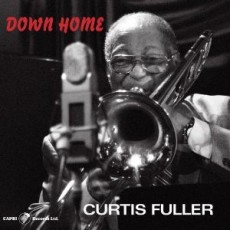
Over his career Curtis has worked with Slide Hampton, Bud Powell, Jimmy Smith, Wayne Shorter, Abbey Lincoln, Lee Morgan, Hank Mobley, Blue Mitchell and Joe Henderson, and that’s the very short list. He performed with Dizzy Gillespie’s band, toured with Count Basie, was the sixth Jazz Messenger with Art Blakey in 1961, was the first trombonist to hold membership in the Art Farmer-Benny Golson Jazztet, and has recorded for Savoy, Epic, Impulse, Status, Challenge, Timeless and Capri among others and his latest album, “Down Home” on Capri.
In addition to continuing to perform and record, he was a faculty member of the New York State Summer School of the Arts – School of Jazz Studies. Trombonist Curtis Fuller passed away on May 8, 2021.

More Posts: trombone
Daily Dose Of Jazz…
Mark Elf was born in Queens, New York on December 13, 1949 and started playing guitar at the age of 11. He attended Berklee College of Music from 1969-71 when his first professional jazz gig came as a sideman with Gloria Coleman and Etta Jones at the Club Barron in Harlem, New York that was double billed with the George Benson Quintet.
During the 1970’s he toured with Lou Donaldson, Jimmy McGriff, Richard “Groove” Holmes and Charles Earland and recorded a number of albums with them, his first with McGriff and Holmes in 1973 on the Giants of the Organ Come Together. In the late 1970’s Mark worked and recorded with Junior Cook and Bill Hardman. By the 80’s he was touring Europe with Dizzy Gillespie, Clark Terry and other jazz luminaries. In 1986 he recorded his first album as a called the Mark Elf Trio Volume 1.
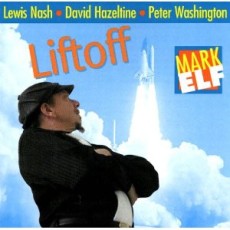
He continued to record as a leader over the next two decades with Hank Jones, Jimmy Heath, Ray Drummond and Ben Riley, Jon Hendricks, Wynton Marsalis, Benny Golson, Al Grey and Red Holloway. He also inked his first overseas record deal. In 1995 Mark established Jen Bay Records and stunned the record industry with hit recordings. From 1996 to 2004 all 10 of his recordings had finished in the top ten on national jazz radio with eight of them going to #1 consecutively from 1997 to 2004.
From 1970 to the present, guitarist, clinician and educator Mark Elf has taught guitar and theory at independent studios, colleges and universities across the United States and abroad, and his clinics are recognized as some of the finest in the world. He is sought after for his lectures on “How To Succeed As An Indie”. He owns his own successful record label and publishing company. He continues touring with his trio at festivals, colleges and clubs.
More Posts: guitar
Daily Dose Of Jazz…
Ray Willis Nance was born on December 10, 1913 in Chicago, Illinois and as a child he studied piano, took violin lessons and was self-taught on trumpet. He led small groups from 1932-1937, then spent periods with the orchestras of Earl Hines and Horace Henderson through to 1940, however, he is best known for his long association with Duke Ellington through most of the 1940s and 1950s, after he was hired to replace Cootie Williams.
Shortly after joining the band, Nance was given the trumpet solo on the first recorded version of “Take The “A” Train” which became the Ellington theme, a major hit and jazz standard. Nance’s “A Train” solo is one of the most copied and admired trumpet solos in jazz history that even Williams upon his return to the some twenty years later would play Nance’s solo almost exactly as the original.
Ray was often featured on violin and was the only violin soloist ever featured in Ellington’s orchestra. He is also one of the well-known vocalists from the Ellington orchestra, having sung arguably the definitive version of “It Don’t Mean A Thing (If It Ain’t Got That Swing). It was Nance’s contribution to take the previously instrumental horn riff into the lead vocal, which constitute the now infamous, “Doo wha, doo wha, doo wha, doo wha, yeah!” The multi-talented trumpeter, violinist, vocalist and dancer earned him the nickname “Floorshow”.
He left the Ellington band in 1963 after having switched to and playing cornet alongside his predecessor Cootie Williams for a year. Over the course of his career he recorded a few albums as a leader and with Earl Hines, Rosemary Clooney and others. Ray Nance passed away on January 28, 1976 in New York City.

Daily Dose Of Jazz…
Donald Byrd was born Donaldson Toussaint L’Ouverture Byrd II on December 9, 1932 in Detroit, Michigan. He studied music and trumpet at Cass Technical High School, performing with Lionel Hampton prior to graduating. Joining the Air Force he played with the band, followed by matriculation through Wayne State University and the Manhattan School of Music.
He came to prominence while at the Manhattan School when he joined Art Blakey’s Jazz Messengers replacing Clifford Brown. By 1955 he was recording with Jackie McLean and Mal Waldron, left the Messengers a year later and performed with John Coltrane, Sonny Rollins, Herbie Hancock and Thelonious Monk.
Byrd’s first full-time band was a quintet that he co-led from 1958-61 with Pepper Adams, an ensemble with hard driving performances as captured live on “At The Half Note Café”. In June 1964, Byrd jammed with jazz legend Eric Dolphy in Paris and throughout the rest of the decade and into the 70s was a leader and notable sidemen for Blue Note’s stable of jazz greats.
In the 1970s, Donald moved away from his previous hard-bop jazz base and began to record jazz-fusion, jazz-funk, soul-jazz, and rhythm and blues. Teaming up with the Mizell Brothers, he recorded Black Byrd in 1972 that subsequently became Blue Note’s highest selling album ever. Three subsequent big selling albums called “Street Lady”, Places and Spaces, and “Steppin’ Into Tomorrow” followed this. In 1973, he created the Blackbyrds, a fusion group consisting of his best students that scored several major hits including “Happy Music”, “Walking In Rhythm” and “Rock Creek Park”. Byrd is best remembered as one of the only bebop jazz musicians who successfully pioneered the funk and soul genres while simultaneously remaining a pop artist.
Dr. Donald Byrd holds three master degrees, a law degree and a doctorate and has pursued a career as an educator teaching at Rutgers University, Hampton Institute, New York University, Howard University, Queens College, Oberlin College, Cornell University and was named artist-in-residence at Delaware State University. The trumpeter passed away at the age of 80 in Teaneck, New Jersey on February 4, 2013 leaving a legacy of recordings that spanned the jazz idiom.
More Posts: trumpet