

Daily Dose Of Jazz…
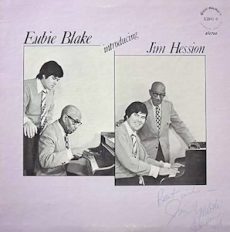
Jim Hession was born on December 10, 1947 in Pasadena, California, where he studied piano with composer Oscar Rasbach. By the time he turned twenty he was a fixture in the traditional jazz scene, with his incredibly accurate two-handed piano style. He was a founding member of the Maple Leaf Club, receiving his degree in composition from the University of California at Los Angeles (UCLA), where he studied under Paul Chihara and Lalo Schifrin.
Jim met and began recording with Eubie Blake and while recording with Eubie Blake in New York City he began exploring more contemporary jazz venues, while retaining his handle on traditional jazz styles like ragtime, stride and boogie-woogie.
He met his future wife Martha while they were attending UCLA, where she was studying piano and voice. She began singing professionally with Jim and started a professional association with the Walt Disney Company in 1967 until relocating to the Gulf Coast in 2003.
Over the years they have performed with such luminaries as Teddy Wilson, Al Hirt, Bob Crosby, Johnny Guarnieri, Max Morath, Shelton Brooks, Gregory Hines, Savion Glover, and Disney songwriters the Sherman Brothers. They have acquired an incredible knowledge of the history of American music and hold 85,000+ pieces, one of the largest privately-held collections of original sheet music in the United States.
They have lectured at many colleges and educational venues across the country. The couple have performed as a jazz duo, headlined the American Jazz Quintet, appeared on television, produced stage shows, and historical lectures. Pianist Jim Hession and Martha Hession continue to bring a level of talent and versatility not often found on the music scene.

More Posts: bandleader,history,instrumental,jazz,music,piano
Daily Dose Of Jazz…
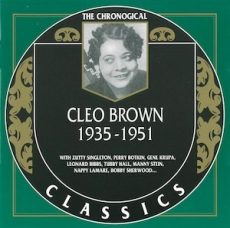
Cleopatra Brown was born on December 8, 1909 in De Kalb, Mississippi. She moved to Meridian, Mississippi when her father took a position as pastor and in his church she played piano as a child.
In 1919 her family moved to Chicago, Illinois and she began learning piano from her brother who worked with Pine Top Smith, playing boogie-woogie for dances. Around the time Cleo was 14 she worked in vaudeville, as well as taking gigs in clubs. In 1935, she replaced Fats Waller as pianist on New York radio station WABC.
From the 1930s to the 1950s she toured the United States regularly, recording for Decca Records among other labels along the way and recording many humorous, ironic titles such as Breakin’ in a New Pair of Shoes, Mama Don’t Want No Peas and Rice and Coconut Oil, When Hollywood Goes Black and Tan, and The Stuff Is Here and It’s Mellow.
Cleo’s stride piano playing was often compared to Fats Waller and she is credited as an influence on Dave Brubeck, who played during the intermissions of her shows, and on Marian McPartland. She played regularly at clubs in Chicago, toured widely, and recorded for both Decca and Capitol Records.
Brown began to shy away from singing bawdy blues songs because of her deepening religious beliefs. In 1953, she was baptized, retired from music, and became a nurse in 1959. Jazz biographies frequently listed her as deceased due to her absence from music. The song Sweet Cleo Brown was recorded by Brubeck in tribute.
From the mid-1970s until 1981, she performed under the name of C. Patra Brown on radio shows in Denver, Colorado. She replaced boogie-woogie music with slower, inspirational music. She returned to record again, and performed on National Public Radio.
Pianist and vocalist Cleo Brown, who was the first woman instrumentalist to receive the NEA Jazz Masters Fellowship, and also performed and recorded under the name of Cleo Patra Brown, died on April 15, 1995, in Denver, Colorado.
More Posts: bandleader,history,instrumental,jazz,music,piano,vocal

Daily Dose Of Jazz…
George James was born in Boggs, Oklahoma on December 7, 1906. His career didn’t begin until the late 1920s joining the bands of Charlie Creath and Johnny Neal. He moved to Chicago, Illinois in 1928, where he played with Jimmie Noone, Sammy Stewart, Ida Marples, Jabbo Smith, and Bert Hall.
In 1931 through the first quarter of 1932 he toured with Louis Armstrong, and at the end of the tour he remained in New York City. There he joined the Savoy Bearcats and later played with Charlie Turner’s Arcadians. By the middle of the decade Fats Waller assumed leadership of the Arcadians, and James played under him until 1937.
Finishing the decade playing in the Blackbirds Revue, early in the 1940s he worked with James P. Johnson, Benny Carter, Teddy Wilson, and Lucky Millinder, and led his own bandhttps://notoriousjazz.com/jazz-type/swing/daily-dose-of-jazz-3977↗ in 1943-44. Later in the decade James played with Claude Hopkins and Noble Sissle.
He was active both as a leader and a sideman into the 1970s, playing with Clyde Bernhardt and the Harlem Blues and Jazz Band in that decade. Saxophonist, clarinetist, and flautist George James died on January 30, 1995 in Columbus, Ohio.
More Posts: bandleader,clarinet,flute,history,instrumental,jazz,music,saxophone
Daily Dose Of Jazz…
Dave Wilkins was born on September 25, 1914 in Barbados. He first played in Salvation Army bands in his native country. In 1937, he moved to London, England, where he worked with Ken Snakehips Johnson’s West Indian Swing Band among others.
He recorded with Una Mae Carlisle and Fats Waller in 1938, and continued to work with Johnson until 1941. Following this, he played with English jazz musicians such as Ted Heath, Harry Parry, Joe Daniels and Cab Kaye.
Trumpeter Dave Wilkins, who stopped playing in the 1970s, died on November 26, 1990 in London, England.
 </p
</p
More Posts: history,instrumental,jazz,music,trumpet
Daily Dose Of Jazz…
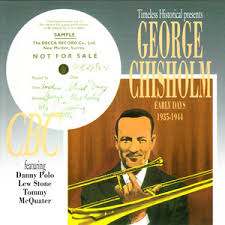
George Chisholm was born on March 29, 1915 in Glasgow, Scotland and at the age of fifteen in the late 1930s he moved to London, where he played in dance bands led by Bert Ambrose and Teddy Joyce. He later recorded with jazz musicians such as Coleman Hawkins, Fats Waller and Benny Carter during their visits to the UK.
During the Second World War, he signed on with the Royal Air Force and joined the RAF Dance Orchestra, known popularly as the Squadronaires, remaining in the band long after he was demobbed. George followed this with freelance work and a five-year stint with the BBC Showband, the forerunner of the BBC Radio Orchestra. As a core member of Wally Stott’s orchestra on BBC Radio’s The Goon Show, he made several minor acting appearances.
He had roles in the films The Mouse on the Moon, The Knack …and How to Get It and Superman III. He was part of the house band for the children’s programs Play School and Play Away. He also sang and was a storyteller on Play School occasionally.
During the 1980s despite undergoing heart surgery, Chisholm continued to play, working with his own band the Gentlemen of Jazz and Keith Smith’s Hefty Jazz among others, and playing live with touring artists.
By the mid-1990s he retired from public life suffering from Alzheimer’s disease. Trombonist and vocalist George Chisholm, who was appointed as an Officer of the British Empire (OBE), died on December 6, 1997 at the age of 82.