

Daily Dose Of Jazz…
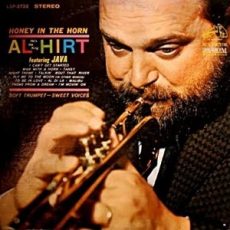
Alois Maxwell Hirt was born on November 7, 1922 in New Orleans, Louisiana to a police officer father. At the age of six, he got his first trumpet, which had been purchased at a local pawnshop. He played in the Junior Police Band with friend Roy Fernandez, the son of Alcide Nunez. By 16 he was playing professionally with his friend Pete Fountain, while attending Jesuit High School. During this time, he was hired to play at the local horse racing track, beginning a six-decade connection to the sport.
1940 saw Al in Cincinnati, Ohio studying at the Cincinnati Conservatory of Music with Dr. Frank Simon. After a stint as a bugler in the Army during World War II, he performed with various swing big bands, including those of Tommy Dorsey, Jimmy Dorsey, Benny Goodman, and Ina Ray Hutton.
In 1950 Hirt became the first trumpet and featured soloist with Horace Heidt’s Orchestra and after several years on the road he returned to New Orleans working with various Dixieland groups and leading his own bands. He soon signed with RCA Victor and posted twenty-two albums on the Billboard charts in the 1950s and 1960s. He recorded the theme for the 1960s television show The Green Hornet, with arranger and composer Billy May.
From the mid-1950s to early 1960s, Hirt and his band played nightly at Dan’s Pier 600, hosted the hour-long television variety series Fanfare, as the summer replacement for Jackie Gleason and the American Scene Magazine, and would go on to play for Pope John Paul II.
Trumpeter and bandleader Al Hirt died of liver failure on April 27, 1999 at the age of 76, after having spent the previous year in a wheelchair due to edema in his leg.

More Posts: bandleader,history,instrumental,jazz,music,trumpet

Daily Dose Of Jazz…
Christopher Burnett was born in Olathe, Kansas on November 2, 1955 and grew up in a military family that moved often before settling in the Kansas City area. He was exposed to music growing up as his mother introduced him to the piano and he was a member of the youth choir at his church. He took up saxophone and clarinet in his school band. After high school, he enlisted in the U.S. Army Music Program where he performed and pursued higher education, studying at the Armed Forces School of Music, Webster University, Missouri’s Columbia College, Berklee College of Music, and American University.
Spending 22 years in the military, Chris rose to the rank of 1st Sergeant in the position of Enlisted Bandleader, staff and faculty assignment at the Armed Forces School of Music, and the leading Chief Petty Officer of the NATO Band in Naples, Italy. He served as NATO Ceremonial Band Conductor, directed the jazz band, played the lead alto saxophone chair with the West Point Military Academy Band’s Jazz Knights, and a featured soloist with the Hof Symphony Orchestra in Germany.
After leaving the military Burnett continued to teach, holding the position of director of the jazz ensemble program and adjunct lecturer at Missouri University of Science and Technology, formerly University of Missouri-Rolla, where he worked as an Adjunct Lecturer for a decade.
He has performed with artists like Bobby Watson, Will Matthews, Marcus Hampton, Ahmed Alaadeen, and many more. Burnett is the Founder and Artistic Director of KC Area Youth Jazz and along with colleagues Erica Lindsay and Sumi Tonooka is a co-founder of the large independent recording label, Artists Recording Collective.
He has held residencies at the historic Drum Room and the Black Dolphin in Kansas City, and appeared as a guest artist and clinician for the Northwest Missouri State Jazz Festival. He released his debut album as a leader, Time Flies in 2013, Firebird in 2014, in 2021 The Standards, Vol. 1, and Live at The Drum Room in Kansas City in 2022.
More Posts: bandleader,educator,history,instrumental,jazz,music,saxophone
Daily Dose Of Jazz…
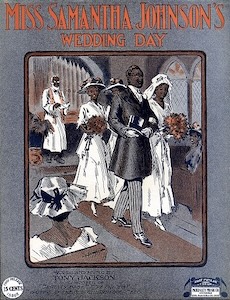
Tony Jackson was born Antonio Junius Jackson an epileptic on October 25, 1882 into a poor Black family of freed slaves in Uptown New Orleans, Louisiana. His twin brother died at fourteen months of age. Showing musical talents at a young age by 10 he constructed a crude properly tuned harpsichord out of junk in his backyard. He played hymns he heard in church and soon the neighborhood was offering the use of their pianos and reed organs to practice on. This led to his first musical job at age 13, when he began playing piano during off hours at a Tonk run by bandleader Adam Olivier.
Jackson became the most popular and sought after entertainer in the red light district Storyville. Able to remember and play any tune he had heard once and was hardly ever stumped by obscure requests. His singing voice was also exceptional, and he was able to sing operatic parts from baritone to soprano range. He became a mentor to Jelly Roll Morton.
Tony wrote many original tunes, a number of which he sold rights to for a few dollars or were simply stolen from him; some of the old time New Orleans musicians said that some well known Tin Pan Alley pop tunes of the era were actually written by Jackson.
Well dressed always with a pearl gray derby, checkered vest, ascot tie with a diamond stickpin, with sleeve garters on his arms to hold up his cuffs as he played. This became a standard outfit for ragtime and barrelhouse pianists.
Moving to Chicago, Illinois hoping to have more of an influence on his career. Jackson was a resident performer at the De Luxe and Pekin Cafes in the city. In his later years his voice and dexterity were impaired by disease, syphilis or cirrhosis of the liver in addition to chronic epilepsy. Pianist, singer, and composer Tony Jackson died on April 20, 1921.

More Posts: bandleader,composer,history,instrumental,jazz,music,piano,vocal
Daily Dose Of Jazz…
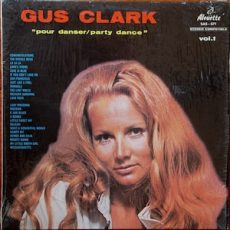
Gus Clark was born Gustave De Clercq on October 21, 1913 in Antwerp, Belgium. While still in his teens he led local dance bands and also played in the groups of musicians such as Harry Pohl, Maurice Pinto, and Jack Hoedemaeker.
In the 1930s Gus played with his own group in Brussels, Belgium, and Coleman Hawkins performed with this ensemble. He later set up a new ensemble of all-Black musicians in Belgium, which included Lauderic Caton as a sideman.
Clark performed with Jean Omer, Jean Robert, and Gus Deloof as a sideman, and continued recording as a leader in the 1940s and 1950s.
Pianist Gus Clark died in his native city on April 10, 1979.
More Posts: history,instrumental,jazz,music,piano
Daily Dose Of Jazz…
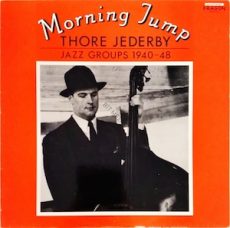
Thore Jederby was born October 15, 1913 in Stockholm, Sweden and received his formal training in music at the Royal Swedish Academy of Music. He began playing jazz in the mid-1930s, playing with Arne Hülphers’s band from 1934 to 1938, and then with Thore Ehrling’s ensemble from 1938 through the end of World War II.
Thore led his own group, the Swing Swingers, for studio recordings in the mid-1930s, and led smaller ensembles for recording sessions in the 1940s.
Later in his life, Jederby became active in the capturing of the history of Swedish jazz. He was involved in reissues of early Swedish recordings, curated radio shows devoted to Swedish jazz, and participated in a national commission on the history of jazz in Sweden.
Double bassist, record producer, and radio broadcaster Thore Jederby died on January 10, 1984 in his city of birth.
More Posts: bass,history,instrumental,jazz,music