

Daily Dose Of Jazz…
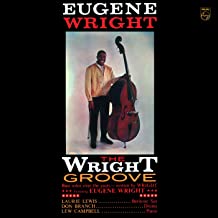
Eugene Joseph Wright was born May 29, 1923 in Chicago, Illinois. Mostly self-taught but took a few lessons late in his career from Paul Gregory. He studied cornet in high school. He played with the Lonnie Simmons group and led his own 16-piece band, the Dukes of Swing in the Forties. He played with Gene Ammons, Count Basie, and Arnett Cobb in the late ’40s and early ’50s, then worked with Buddy DeFranco from 1952 to 1955, touring Europe with him.
He played in the Red Norvo trio in 1955, toured Australia with them, and was featured in a film short with Charlie Barnet. His biggest opportunity came when he was hired by pianist Dave Brubeck, remaining until 1968. He led his own ensemble on a tour of Black colleges in 1969 and 1970, then played with Monty Alexander’s trio from 1971 to 1974.
During the ’70s working in television studios found him film soundtrack work as well as play in clubs. He also did private teaching and became head of the advisory board in the jazz division of the International Society of Bassists, and head of the University of Cincinnati’s jazz department.
Over the course of his lengthy career Wright has worked with Charlie Parker, Billie Holiday, Carmen McRae, Buddy DeFranco, Cal Tjader, Kai Winding, Sonny Stitt, Paul Desmond, Kenny Drew, Dottie Dodgion, Lee Shaw, Buddy Collette, Gerry Wiggins and Dorothy Donegan among others, participating on more than five dozen recordings, thirty-two of which were with Brubeck.
With the death of Brubeck on December 5, 2012, he became the last surviving member of the quartet. Cool and swing bassist Eugene Wright, who has recorded once as a leader, The Wright Groove, is presently still active on the jazz scene at age 96.
More Posts: bandleader,bass,history,instrumental,jazz,music
Daily Dose Of Jazz…
Everett Barksdale, born April 28, 1910 in Detroit, Michigan, played bass and banjo before settling on guitar. During early 1930 he moved to Chicago, Illinois where he joined Erskine Tate’s band. He recorded for the first time with violinist Eddie South in 1931, who he remained with until 1939.
A move to New York City saw Everett become a member of the Benny Carter Big Band. Around that same time, he recorded with Sidney Bechet and during the 1940s, he worked for CBS as a session musician.
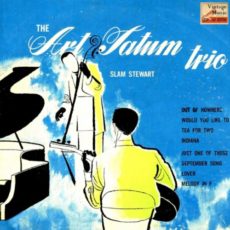
As a sideman, Barksdale played guitar in many genres, working with vocalists Dean Barlow, Maxine Sullivan, the Blenders, and the Clovers. He played on the hit Love Is Strange by Mickey & Sylvia, was the music director for the Ink Spots, and beginning in 1949, he worked with pianist Art Tatum until Tatum died in 1956.
During the Fifties and Sixties, he was part of the ABC house band and played on recordings with a who’s who list of vocalists and musicians not limited to Lena Horne, Sammy Davis Jr., Dinah Washington, Sarah Vaughan, Milt Hinton, Buddy Tate, Chet Baker, Red Allen, Harold Vick, Oscar Brown Jr., J. J. Johnson, Clark Terry, Kai Winding, Louis Armstrong, The Drifters and Ben E. King. He also played guitar in the studio for pop and soul musicians such as.
Guitarist and session musician Everett Barksdale retired from active performance in the 1970s, moved to the West Coast and passed away in Inglewood, California on January 29, 1986.

More Posts: guitar,history,instrumental,jazz,music
Daily Dose Of Jazz…
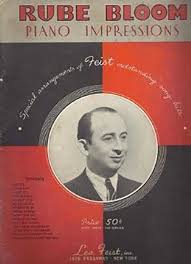
Reuben Bloom was born on April 24, 1902 in New York City, where he learned to play the piano. During the 1920s he wrote many novelty piano solos which are still well regarded today. He recorded for the Aeolian Company’s Duo-Art reproducing piano system various titles including his Spring Fever.
In 1927 Rube had his first hit with Soliloquy and his last hit was “Here’s to My Lady” in 1952, which he wrote with Johnny Mercer. In 1928, he made a number of records with Joe Venuti’s Blue Four for OKeh Records, including five songs he sang, as well as played piano.
He formed and led a number of bands during his career, most notably Rube Bloom and His Bayou Boys. They recorded three records in 1930 that are considered some of the best made during the early years of the Depression. The Bayou Boys was an all-star studio group consisting of Benny Goodman, Adrian Rollini, Tommy Dorsey and Mannie Klein. At other times, Bloom played with other bands, such as with Bix Beiderbecke and Frankie Trumbauer in the Sioux City Six as well as his continued frequent work with Joe Venuti’s Blue Four.
During his career, Rube also worked with many well-known performers, including Ruth Etting, Stan Kenton, Jimmy Dorsey. He collaborated with a wide number of lyricists including Ted Koehler, and Mitchell Parish. During his lifetime he published several books on the piano method.
Bloom’s I Can’t Face the Music with lyrics by Ted Koehler was recorded by Ella Fitzgerald on her 1962 Verve release, Rhythm is My Business, in a fabulous swing/big band version with Bill Doggett. Some of his best-known composition collaborations with lyricists were Day In, Day Out and Fools Rush In (Where Angels Fear to Tread) with lyrics by Johnny Mercer; Give Me the Simple Life with Harry Ruby; and Maybe You’ll Be There with lyrics by Sammy Gallop.
Pianist, vocalist, songwriter, arranger, bandleader, recording artist, and author Rube Bloom passed away on March 30, 1976 in his hometown.
More Posts: arranger,author,bandleader,history,instrumental,jazz,music,piano,recording artist,songwriter,vocal
Daily Dose Of Jazz…
Bobby Rosengarden was born Robert Marshall Rosengarden on April 23, 1924 in Elgin, Illinois and began playing drums when he was 12, and later studied at the University of Michigan. After playing drums in Army bands in World War II, he moved to New York City and worked in several groups between 1945 and 1948 before becoming a busy studio musician.
He played in the orchestras at NBC-TV from 1949–1968 and ABC from 1969–1974 on The Steve Allen Show, The Ernie Kovacs Show, Sing Along With Mitch, Johnny Carson’s The Tonight Show Band, and led the band for The Dick Cavett Show.
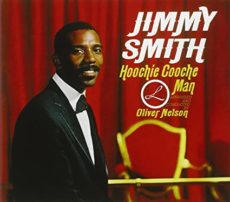
Through the years, Rosengarden was an active studio musician, recording with Duke Ellington, Billie Holiday, Skitch Henderson, Quincy Jones, Peter Nero, Gil Evans, Miles Davis, Gerry Mulligan, Benny Goodman, Moondog, Dick Hyman, Arlo Guthrie, Carmen McRae, Ben E. King, Harry Belafonte, Barbra Streisand, Jimi Hendrix, Stan Getz, Oliver Nelson, Jimmy Smith, Sylvia Syms, Milt Hinton, Derek Smith, Bob Wilber, Keny Davern, Walter Wanderley, Kai Winding and Tony Bennett.
In later years, Rosengarden was most often heard as the drummer with a variety of all-star, swing-oriented groups, including the Soprano Summit. Drummer Robert Rosengarden passed away from Alzheimer’s disease on February 27, 2007 in Sarasota, Florida, at the age of 82.
More Posts: drums,history,instrumental,jazz,music
Daily Dose Of Jazz…
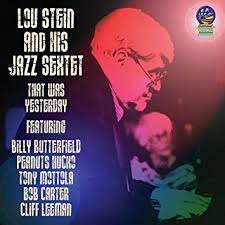
Lou Stein was born on April 22, 1922 in Philadelphia, Pennsylvania. By 1942 he had joined Ray McKinley’s band in 1942. While serving military service he played with Glenn Miller’s Army Airforce Band stateside during World War II but never went overseas.
After the war, he worked with Charlie Ventura in 1946 and 1947 and became a session musician. Lou performed with the Lawson-Haggart Band, Benny Goodman, Sarah Vaughan, the Sauter-Finegan Orchestra, Louie Bellson, Red Allen, Coleman Hawkins, and Lester Young.
Recording as a bandleader, in 1957 Stein had a U.S. Top 40 hit with Almost Paradise, which peaked at No. 31 on the Billboard Hot 100. His cover version of Got a Match made the Cashbox Top 60 in 1958. His most famous composition was East of Suez.
He played with Joe Venuti and Flip Phillips from 1969 to 1972. From 1954 to 1994 he recorded sixteen albums as a leader and through the Fifties, he recorded with Louis Bellson, Woody Herman, Lee Konitz, Joe Newman, Charlie Parker, Cootie Williams. Pianist and composer Lou Stein, who was comfortable in swing, bop, Dixieland, and commercial settings, passed away on December 11, 2002.
More Posts: bandleader,composer,history,instrumental,jazz,music,piano