

Daily Dose Of Jazz…
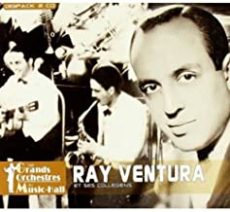
Raymond Ventura was born on April 16, 1908 into a Jewish family in Paris, France and learned to play the piano as a child. By the time he turned 17 in 1925 he was the pianist for the Collegiate Five, which recorded as the Collegians for Columbia Records beginning in 1928 and then for Decca in the 1930s.
Later he led the Collegians and it became a dance orchestra resembling a big band. His sidemen included Alix Combelle, Philippe Brun, and Guy Paquinet. In the early Forties, Ray led a big band in South America and in France during the rest of the decade.
One of his band’s popular songs from 1936 was Tout va très bien, Madame la Marquise in which the Marquise is told by her servants that everything is fine at home except for a series of escalating calamities. It was seen as a metaphor for France’s obliviousness to the approaching war.
Between 1931 and 1953 he appeared with his big band in four films, American Love, Beautiful Star, Women of Paris, and A Hundred Francs A Second. Pianist and bandleader Ray Ventura, who helped popularize jazz in France in the 1930s, March 29, 1979 in Palma de Mallorca, Spain.

More Posts: bandleader,history,instrumental,jazz,music,piano
Daily Dose Of Jazz…
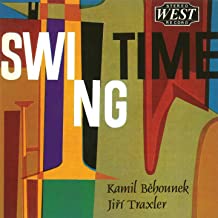
Kamil Běhounek was born on March 29, 1916 in Blatná, Czech Republic and was an autodidact on accordion, having learned to play by imitating recordings and BBC broadcasts. While studying law in Prague he began performing in clubs and recorded his first solo accordion date in 1936. By the late 1930s, he was working with the Blue Music Orchestra, Rudolf Antonin Dvorsky, Jiří Traxler, and Karel Vlach.
In 1943, he was forcibly compelled by the Nazis to go to Berlin and make arrangements for the bands of Lutz Templin and Ernst van’t Hoff. Upon returning to Czechoslovakia in 1945, he used some of these arrangements for his own band, then returned to Germany the following year, where he continued arranging for bandleaders such as Adalbert Luczkowski, Willy Berking, Heinz Schönberger, and Werner Müller.
He played with his own ensemble, including in Bonn, Germany and after 1948 he performed in West Germany at American soldiers’ clubs. Between 1968 and 1977 he recorded several albums of folk music but continued to play swing with his own groups. He also wrote an autobiography, Má láska je jazz (Jazz is my Love), which was published posthumously in 1986.
Bohemian accordionist, bandleader, arranger, composer, and film scorer Kamil Běhounek, who occasionally played tenor saxophone, passed away on November 22, 1983 in Bonn, Germany.

More Posts: accordion,arranger,bandleader,composer,film scorer,history,instrumental,jazz,music,saxophone

Daily Dose Of Jazz…
Chuck Wayne was born Charles Jagelka on February 27, 1923 in New York City to a Czechoslovakian family. As a boy, he learned banjo, mandolin, and balalaika. By the early 1940s he was playing in jazz bands on 52nd Street and after two years in the Army, he returned to New York City, joined Joe Marsala’s band, and settled in Staten Island until a 1991 move to New Jersey. He changed his musical style after hearing Charlie Parker, recording with Dizzy Gillespie in 1945. Frustrated with the difficulty of getting the sound he wanted, he considered switching to saxophone.
Wayne was a member of Woody Herman’s First Herd, the first guitarist in the George Shearing quintet, worked with Coleman Hawkins, Red Norvo, Bud Powell, Jack Teagarden, George Shearing, Lester Young, and Barbara Carroll. During the 1950s, he played with Tony Bennett, Gil Evans, Brew Moore, Zoot Sims, and George Wallington. In the Sixties, CBS hired him as a staff guitarist and for the next two decades, he played on Broadway, accompanied vocalists, and performed in guitar duos with Joe Puma and Tal Farlow.
He wrote Sonny in honor of Sonny Berman. Years later, Miles Davis took the song, renamed it Solar, and claimed he wrote it. His Butterfingers and Prospecting have been incorrectly attributed to Zoot Sims. Chuck was known for a bebop style influenced by saxophone players of his time and he developed a technique not widely adopted, and also developed a comprehensive approach to guitar chords and arpeggios.
Over the course of his career, he recorded eight albums as a leader beginning with his 1953 album The Chuck Wayne Quintet on the Progressive label. He worked as a sideman with Gil Evans, Anthony Perkins, Dick Katz, Duke Jordan, and Frank Wess, among others. Guitarist Chuck Wayne, one of the first jazz guitarists to learn bebop, passed away on July 29, 1997.
More Posts: bandleader,guitar,history,instrumental,jazz,music
Daily Dose Of Jazz…
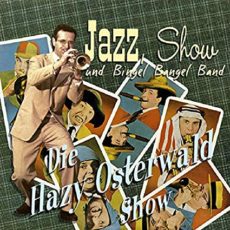
Hazy Osterwald was born Rolf Osterwald on February 18, 1922 in Bern, Switzerland. He began his career as a pianist, arranged for Fred Böhler in the late 1930s and joined him as a trumpeter in 1941. Around this time he also worked with Edmond Cohanier, Philippe Brun, Bob Huber, Eddie Brunner and Teddy Stauffer.
Hazy led his own ensemble starting in 1944, recording through the 1970s, with sidemen including Ernst Höllerhagen and Werner Dies. In the late 1940s he recorded with Gil Cuppini and played at the Paris Jazz Fair with Sidney Bechet and Charlie Parker. Trumpeter, vibraphonist, vocalist and bandleader Hazy Osterwald passed away on February 26, 2012 in Lucerne Switzerland.
More Posts: bandleader,history,instrumental,jazz,music,trumpet,vibraphone,vocal
Daily Dose Of Jazz…
Charlie Holmes was born on January 27, 1910 near Boston, Massachusetts. He began playing alto saxophone at age 16 and emulated the style of his childhood friend, Johnny Hodges. He began playing professionally a week later and after moving to New York City he worked for a variety of groups, including Luis Russell in 1928.
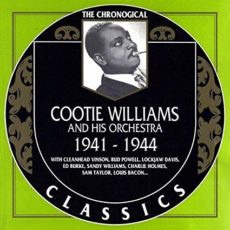
Between 1929 and 1930 he recorded with Red Allen and is best known for composing Sugar Hill Function. He would work with Russell again a few times and in 1932 joined the Mills Blue Rhythm Band. He was a member of John Kirby’s Sextet, Cootie Williams’ Orchestra, and Louis Armstrong’s band for much of the next two decades. He left music in 1951 and did not return for twenty years, only to work in Clyde Bernhardt’s Harlem Blues & Jazz Band and later played for the Swedish band Kustbandet.
Never taking on the role of a leader in any recording or group, swing era saxophonist Charlie Holmes, who also played clarinet and oboe for the Boston Civic Symphony Orchestra, passed away on September 19, 1985 in Stoughton, Massachusetts.

More Posts: bandleader,clarinet,history,instrumental,jazz,music,oboe,saxophone