

Daily Dose Of Jazz…
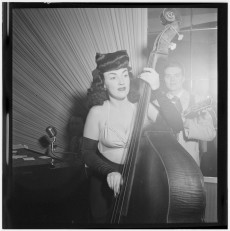
Bonnie Wetzel was born Bonnie Jean Addleman on May 15, 1926 in Vancouver, Washington. She learned violin as a child and was an autodidact on bass.
She played with Ada Leonard in an all-female ensemble and soon after worked in a trio with Marian Grange. Bonnie married trumpeter Ray Wetzel in 1949 and the pair worked in the Tommy Dorsey Orchestra in 1951.
Wetzel played in the Beryl Booker Trio with Elaine Leighton in 1953. They toured Europe in 1953-54 and recorded for Discovery Records. She also played with Herb Ellis, Charlie Shavers, Roy Eldridge and Don Byas. During the 1950s she freelanced in New York City. Double-bassist Bonnie Wetzel, who never led a recording session in her short career, passed away on February 12, 1965, at the age of 38.

Take A Dose On The Road

More Posts: bass
Daily Dose Of Jazz…
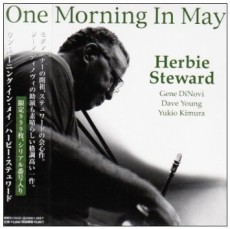
Herbie Steward was born Herbert Bickford Steward on May 7, 1926 in Los Angeles, California. He was widely known for being one of the tenor saxophones in the Four Brothers, alongside Stan Getz, Zoot Sims and Serge Chaloff in Woody Herman’s Second Herd.
Having a nice tone, Steward interacted well and was an above-average soloist. He also played alto saxophone, soprano saxophone and clarinet and was active from the 1940s to the Sixties and played in the swing and big band jazz genres. During his active years he recorded or performed with Earle Spencer, Smith Dobson, Tecumseh “Tee” Carson, Eddie Duran, John Mosher, Eddie Moore, Gene DiNovi, Sir Charles Thompson, David Young, Yukio Kimura, Kohnosuke Saijoh, Al Cohn, Stan Kenton, Chaloff and Sims.
Tenor saxophonist Herbie Steward, who has only a few albums as a leader in print at present, passed away on August 9, 2003 in Clearlake, California.
Take A Dose On The Road
More Posts: saxophone
Daily Dose Of Jazz…
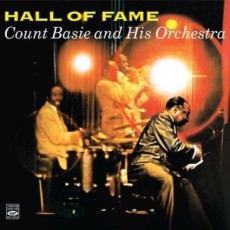
Sonny Payne was born on May 4, 1926 in New York City. His father was Wild Bill Davis’ drummer Chris Columbus. After early study with Vic Berton, in 1944 he started playing professionally around New York with the Dud and Paul Bascomb band, Hot Lips Page, Earl Bostic, Tiny Grimes and Lucille Dixon through the decade.
From 1950 to 1953, Payne played with Erskine Hawkins’ big band and led his own band for two years, but in late 1954 he made his most significant move, joining Count Basie’s band for more than ten years of constant touring and recording. He recorded Counting Five In Sweden with Joe Newman in 1958 on the Metronome label..
Leaving Basie in 1965, he again led his own trio and toured with Illinois Jacquet in 1976. He went Frank Sinatra’s personal drummer for all of the singer’s appearances with the Count Basie Orchestra in 1965 and 1966, and he later rejoined Basie as the regular drummer from 1973–1974. Most of the rest of his career, however, was spent in the Harry James band, which he joined in 1966, and with whom he was working when he passed away of pneumonia at the age of 52 on January 29, 1979 in Los Angeles, California. Harry James paid all of his medical bills and subsequent funeral costs.
Uplift Someone’s World
More Posts: drums
Daily Dose Of Jazz…
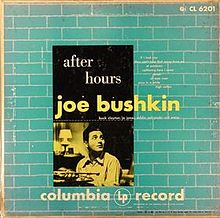
Sid Weiss was born April 30, 1914 in Schenectady, New York and learned clarinet, violin, and tuba when young. He switched to bass in his teens. He moved to New York City around 1931 and worked the following decade with Louis Prima, Bunny Berigan, Wingy Manone, Artie Shaw, Tommy Dorsey, Charlie Barnet and Adrian Rollini.
He was with Benny Goodman from 1941–1945, then played in the second half of the 1940s and the early 1950s with Muggsy Spanier, Pee Wee Russell, Cozy Cole, Bud Freeman, Duke Ellington and Eddie Condon. He quit full-time performing in the mid-1950s and in 1968 was an executive of the musicians’ union in Los Angeles, California. Bassist Sid Weiss passed away on March 30, 1994.
Dose A Day-Blues Away
More Posts: bass
Daily Dose Of Jazz…
Duke Ellington was born Edward Kennedy Ellington on April 29, 1899 in Washington, D.C. to parents who were pianists with his mother primarily playing parlor songs and his father preferring operatic arias. At the age of seven, he began taking piano lessons from Marietta Clinkscales. Surrounded by dignified women who reinforced his manners and taught him to live elegantly, his childhood friends noticed that his casual, offhand manner, easy grace and dapper dress and began calling him “Duke”.
Though Ellington took piano lessons, he was more interested in baseball. Ellington went to Armstrong Technical High School in Washington, D.C. and his first job was selling peanuts at the Washington Senators baseball games. Sneaking into Frank Holiday’s Poolroom at the age of fourteen and hearing the poolroom pianists play ignited Duke’s love for the instrument, and he began to take his piano studies seriously. But in the summer of 1914, while working as a soda jerk at the Poodle Dog Cafe he wrote his first composition, Soda Fountain Rag, created by ear, as he had not yet learned to read and write music.
He took private lessons in harmony from Dunbar High School music teacher Henry Lee Grant and with guidance of pianist and bandleader Oliver “Doc” Perry, he learned to read sheet music, project a professional style, and improve his technique. He was equally inspired by his encounters with James P. Johnson, Lukey Roberts, Will Marion Cook, Fats Waller and Sidney Bechet.
Playing gigs in cafés and clubs around D.C. and working as a freelance sign-painter, in 1917 Ellington began assembling groups to play for dances beginning with The Duke Serenaders. His group ventured to Harlem joining Wilber Sweatman’s orchestra, becoming a part of the Renaissance. Striking out on their own they hit roadblocks and though Willie “The Lion” Smith introduced them to the scene and gave them some money, they ultimately returned to D.C. discouraged.
A 1923 gig in Atlantic City, New Jersey led to the prestigious Exclusive Club in Harlem, followed by the Hollywood Club and a four-year engagement, giving Ellington a solid artistic base. He would go on to lead The Washingtonians, record eight records, contribute four songs to the 1925 all-Black revue Chocolate Kiddies starring Lottie Gee and Adelaide Hall, and struck an agreement of 45% interest in his future with agent-publisher Irving Mills. He would record on nearly every label at the time giving him popular recognition.
In 1927 he began his engagement at the Cotton Club receiving national attention from weekly radio broadcasts from the club gave Ellington national exposure. He gained worldwide recognition with Adelaide Hall on Creole Love Call and Black and Tan composed by Bubber Miley. He would go on to play for Florenz Ziegfeld, compose music for film scores, hire Ivie Anderson and create hits It Don’t Mean A Thing If It Ain’t Got That Swing, Mood Indigo, Sophisticated Lady, Solitude and In A Sentimental Mood.
By the 1930s as the Depression worsened, Duke was still able to produce music and continue a high profile with his radio broadcasts. He had hits like Caravan and I Let a Song Go Out of My Heart. His short film Symphony In Black introduced Billie Holiday on A Rhapsody of Negro Life, winning an Academy Award for Best Musical Short Subject.
In 1939 he began his association with Billy Strayhorn and the stage turned up again with more great music collaborations, such as Take The “A” Train. Among the musicians in Duke’s orchestra at one time or another were Ben Webster, Cootie Williams, Ray Nance, Johnny Hodges, Jimmy Blanton, Herb Jeffries, Al Hibbler, Mary Lou Williams, Sonny Greer, Clark Terry, Louie Bellson, and many others to numerous to mention here.
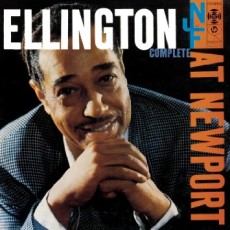
Ellington’s appearance at the Newport Jazz Festival on July 7, 1956 returned him to wider prominence and introduced him to a new generation of fans with Paul Gonsalves’ 27-chorus marathon solo, culminating in an album release.
Over the next two decades Duke continued to tour, compose and record, have statues erected, schools , streets, parks, buildings and bridges named for him, and a coin and a stamp honoring him. He has an annual competition, The Essentially Ellington High School Jazz Competition and Festival at Jazz At Lincoln Center, has a star on the Hollywood Walk of Stars, was awarded a special Pulitzer Prize, received a Presidential Medal of Freedom, a Grammy Lifetime Achievement Award, Legion Of Honor from France, won 12 Grammy Awards, and has nine songs inducted into the Grammy Hall of Fame among too many to list.
Pianist, bandleader and composer Duke Ellington, who composed to the very last days of his life and never came off the road, passed away on May 24, 1974 of complications from lung cancer and pneumonia, a few weeks after his 75th birthday.
Take A Dose On The Road
More Posts: piano