

Daily Dose Of Jazz…
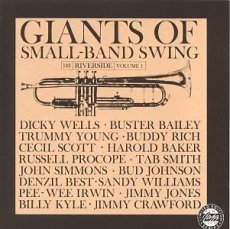
Cecil Scott was born in Springfield, Ohio on November 22, 1905 and played clarinet and tenor saxophone as a teenager with his brother, drummer Lloyd Scott. They played together as co-leaders through the end of the 1920s, holding residencies in Ohio, Pittsburgh, Pennsylvania and in New York City at the Savoy Ballroom. Among the members of this ensemble were Dicky Wells, Frankie Newton, Bill Coleman, Roy Eldridge, Johnny Hodges and Chu Berry.
By 1929 Cecil took full music control over the group in 1929, though Lloyd continued to manage the group. However, he was seriously injured in an accident in the early 1930s that temporarily sidelined his career. After recovery, he would play in different groups through the Thirties with Ellsworth Reynolds, Teddy Hill, Clarence Williams and Teddy Wilson accompanying Billie Holiday.
The early 1940s saw Scott playing with Albert Socarras, Red Allen, and Willie “The Lion” Smith prior to reassembling his band that hired at times Hot Lips Page and Art Hodes and towards the end of the decade worked with Slim Gaillard.
In 1950 Cecil disbanded the group, worked with Jimmy McPartland as a sideman, occasionally led groups and continued to play as a sideman up until the time of his death on January 5, 1964 in New York City. The clarinetist, tenor saxophonist and bandleader is credited on some 75 albums.

Inspire A Young Mind
Daily Dose Of Jazz…
Charlie “Fess” Johnson was born on November 21, 1891 in Philadelphia, Pennsylvania. He led an ensemble called the Paradise Ten and played in Harlem clubs like Small’s Paradise between 1925 and 1935.
Though Charlie was an accomplished pianist very rarely did he eve solo on his recording sessions and as a unit never achieved the reputation is so deserved. It was noted later that the band rivaled Duke Ellington and anyone else and employed a number of notables like Sidney DeParis, Charlie Irvis, Dicky Wells, Benny Waters and Benny Carter, who also wrote arrangements for the band.
He led the ensemble until 1938 then his musical endeavors freelancing in various ensembles around New York City until he retired in the 1950s due to health issues. Pianist and bandleader Charlie Johnson, who nickname “Fess” it is assumed was shortened from Professor, passed away in Harlem Hospital on December 13, 1959 in New York City.
Give A Gift Of Jazz – Share
More Posts: piano
Daily Dose Of Jazz…
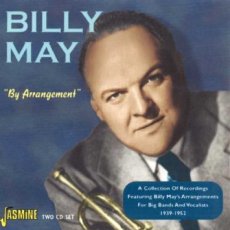
Billy May was born William E. May on November 10, 1916 in Pittsburgh, Pennsylvania and started playing the tuba in the high school band. At seventeen he began playing with Gene Olsen’s Polish-American Orchestra and a few local bands. Hearing Charlie Barnet’s band on the radio, he approached the bandleader in 1938 and asked if he could write arrangements for the band. For the next two years he arranged, played trumpet and recorded with Barnet, with his arrangement of Ray Noble’s Cherokee becoming a major hit during the swing music era.
By 1940 Glenn Miller hired May away from Barnet to arrange, play and record prior to performing the same duties with Les Brown before settling in as staff arranger for the NBC radio network and the n at Capitol Records.
He composed for television with such familiar scores as The Green Hornet, Batman, Naked City and Emergency; and for film Sergeants 3, Pennies from Heaven, Orchestra Wives, Cocoon and Cocoon: The Return among others. While at Capitol Records, Billy’s orchestra backed many of the arrangements he wrote for the top singers, including Frank Sinatra, Nat “King” Cole, Peggy Lee, Vic Damone, Rosemary Clooney, Bobby Darin, Ella Fitzgerald, Johnny Mercer, Jack Jones, Bing Crosby, Nancy Wilson and the list continues.
With his own band, May had a hit single, “Charmaine” though his most famous composition was the children’s song “I Tawt I Taw A Puddy Tat” recorded with Mel Blanc in 1950. He released an album as a leader titled Sorta-May, won a Grammy in 1959 for Best Performance By An Orchestra, went on to work with Verve, Reprise, Warner Bros. and Roulette record labels collaborating with Duke Ellington, Sammy Davis Jr., Petula Clark, Mel Torme, Jo Stafford, Dean Martin and Keely Smith on one of his final musical works. Composer, arranger and trumpeter Billy May passed away on January 22, 2004 at the age 85.
Take A Dose On The Road
More Posts: trumpet
Daily Dose Of Jazz…
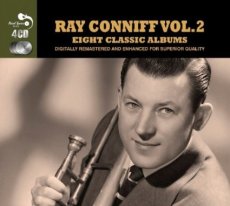
Joseph Raymond Conniff was born on November 6, 1916 in Attleboro, Massachusetts, learned to play trombone from his father and learned music arranging from a course book.
Post World War II he joined the Artie Shaw big band writing many of his arrangements. Hired by Mitch Miller, head of A&R at Columbia Records, Ray became the house arranger. During this period he worked with Rosemary Clooney, Johnny Mathis, Frankie Laine, Marty Robbins and Johnny Ray among others. In 1955 Ray wrote a top 10 arrangement for Don Cherry’s “Band of Gold” that sold more than a million copies.
From 1957 to 1969 Conniff arranged and recorded as a leader and sideman for Columbia and their subsidiary label Epic, became a bandleader and had 28 albums in the American Top 40, created the Ray Conniff Singers, toured Europe, was the first American popular artist to record in Russia and stepping out of his element he produced a couple of light jazz albums sans vocals.
Conniff’s most famous album was his 1966 release of “Somewhere My Love” written to the tune Lara’s Theme from the 1965 film Dr. Zhivago. It featured the 12 female and 13 male Ray Conniff Singers. The album went platinum, hit the top of the American and European charts and grabbed a Grammy Award.
The next three decades were equally lucrative for Ray recording mainly out of Los Angeles and finding fame touring Latin and South America. He recorded an average of two instrumental and one vocal album a year and sold over 70 million albums worldwide. He continued to record and perform until his death on October 12, 2002 in Escondido, California.
Jazz Is Global – Share
More Posts: trombone
Daily Dose Of Jazz…
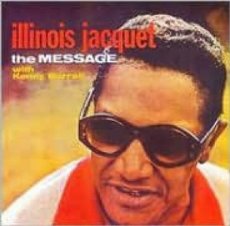
Jean-Baptiste Illinois Jacquet was born October 30, 1922 in Broussard, Louisiana to a Sioux mother and Creole father and bandleader. They moved to Houston, Texas when he was just an infant and grew up performing in his father’s band primarily on the alto saxophone.
At 15, Jacquet began playing with the Milton Larkin Orchestra, a Houston-area dance band. In 1939, he moved to Los Angeles, California where he met Nat King Cole and would sit in with the trio on occasion. In 1940, Cole introduced Jacquet to Lionel Hampton who hired him and asked him to switch to tenor.
In 1942, at age 19, Illinois soloed on the Hampton Orchestra’s recording of “Flying Home”, one of the very first times a honking tenor sax was heard on record. The song and solo became such a hit that every sax player who followed, notably Arnett Cobb, Dexter Gordon, Jimmy Forrest, Eddie “Lockjaw” Davis and Sonny Rollins, memorized them.
Quitting the Hampton band in 1943 and joined Cab Calloway’s Orchestra appearing with the band in Lena Horne’s movie Stormy Weather. Returning to California in 1944 he started a small band with his brother Russell and a young Charles Mingus.
It was at this time that Jacquet appeared in the Academy Award-nominated short film Jammin’ the Blues with Lester Young. He also appeared at the first Jazz at the Philharmonic concert and in 1946 he moved to New York City and joined Count Basie, replacing Young.
Through the 1960s and ‘70s he continued to perform mostly in Europe in small groups through the 1960s and 1970s, then led the Illinois Jacquet Big Band from 1981 until his death. He was the first jazz musician to be an artist-in-residence at Harvard University in 1983, played “C-Jam Blues” with President Clinton on the White House lawn during Clinton’s inaugural ball in 1993.
Illinois Jacquet, a skilled and melodic improviser, and a pioneer of the honking tenor saxophone that became the hallmark of early rock and roll, passed away of a heart attack in his home in Queens, New York on Thursday, July 22, 2004. He was 81 years of age.
Jazz Is Global – Share