

Daily Dose Of Jazz…
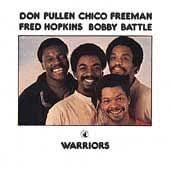
Fred Hopkins was born on October 11, 1947 in Chicago, Illinois and grew up in a musical family, listening to a wide variety of music from an early age. Attending DuSable High School, he studied music under Walter Dyett, who became well-known for mentoring and training musicians. Originally inspired to learn the cello, without one at the school Dyett steered him to the bass. After graduating from high school, while working at a grocery store he was encouraged to pursue music more seriously.
Hopkins soon began playing with the Civic Orchestra of Chicago, where he was the first recipient of the Charles Clark Memorial Scholarship, and studying with Joseph Gustafeste, principal bassist for the Chicago Symphony Orchestra at the time, as well as picking up piano duo gigs. He also began playing with Kalaparusha Maurice McIntyre, with whom he made his debut recording in 1970 Forces and Feelings. At that point he started becoming more serious about improvisation, playing with Muhal Richard Abrams’s Experimental Band and other related groups.
The early 1970s saw him forming a trio called Reflection with saxophonist Henry Threadgill and drummer Steve McCall. In 1975, he left Chicago, moved to New York City, regrouped with Threadgill and McCall, renamed their trio Air, and went on to tour and record extensively. He also joined the AACM, immersed himself in New York’s loft scene. Over the following decades, he increasingly gained recognition, gigging with Roy Haynes.
He performed and recorded with Muhal Richard Abrams, Hamiet Bluiett, Anthony Braxton, Marion Brown, Arthur Blythe, Oliver Lake, David Murray, Diedre Murray, and Don Pullen, as well as with various groups led by Threadgill. Moving back to Chicago in 1997, he continued to perform, tour, and record with a wide variety of musicians. Double bassist Fred Hopkins passed away on January 7, 1999 at age 51 of heart disease at the University of Chicago Hospital.

More Posts: bandleader,bass,history,instrumental,jazz,music
Daily Dose Of Jazz…
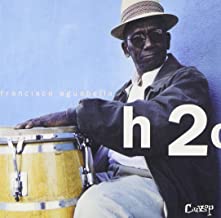
Francisco Aguabella was born on October 10, 1925 in Matanzas, Cuba. Demonstrating a special aptitude for drumming at an early age, he was initiated into several Afro-Cuban drumming traditions, including batá, iyesá, arará, olokún, and abakuá. Aguabella also grew up with rumba.
He is one of a handful of Cuban percussionists who came to the United States in the 1940s and 50s. In the 1950s, he left Cuba to perform with Katherine Dunham in the Shelley Winters film Mambo filmed in Italy. He immigrated to the United States in 1953, performing and touring with Peggy Lee for the next seven years.
During his long career, he performed in Europe, Australia, South America, and throughout the United States, including the White House. Aguabella enjoyed extensive music performing and recording careers, delighted many audiences with his masterful and powerful rhythms.
Francisco performed with many great jazz artists such as Dizzy Gillespie, Tito Puente, Mongo Santamaria, Frank Sinatra, Peggy Lee, Eddie Palmieri, Cachao, Lalo Schifrin, Cal Tjader, Nancy Wilson, Poncho Sanchez, Bebo Valdes, Carlos Santana, and numerous others. He is featured in two documentaries, Sworn to the Drum and Aguabella. He has also appeared with his ensemble on television programs.
During the Seventies, he was a member of the Jorge Santana Latin rock band Malo. Francisco was a widely recognized master conguero and bata artist, a caring and knowledgeable instructor. Aguabella was a faculty member at the annual Explorations in Afro-Cuban Dance and Drum workshop hosted by the Humboldt State University Office of Extended Education in Arcata, California. While living in Los Angeles, California, he taught Afro-Cuban drumming to undergraduate and graduate students at the University of California, Los Angeles.
A prolific session musician and recorded seven albums as a leader, throughout his career, he played congas, bata, quinto, coro, shekere, drums, claves, bongos, timbales, cajon, and other assorted percussion instruments. Percussionist Francisco Aguabella, who received a National Heritage Fellowship from the National Endowment for the Arts, passed away in Los Angeles on May 7, 2010 of a cancer-related illness.
More Posts: bandleader,history,instrumental,jazz,music,percussion
Daily Dose Of Jazz…
Elmer Chester Snowden was born on October 9, 1900 in Baltimore, Maryland and by 1917, a month before his 17th birthday, his listed occupation was a musician. While still living at home with his mother in 1920, the census had him employed as a musician in a dance hall.
The original leader of the Washingtonians, he brought the group to New York City in 1923. However, unable to get a booking, he sent for Duke Ellington, who was with the group when it recorded three test sides for Victor and who eventually took over leadership, and that band became his famous orchestra.
Making numerous appearances as a session musician, sideman, or accompanist on almost every New York City label from 1923 on, Elmer was often in trios with Bob Fuller on clarinet and Lou Hooper on piano. They rarely received credit for their work during those days but did show up on two Bessie Smith sides and six sides for the Sepia Serenaders.
Snowden was also a renowned bandleader who employed at one time or another Count Basie, Jimmie Lunceford, Bubber Miley, “Tricky Sam” Nanton, Frankie Newton, Benny Carter, Rex Stewart, Roy Eldridge, and Chick Webb in his various bands.
So active in the 1920s he was an agent and musician, and at one time had five bands playing under his name in New York, one of which was led by pianist Cliff Jackson. Most of his bands were not recorded, but a Snowden band that included Eldridge, Al Sears, Dicky Wells, and Sid Catlett appeared in a 1932 film, Smash Your Baggage.
By the mid-1930s his career was one of relative obscurity in New York, however, he continued to play throughout the 30s, 40s and 50s far from the limelight. A dispute with the New York Musicians Union, he moved to Philadelphia, Pennsylvania where he taught music. Counted among his pupils were pianist Ray Bryant, his brother, bassist Tommy Bryant, and saxophonist Sahib Shihab.
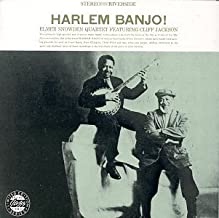
Working as a parking lot attendant in 1959 disc jockey Chris Albertson, ran across him and the following year brought Snowden and singer-guitarist Lonnie Johnson together for two Prestige albums. He assembled a quartet that included Cliff Jackson for a Riverside session, Harlem Banjo, and, in 1961 he put together a sextet session with Roy Eldridge, Bud Freeman, Jo Jones, and Ray and Tommy Bryant that was released on the Fontana and Black Lion labels.
Appearing at the 1963 Newport Jazz Festival gave his career a boost, then he moved to California to teach at the University of California, Berkeley, and played with Turk Murphy as well as taking private students for lessons in guitar and banjo. He toured Europe in 1967 with the Newport Guitar Workshop. In 1969, banjoist Elmer Snowden, who also played guitar and all the reed instruments, and is responsible for launching the careers of many top musicians, moved back to Philadelphia, where he passed away on May 14, 1973.
More Posts: bandleader,banjo,history,instrumental,jazz,music
Daily Dose Of Jazz…
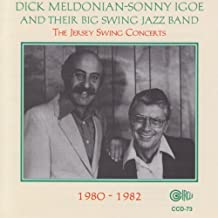
Owen Joseph “Sonny” Igoe was born on October 8, 1923 in Jersey City, New Jersey and grew up in Ridgewood, New Jersey. He attended Ridgewood High School when he got his start after winning a Gene Krupa drumming contest. His playing was initially influenced by Krupa, but he soon drew upon elements of Max Roach and others, which eventually developed into an exuberant and individual style.
From the mid-1940s to 1988, Sonny performed on over 79 recordings with bands and artists, including The Buddy Stewart Quintet, Benny Goodman and His Orchestra, Woody Herman and His Orchestra, Frances Wayne with Neal Hefti and His Orchestra, Rita Moss with the George Williams Orchestra, Charlie Ventura, Tony Bennett, Billy Maxted and His Manhattan Jazz Band, The Chuck Wayne Quintet, The Don Elliott Quintet, Joe Wilder, Phil Napoleon and His Original Memphis Five, Sammy Spear, Pee Wee Erwin, Joe Williams, Marlene Ver Planck, Savina Hartwell, Dick Meldonian, and Doctor Billy Dodd.
In the 1960s, Igoe was a member of the NBC Television Orchestra and then the CBS Television Orchestra, where his credits included The Ed Sullivan Show and The Jackie Gleason Show.
Drummer Sonny Igoe, who toured with the orchestras of Tommy Reed, Les Elgart, Ina Ray Hutton, Benny Goodman, and Woody Herman, passed away on March 28, 2012 in Emerson, New Jersey where he was a longtime resident.
More Posts: bandleader,drums,history,instrumental,jazz,music
Daily Dose Of Jazz…
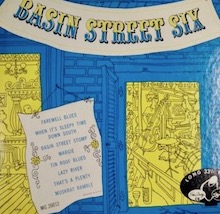
George Girard was born on October 7, 1930 in Jefferson Parish, Louisiana. In high school, he studied music under Johnny Wiggs and became a professional musician immediately after graduating in 1946. He played and toured with the bands of Johnny Archer and Phil Zito before co-founding the band The Basin Street Six, made up mostly of friends he had grown up with, including clarinetist Pete Fountain. The band got a regular gig at L’Enfant’s Restaurant in New Orleans, as well as regular television broadcasts over WWL. The band started receiving favorable national attention, but Girard was dissatisfied with it and broke up the band in 1954.
He found his own band, George Girard & the New Orleans Five which included trombonist Bob Havens, drummer Paul Edwards, and bassist Bob Coquille. He landed a residency at the Famous Door in the French Quarter, recorded for several labels, and got a weekly broadcast on CBS. His ambitions to make a national name for himself and the musical ability to do so fell short of time as he became ill and in 1956 had to give up playing.
Trumpeter George Girard, a member of the Basin Street Six whose technical ability combined Dixieland and big band style trumpet, passed away from colon cancer in New Orleans, Louisiana on January 18, 1957.
More Posts: bandleader,history,instrumental,jazz,music,trumpet