

Daily Dose Of Jazz…
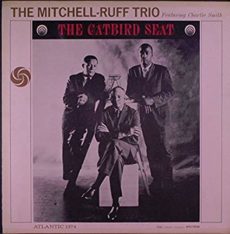
Dwike Mitchell was born Ivory Mitchell Jr. on February 14, 1930 and raised in Dunedin, Florida. He began playing piano around the age of three after his father, who had a job driving a garbage truck, brought home an old piano discarded by its owner. With the help of his mother, who made him play exercises and scales, and a cousin, who had been taking piano lessons herself, he soon displayed an exceptional aptitude for the instrument. He began performing in public at the age of five. His mother, a soloist in her church choir, needed an accompanist and gave the job to her young son. Before long he was playing for the entire Sunday morning service, a role he would continue to perform through the age of seventeen while attending Pinellas High School.
In 1946, Mitchell enlisted and was stationed at Lockbourne Air Force Base, at that time an all-black facility renowned for its excellent music program, where he was assigned to the band. It was here that he heard the music of Rachmaninoff that impacted his piano style development. Post-discharge from the Army, he went to the Philadelphia Musical Academy, where he studied under pianist Agi Jambor. After graduation, he joined Lionel Hampton and changed his name from Ivory to Dwike, at his mother’s suggestion, based on several family names.
By the mid-Fifties, he reunited with French horn player Willie Ruff, when he joined the Hampton orchestra. In 1955 the two men left the orchestra to form the Mitchell-Ruff jazz duo. The duo placed an emphasis on introducing American jazz music in parts of the world unfamiliar with the idiom. Among these, were visits to the Soviet Union in 1959 and to China in 1981. Throughout his duo and trio career they recorded fourteen albums, he also taught piano. In 2012, after becoming ill, he returned to his native South, spending his last months in Jacksonville, Florida. On April 7, 2013 pianist Dwike Mitchell passed away from pancreatic disease.

More Posts: bandleader,educator,history,instrumental,jazz,music,piano

Daily Dose Of Jazz…
Brian Lemon was born on February 11, 1937 in Nottingham, England to parents who were semi-professional dance-band violinists who both worked for the cigarette manufacturer John Player & Sons. Inspired by Fats Waller and later by Art Tatum and Teddy Wilson, he studied the piano with Reg Conroy, a local teacher, and was soon proficient enough to perform in palais bands in his home city.
By the mid-1950s, at 19, he moved to London and joined Freddy Randall’s group. After that, he worked with George Chisholm and Kenny Baker. Over the years, Brian worked with Benny Goodman, Charlie Watts, Scott Hamilton, Buddy Tate, Milt Jackson, Ben Webster, and Digby Fairweather. He led an octet that played songs by Billy Strayhorn.
For 10 years from 1994 Lemon recorded a sequence of 27 albums for Zephyr, with seven as leader. Zephyr was set up by retired businessman John Bune to record Lemon’s work. Adelaide Hall recorded an album with The Brian Lemon Half-Dozen. A rare copy is at the British Library.
After the development of severe osteoarthritis in his handsLemon retired from music around 2005. Pianist and arranger Brian Lemon passed away on October 11, 2014.
More Posts: bandleader,history,instrumental,jazz,music,piano
Daily Dose Of Jazz…
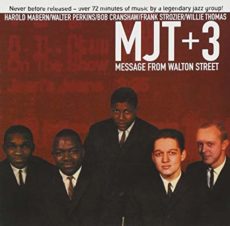
Walter “Baby Sweets” Perkins was born on February 10, 1932 in Chicago, Illinois. Starting out in his hometown, he began his professional career drumming with Ahmad Jamal in 1956–57. He recorded as a leader for Argo Records in 1957 under the name MJT+3 with trumpeter Paul Serrano, Nicky Hill on tenor saxophone, Muhal Richard Abrams on piano, and bassist Bob Cranshaw.
1959 witnessed the regrouping under the same name with Willie Thomas on trumpet, Frank Strozier on alto saxophone, pianist Harold Mabern, and Cranshaw on bass. They recorded four albums for Vee-Jay in 1959 and 1960 and played in Chicago until 1962 when Walter made his move to New York City.
Perkins played with Sonny Rollins in 1962 and accompanied Carmen McRae in 1962–63. By 1964 he was playing with Art Farmer and Teddy Wilson, however, following this he recorded with Rahsaan Roland Kirk, George Shearing, Gene Ammons, Charles Mingus, Billy Taylor, Etta James, J.J. Johnson, Johnny Coles, Booker Ervin, Jaki Byard, Lucky Thompson, Pat Martino, Sonny Stitt, Sonny Criss, Ray Bryant, Duke Pearson, Bobby Timmons, and Charles Earland. And that’s the shortlist as he recorded some 44 albums throughout his career as a sideman.
Drummer Walter Perkins passed away on February 14, 2004 in Queens, New York.
More Posts: bandleader,history,instrumental,jazz,music,vocal

Daily Dose Of Jazz…
Erskine Butterfield, born February 9, 1913 in Syracuse, New York and began playing piano at an early age when his family moved to Newark, New Jersey, where he later studied piano. In the 1930s, he regularly appeared on radio, including WOR in New York City, and played with Noble Sissle’s orchestra. He made his first sound recording and reproduction in 1937 on the Variety record label.
In 1938, he signed with Decca Records for which he recorded over forty titles between 1940 and 1942, many of which were released. Butterfield was called the Singing Vagabond of the Keys by the Chicago Defender in 1939. He was innovative in utilizing black and white musicians together in his combo, which included session musicians such as clarinetist Jimmy Lytell, guitarist Carmen Mastren, and Haig Stevens on bass.
1939 saw Butterfield signing with Joe Davis of Beacon Records, with whom he would maintain a long term relationship. However, in 1943 he was drafted but continued to play in a group, recorded eight titles for Joe Davis under the name Erskine Butterfield and his Blue Boys in ‘44 and cutting V-Discs in 1945.
After World War II, Erskine formed a trio and toured extensively, but his music style was less successful commercially. He recorded for a number of small labels in the late 1940s, after which his recording activity dropped off. In 1956, however, he again recorded a number of titles for Joe Davis with a reformed group, Butterfield and his Blue Boys, including musicians such as Sam “The Man” Taylor on saxophone and Panama Francis on drums. He made appearances on The Nat King Cole Show, The Tony Martin Program and The Jo Stafford Show.
His light swing and traditional piano phrases resulted in some of his songs, such as Lovin’ Man and Because Of You, being used in film soundtracks. Pianist, singer, bandleader and composer Eskine Butterfield, credited with helping to invent the style of cocktail piano, passed away on July 11, 1961 in New York City.
More Posts: bandleader,history,instrumental,jazz,music,piano

Daily Dose Of Jazz…
On February 8, 1947 Kerrie Agnes Biddell was born in the inner-city community of Kings Cross in Sydney, New South Wales, Australia. An only child two pianist parents, her mother an accomplished jazz pianist and her father a part-time pianist, she attended St. Vincent’s Convent at the age of six, soon after her father left her mother. In 1962, she suffered a collapsed lung and rheumatoid arthritis, the latter of which affected her piano playing, so she decided to become a singer.
At twenty, Kerrie sang background vocals for Dusty Springfield and impressed, Springfield suggested she become a lead singer. She joined a local band, The Echoes, then in 1968, The Affair. With her added voice the group was able to cover various musical styles, such as soul, funk, and pop compositions. In 1969, they competed and won the national competition Hoadley’s Battle of the Sounds in the vocal-group category. The prize was a trip to London, England, the group relocated in mid-1970, only to disband months later. Before disbanding, they recorded Sly and the Family Stone’s Sing a Simple Song, which would become one of Biddell’s signature songs.
Returning to Australia she toured with the Daly-Wilson Big Band, performing swing music. In between her stint with Wilson, she toured with Dudley Moore, Cilla Black, and Buddy Rich. In 1972, married to former alto saxophonist for Sounds Incorporated David Glyde, they moved to Canada and her career as a session singer began soon after. She and her husband toured in the United States, including clubs in Las Vegas. Offered a three-year six-figure contract with the MGM Grand Hotel and Casino, but declined and moved back to Australia, enrolling in the Sydney Conservatorium of Music.
Moving on to a solo career, her first album won two ARIA awards, she sang on hundreds of jingles, television shows and film scores, and joined the faculty of the Jazz Diploma course at the Conservatorium. She wrote a one-woman show, Legends, which later included June Bronhill, Lorrae Desmond, Toni Lamond, and Jeanne Little. In 2001, due to poor health, she retired from performing but continued her teaching career. On 4 September 2014, jazz and session singer and vocal teacher Kerrie Biddell passed away from a stroke on September 5, 2014. She was 67.
More Posts: bandleader,history,instrumental,jazz,music,vocal