Daily Dose Of Jazz…
Makanda Ken McIntyre was born Kenneth Arthur McIntyreon on September 7, 1931 in Boston, Massachusetts to a father whoplayed mandolin. He started his musical life on the bugle when he was eight years old, followed by piano. In his teens he discovered the music of Charlie Parker and began playing saxophone at nineteen, then clarinet and flute two years later. Serving in the Army in 1953, for two years he played saxophone and piano in Japan.
Following his discharge Ken attended the Boston Conservatory where he studied with Gigi Gryce, Charlie Mariano, and Andy McGhee. In 1958 he received a degree in flute and composition with a master’s degree the next year in composition. He also received a doctorate (Ed.D.) in curriculum design from the University of Massachusetts Amherst in 1975.
1960 saw McIntyre recording as a leader with Eric Dolphy. The following year and for the next six he taught music in public schools. He took oboe lessons in New York before playing with Bill Dixon, Jaki Byard, and the Jazz Composer’s Orchestra. He went on to spend three years with pianist Cecil Taylor. During the 1970s he recorded with Nat Adderley and Beaver Harris and in the 1980s with Craig Harris and Charlie Haden.
In 1971, he founded the first African American Music program in the United States at the State University of New York College at Old Westbury, teaching for 24 years. He also taught at Wesleyan University, Smith College, Central State University, Fordham University, and The New School for Jazz and Contemporary Music.
In the early 1990s, while performing in Zimbabwe, a stranger handed him a piece of paper with the word “Makanda” written on it, which translates to many skins in the Ndebele language and many heads in Shona. He changed his name to Makanda Ken McIntyre. At the age of 69 on June 13, 2001 he transitioned from a heart attack in New York City.
More Posts: bass clarinet,bassoon,double bass,drums,flute,history,instrumental,jazz,music,oboe,piano,saxophone

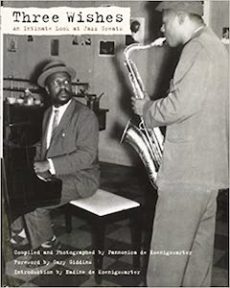
Three Wishes
When the curious Pannonica posed the question of three wishes to Chico Hamilton he came back with the following answers:
- “Well, I think the first wish would be I want everything wonderful for my wife and my family , because they have sacrificed.”
- “I don’t know. I wish that this God-given talent I have ~ someone will get some good out of it..”
- “I wish I never lose my sense of humor.”
*Excerpt from Three Wishes: An Intimate Look at Jazz Greats ~ Compiled and Photographed by Pannonica de Koenigswarter
More Posts: baroness,drums,history,instrumental,jazz,music,pannonica,three,wishes

Daily Dose Of Jazz…
Philip William Seamen was born on August 28, 1926 in Burton upon Trent, Staffordshire, England. He began playing drums at the age of six, turning professional at the age of 18 by joining Nat Gonella and his Georgians in 1944. At 20 he spent a year with Gordon Homer Big Band at the Coronation Ballroom in Ramsgate. He joined the Tommy Sampson Orchestra in 1948 and by 1949, Seamen and tenor saxophonist Danny Moss formed a bebop quintet from within the ranks and was featured on a radio broadcast by the orchestra.
He then went on to play in the Joe Loss Orchestra for about 14 months before taking the top job with Jack Parnell from 1951 until midway 1954. Seamen, being much sought after during the 1950 played in Kenny Graham’s Afro-Cubists projects from 1952 to 1958, from 1954 onwards with the Joe Harriott Quartet, the Ronnie Scott Orchestra and Sextet. He was recruited opn countless sessions as well to perform with Dizzy Reece, Victor Feldman, Jimmy Deuchar, Kenny Baker, Vic Ash, Don Rendell, Stan Tracey, Laurie Johnson, Big Bill Broonzy and Josh White, to name a few.
In 1957 Phil was on his way to America with the Ronnie Scott Sextet as part of a Musicians’ Union exchange tour deal. Unfortunately the Southhampton custom officers found him in possession of drugs, killing his lifelong dream of visiting the States. In 1958, the West End production of West Side Story opened with him after Leonard Bernstein reputedly specifically asked for him, so the producers hired him.
During the first half of the 1960s, he worked often with Tubby Hayes, Joe Harriott, played a couple of nights with Dexter Gordon at Ronnie Scott’s, and recorded with Carmen McRae. In 1964 he played R&B with Alexis Korner and Georgie Fame.
He started teaching in 1962, one of his pupils being Ginger Baker, who went on to influence a whole generation of rock drummers. However, his addiction to alcohol, heroin and other drugs hampered his health and career as many bandleaders refused to hire him with the exception of Freddie Hubbard in 1964 and Roland Kirk in 1967 with a UK tour. On October 13, 1972 drummer Phil Seaman transitioned in his sleep at his home in Old Paradise Street Lambeth, South London, at the age of 46.
Bestow upon an inquiring mind a dose of a Burton upon Trent drummer to motivate the perusal of the genius of jazz musicians worldwide whose gifts contribute to the canon…

The Quarantined Jazz Voyager
As the Jazz Voyager continues to social distance and wears his mask inside stores when grocery shopping and following doctor office protocol, he is still finding time to listen to great jazz. This week coming off the shelves is an album titled Blossom Time at Ronnie Scott’s by pianist and vocalist Blossom Dearie and is a live recording at Ronnie Scott’s Jazz Club in Soho, London, England in 1966. This was her first live album and was released on the British record label, Fontana. The liner notes were written by Jimmy Parsons.
Her personal favorite recording, the swinging trio will intoxicate you with this set of songs just as if you were there in the intimate space listening. Her girlish, soft voice is her signature as she executes each song with style. This is the first of four albums she will record on the Fontana label.
Track List | 39:23
- On Broadway (Barry Mann, Cynthia Weil, Jerry Leiber, Mike Stoller) ~ 3:55
- (Ah, the Apple Trees) When the World Was Young (Michel Philippe-Gérard, Angele Vannier, Johnny Mercer) ~ 4:20
- When in Rome (Cy Coleman, Carolyn Leigh) ~ 4:45
- The Shadow of Your Smile (Johnny Mandel, Paul Francis Webster) ~ 4:13
- Ev’rything I’ve Got (Richard Rodgers, Lorenz Hart) ~ 4:29
- Once Upon a Summertime (Eddie Barclay, Michel Legrand, Eddy Marnay, Johnny Mercer) ~ 3:51
- I’m Hip (Dave Frishberg, Bob Dorough) ~ 2:48
- Mad About the Boy (Noël Coward) ~ 5:05
- The Shape of Things (Sheldon Harnick) ~ 2:42
- Satin Doll” (Duke Ellington, Johnny Mercer, Billy Strayhorn) ~ 5:15
- Blossom Dearie ~ piano, vocals
- Jeff Clyne ~ double bass
- Johnny Butts ~ drums
More Posts: adventure,album,bass,club,drums,festival,genius,jazz,museum,music,piano,preserving,restaurant,travel

Daily Dose Of Jazz…
Louis Freddie Kohlman was born on August 25, 1918 in New Orleans, Louisiana and studied under the famed drummer Louis Cottrell, Sr., and Manuel Manetta. He began playing professionally as a teenager, working with A. J. Piron, Joe Robichaux, Papa Celestin, and Sam Morgan.
Moving to Chicago, Illinois in the middle of the 1930s, he played with Albert Ammons, Stuff Smith, Earl Hines, and Lee Collins. After returning to New Orleans in 1941, he led his own band from 1944. Among the musicians in his band was pianist Dave “Fat Man” Williams. In the mid-1950s he played briefly with Louis Armstrong and recorded as a leader with the Jambalaya Four in 1953. He moved back to Chicago and became the house drummer at Jazz, Ltd. There he played with everyone from Billie Holiday to Art Hodes before once again returning to New Orleans in the 1960s.
Back home he played with Louis Cottrell, Jr., the Dukes of Dixieland, and the Onward Brass Band. In 1969 he appeared at the New Orleans Jazz Festival. As a member of the Preservation Hall Jazz Band, he traveled throughout the United States and overseas.[1]
Playing European festivals with his own groups in the 1970s and 1980s, Freddie recorded with Chris Barber and Dr. John in 1980, and also appears on record with Albert Nicholas, Art Hodes, Bob Wilber, Harry Connick, Jr., the Excelsior Brass Band, and the Heritage Hall Jazz Band.
Kohlman appeared in several films, including Pete Kelly’s Blues, Pretty Baby and Angel Heart.
Drummer, vocalist and bandleader Freddie Kohlman transitioned of cancer at his home in New Orleans, aged 72 on September 29, 1990.
More Posts: bandleader,drums,history,instrumental,jazz,music,vocal