


Daily Dose Of Jazz…
Robert Conti was born November 21, 1945 in Philadelphia, Pennsylvania and was an autodidact, first performing locally at age fourteen and mentoring with Pat Martino. In 1966, after four years on the road touring North America, he settled in Jacksonville, Florida.
In 1970, he dropped out of the music business to work in the securities field. Six years later he picked up his guitar and by 1979, he signed with Discovery Records. Conti released Solo Guitar as his debut as a leader and his sophomore project Latin Love Affair. By 1982 he left music again for the business world but again in 1985 he released another album. The following year he headlined the Florida National Jazz Festival, with Jimmy McGriff and Nick Brignola as his sidemen.
In mid-1988 he was offered a position under filmmaker Dino De Laurentiis in Beverly Hills, California. After a lengthy recovery from a back injury in late 1988, he was offered a position as resident jazz guitarist at the Irvine Marriott, a job he held until 1998.
Since starting his website in 2000, he has released 30 educational DVDs on jazz guitar, including pro chord melody and improvisation using his No Modes No Scales approach to teaching jazz guitar. Guitarist and educator Robert Conti, who has his own line of solid spruce thinline archtop jazz guitars since 2009, continues to teach, and perform.

More Posts: bandleader,educator,guitar,history,instrumental,jazz,music
Daily Dose Of Jazz…
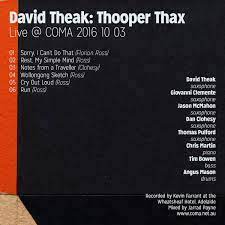
David Theak was born on November 10, 1970 in Sydney, New South Wales, Australia and was raised in a house of impromptu parties. His childhood found him listening to his downstairs neighbor teaching piano every afternoon which led to lessons and a piano for Christmas. His bandmistress at Mona Vale PS introduced him to the saxophone but paid his dues on the baritone horn for a couple of years. After a brief stint at the Conservatorium High School, he returned to the local high school with some enthusiastic music teachers. They encouraged us to improvise and created opportunities for us to play in jazz and rock bands.
he following years saw David practicing, composing, gigging, releasing his own albums and organizing tours of Australia & Europe for his quartet, theak-tet, but with limited opportunities in the 90’s, he became involved with a musician led organization, the Jazzgroove Association, which received NSW and Federal government funding that allowed presentation of new music every week as well as create a record label and form an original creative jazz orchestra, The Jazzgroove Mothership Orchestra.
He went on to become involved with SIMA, WAYJO and the formation of the Australian National Jazz Orchestra and ANJO Youth Big Band. David has been running a boutique international jazz festival for the past five years, is currently a Senior Lecturer in Jazz at the Sydney Conservatorium of Music, Artistic Director of the Australian National Jazz Orchestra, an advisory panel member of the Western Australian Youth Jazz Orchestra, President of the Sydney Improvised Music Association and Artistic Director of the Sydney Con Jazz Festival.
Jazz saxophonist, composer, bandleader, educator, festival director and jazz protagonist, David Theak, who continues to compose, perform and tour, is the artistic director of the Jazzgroove Mothership Orchestra and collaborates with a who’s who of international jazz musicians.
More Posts: bandleader,composer,educator,history,instrumental,jazz,music,saxophone
Daily Dose Of Jazz…
Gabrielle Goodman was born October 23, 1964 in Baltimore, Maryland and her early years of singing in church in Baltimore gave her the skillset to blend jazz and gospel. As a protege of Roberta Flack began her international performance career as a backing vocalist for Flack in the mid-1980s while at the Peabody Institute. She continued to tour and record with her mentor for several years opening for Miles Davis, Ray Charles, the Crusaders and other legends in Japan, Switzerland, Brazil and others around the world.
Goodman’s breakthrough as a solo recording artist happened when she appeared on Norman Connors 1988 album Passion on Capitol Records. She sang lead on five songs, which led to her recording two jazz albums Travelin’ Light in 1993 and Until We Love the following year with Kevin Eubanks, Christian Mcbride, Gary Bartz, Gary Thomas, and Terri Lyne Carrington.
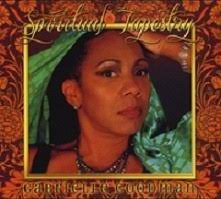
It would be another ten years before she would drop her third album which landed in the soul jazz category ~ Angel Eyes, Songs From The Book and Spiritual Tapestry for the Goodness label. As a touring and performing solo artist she has played festivals and with symphony orchestras.
Goodman has written and arranged songs for Chaka Khan and Roberta Flack, performed alongside Dee Dee Bridgewater and Michael Buble, and also provided vocals for Patti Labelle, Nona Hendryx, Jennifer Hudson, Mary J. Blige, Patrice Rushen, Freddie Jackson, Bryan Ferry, and George Duke.
Vocalist, composer, author, and educator Gabrielle Goodman has a four-octave vocal range and has been an associate professor of voice at Berklee College of Music since 1998.

More Posts: bandleader,educator,history,instrumental,jazz,music,vocal
Daily Dose Of Jazz…
Fred Hersch was born October 21, 1955 in Cincinnati, Ohio to Jewish parents and began playing the piano at the age of four, composing music by eight. By ten he won national piano competitions.
Hersch first became interested in jazz while at Grinnell College in Iowa. He dropped out of school and started playing jazz in Cincinnati, continuing his studies at the New England Conservatory under Jaki Byard and attracting attention from the press in a college recital. Upon graduation, he became a jazz piano instructor at the college.
1977 saw Fred moving to New York City, then gigged with Art Farmer in Los Angeles, California in 1978. He would play with Farmer again three years later, played for singer Chris Connor, then with Joe Henderson. He would go on to perform with Jane Ira Bloom, Jamie Baum, Toots Thielemans, Eddie Daniels, and Janis Siegel. A fortuitous firing of his pianist by Art Pepper gave Hersch the launch of his career when he filled in for the pianist.
In 1986, he taught at Berklee College of Music, performed and recorded sixty-four albums as a leader or co-leader, seventy-nine as a sideman and wrote an autobiography, Good Things Happen Slowly: A Life In and Out of Jazz.
In 1993, Hersch came out as gay and has been treated for HIV since 1984. He fell into a coma in 2008 for two months but when he regained consciousness, he had lost all muscular function as a result of his long inactivity and could not play the piano. After rehabilitation, he was able to play again. He continues to compose, perform and record.
More Posts: bandleader,composer,educator,history,instrumental,jazz,music,piano
Daily Dose Of Jazz…
Paul Tanner was born on October 15, 1917 in Skunk Hollow, Campbell County, Kentucky. One of six brothers, each could play an instrument and he learned to play the trombone at a reform school where his father was employed as superintendent. The brothers were playing in what he described as a strip joint when Glenn Miller heard him and offered him a position in his band.
He gained fame as a trombonist, playing with Glenn Miller and His Orchestra from 1938 to 1942, the group’s entire duration. When it disbanded, Paul joined the U.S. Army Air Force, becoming a part of the 378th Army Service Forces Band at Ft Slocum, New York. He later worked as a studio musician in Hollywood.
Tanner earned bachelor, master and doctorate degrees at the University of California, Los Angeles between 1958 and 1975. He was influential in launching UCLA’s highly regarded jazz education program in 1958. He became a professor at UCLA and authored or co-authored several academic and popular histories related to jazz.
He developed and played the Electro-Theremin, an electronic musical instrument that mimics the sound of the theremin. He can be heard performing on the opening title theme music of My Favorite Martian, on several 1966-1967 Beach Boys recordings, Good Vibrations, Wild Honey, I Just Wasn’t Made For These Times, and Tune L.
Trombonist, educator and inventor Paul Tanner transitioned from pneumonia on February 5, 2013 at the age of 95. Of all the members of the Glenn Miller Orchestra, only trumpeter Ray Anthony is still living.
More Posts: educator,history,instrumental,inventer,jazz,music,trombone