

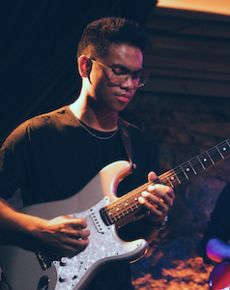
ALVIN BRENDAN, BEN MILLMAN & TRENT OTTER
Guitarist Alvin Brendan has been crafting a strong identity for himself as a jazz musician and session musician in Vancouver over the last few years. Despite his youth, Brendan has been fortunate enough to find himself in a variety of different recording sessions and live performances that has allowed him to hone his craft in a multitude of styles and genres. He is excited to merge many of his musical loves in this new format. Brendan has recruited long-time collaborators Benjamin Millman (keys) and Trent Otter (drums) to showcase their collective love of the improvisational aspect of jazz music, and the modern aesthetic of contemporary R&B and neo-soul.
NO RESERVATION REQUIRED – Walk-in only.
More Posts: adventure,album,club,festival,genius,guitar,jazz,museum,music,preserving,restaurant,travel
Daily Dose Of Jazz…
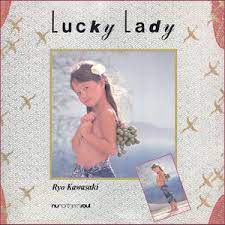
Ryo Kawasaki was born February 25, 1947 in Kōenji, Tokyo during Japan’s recovery in the early post World War II period. His mother encouraged him to take piano and ballet lessons, and he took voice lessons and solfege at age four and violin lessons at five, and he was reading music before elementary school. As a grade scholar, he began a lifelong fascination with astronomy and electronics. When he was 10, he bought a ukulele and at 14 he got his first acoustic guitar. The album Midnight Blue by Kenny Burrell and Stanley Turrentine inspired him to study jazz.
In high school, he began hanging out at coffee-houses that featured live music, formed a jazz ensemble and built an electronic organ that served as a primitive synthesizer. By the time he was 16, his band was playing professionally in cabarets and strip joints. Although he continued to play music regularly, he attended Nippon University, majored in physics and earned his Bachelor of Science Degree. He also did some teaching and contest judging at the Yamaha musical instrument manufacturer’s jazz school. Additionally, he worked as a sound engineer for Japanese Victor Records and BGM/TBS Music, where he learned mixing and editing.
He recorded his first solo album for Polydor Records when he was 22. And was voted the No. 3 jazz guitarist in a Japanese jazz poll. He spent most of the next three years working as a studio musician on everything from advertising jingles to pop songs including countless radio and TV appearances. He recorded his second album for Toshiba when he was 24. He played with B.B. King at a blues festival and also met George Benson and they jammed for five hours at Kawasaki’s house.
Moving to New York City in 1973 he was offered an immediate gig with Joe Lee Wilson playing at the Lincoln Center as part of the Newport Jazz Festival. Soon Ryo was jamming regularly as part of the loft scene and was invited to play with Bobbi Humphrey. A few months later Gil Evans invited him to join The Gil Evans Orchestra which was then working on a jazz recording, The Gil Evans Orchestra Plays the Music of Jimi Hendrix. He would go on to record on Evan’s There Comes a Time. He became the guitarist in the Chico Hamilton Band, made his debut U.S. album, Juice, in 1976 for RCA and was one of the first Japanese jazz artists to sign with a major label in the States.
He explored Music of India, recorded with Dave Liebman and toured European jazz festivals with Joanne Brackeen as a piano/guitar duo and they recorded a pair of albums. In the mid-1980s, Kawasaki drifted out of performing music in favor of writing music software for computers. He also produced several techno dance singles, formed his own record company called Satellites Records, and later returned to jazz-fusion in 1991.
He continued to release albums up to 2017 and had two retrospective Ep’s released spanning years of 1976~1980 and 1979~1983. Guitarist and keyboardist Ryo Kawasaki transitioned on April 13, 2020 in Tallinn, Estonia at the age of 73.

More Posts: audio engineer,bandleader,composer,guitar,history,instrumental,jazz,keyboard,music

Three Wishes
Calvin Newborn acknowledged Nica’s question of three wishes by speaking with these three:
-
- “Well, the first would be a new instrument ~ a new guitar.”
- “I want to have an estate, some property. You know.”
- “A beautiful woman.”
*Excerpt from Three Wishes: An Intimate Look at Jazz Greats ~ Compiled and Photographed by Pannonica de Koenigswarter
More Posts: baroness,guitar,history,instrumental,jazz,music,pannonica,three,wishes

Daily Dose Of Jazz…
Kim Reith was born on February 19, 1954 in San Diego, California. As a child, she was exposed to a large jazz, blues, folk, opera, world and ethnomusicology recording collection belonging to her music-loving mother.
In 1979 Reith made her entrée into music as a backup vocalist in an all-women’s blues and gospel chorale for San Francisco, California blues pianist, singer/songwriter and recording artist Gwen Avery. She began her instrumental career as a guitarist, singer and songwriter for an experimental SF punk-rock trio, the Well Babies. In 1985 she began studying guitar privately with San Francisco jazz guitarists Marlena Teich and Duncan James and with the Los Angeles/San Diego jazz guitarist Art Johnson, and spent many years in independent study.
1987 saw her beginning to focus exclusively on jazz studies, eventually getting her feet wet with various small San Francisco jazz bands. In 1992 she supported herself by playing solo jazz guitar on the streets of Paris, France returning to San Diego in 1993. That year, she joined acclaimed avant-garde Canadian saxophonist Maury Coles for duo explorations and performances. At the opposite end of the jazz spectrum, Kim also performed with the UCSD Big Band under Jimmie Cheatham’s direction. She formed both the duo Groove Yard and the Kim Reith Trio in 1994, performing extensively with both groups throughout San Diego between 1994 and 2000.
Reith has been composing jazz works for small and large ensembles since 1993, formally studying jazz theory, composing and arranging under Rick Helzer at SDSU. Recording her debut album BAIL! In late 1999 she documented her compositions and her ensemble work with San Diego bassist Bruce Grafrath. She has gone on to collaborate with Bronx-born Swiss resident Edmund J. Wood, on a series of experimental open improvisations, featuring Reith on hollow-body electric guitar and Wood on fretless bass and implied-time drum loops.
Guitarist Kim Reith currently composes and performs in Los Angeles, California. Unfortunately she has not posted any of her music on line.
More Posts: bandleader,composer,guitar,history,instrumental,jazz,music
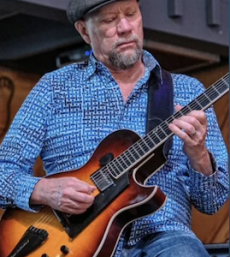
PAUL BOLLENBACK | HARLEM JAZZ SESSION
Paul Bollenback – guitar, Pat Bianchi – organ, Anthony Pinciotti – drums
More Posts: adventure,album,club,festival,genius,guitar,jazz,museum,music,preserving,restaurant,travel