

The Quarantined Jazz Voyager
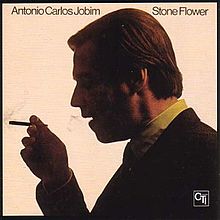
Stone Flower is the sixth studio album by Antônio Carlos Jobim. Recorded over a period of seven sessions in 1970 on March 16, April 23, 24, 29, and May 8, 20, and 22nd by Rudy Van Gelder at Van Gelder Studio in Englewood Cliffs, New Jersey. The album was produced by Creed Taylor, the album was released on July 7, 1970 on CTI Records. The album peaked at #18 on the Jazz Albums chart in 1971 and #196 on the Billboard 200.
Track Listing | 33:47 All tracks composed by Antônio Carlos Jobim, except where noted- Tereza My Love ~ 4:24
- Children’s Games ~ 3:30
- Choro ~ 2:10
- Brazil (Ary Barroso) ~ 7:25
- Stone Flower ~ 3:21
- Amparo ~ 3:41
- Andorinha ~ 3:32
- God and the Devil in the Land of the Sun ~ 2:23
- Sabiá ~ 3:58
- Antônio Carlos Jobim – piano, electric piano, guitar, vocals
- Harry Lookofsky – violin
- Joe Farrell – soprano saxophone
- Urbie Green – trombone
- Hubert Laws – flute
- Ron Carter – double bass
- João Palma – drums
- Airto Moreira – percussion
- Everaldo Ferreira – percussion
- Eumir Deodato – guitar, arranger

More Posts: adventure,club,genius,guitar,jazz,museum,music,piano,preserving,restaurant,travel,vocal,voyager
Daily Dose Of Jazz…
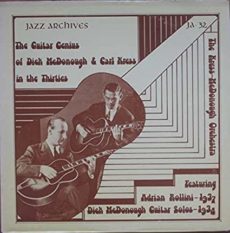
Richard Tobin McDonough was born on July 30, 1904 in New York City and began playing banjo and mandolin in high school. While matriculating through Georgetown University, he performed professionally at weekend dances and two years later started a band. Attending Columbia Law School he played with bands in New York City.
McDonough played with Red Nichols in 1927 as a banjoist, and soon after played with Paul Whiteman. He began studying the guitar and eventually was in demand for session work, recording with The Dorsey Brothers, Red Nichols, and Miff Mole. In the 1930s, he performed in a duo with jazz guitarist Carl Kress and cut several sessions with an orchestra under his own name, in addition to backing numerous other recording artists.
His session work with Mildred Bailey, Smith Ballew, The Boswell Sisters, Rube Bloom, Chick Bullock, The Charleston Chasers, Cliff Edwards, Gene Gifford, Benny Goodman, Adelaide Hall, Annette Hanshaw, Billie Holiday, Baby Rose Marie, Glenn Miller, Irving Mills, Red McKenzie, Johnny Mercer, Red Norvo, Fred Rich, Adrian Rollini, Pee Wee Russell, Ben Selvin, Artie Shaw, Frank Signorelli, Jack Teagarden, Claude Thornhill, Frankie Trumbauer, Joe Venuti, Don Voorhees, and Ethel Waters. He played in the Jam Session at Victor with Fats Waller, Bunny Berigan, and George Wettling.
Struggling with alcohol abuse during his adult life and guitarist Dick McDonough passed away of pneumonia on May 25, 1938 in New York City.

More Posts: bandleader,guitar,history,instrumental,jazz,music,tenor banjo
Daily Dose of Jazz…
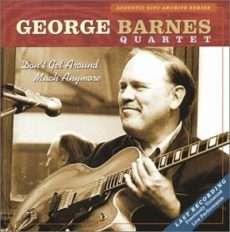
George Warren Barnes was born on July 17, 1921 in South Chicago Heights, Illinois. His father being a guitarist taught him to play the acoustic guitar at the age of nine. A year later, in 1931, Barnes’s brother made a pickup and amplifier for him. Barnes said he was the first person to play electric guitar.
From 1935~1937 he led a band that performed in the Midwest, 1938 he recorded the songs Sweetheart Land and It’s a Lowdown Dirty Shame with blues guitarist Big Bill Broonzy.
In doing so, it has been claimed that he became the first person to make a record on electric guitar, fifteen days before Eddie Durham recorded on electric guitar with the Kansas City Five, though the claim has been contested. In 1938, when he was seventeen, Barnes was hired as a staff guitarist for the NBC Orchestra, staff guitarist and arranger for Decca and recorded with Blind John Davis, Jazz Gillum, Merline Johnson, Curtis Jones, and Washboard Sam.
In 1940, Barnes released his first solo recording, I’m Forever Blowing Bubbles and I Can’t Believe That You’re in Love with Me on Okeh Records. Drafted in 1942 and serving in the Pentagon, after his discharge in 1946, he formed the George Barnes Octet and was given a fifteen-minute radio program on the ABC network.
In 1951, he was signed to Decca by Milt Gabler and moved from Chicago to New York City. In 1953, he joined the television orchestra on the show Your Hit Parade that was conducted by Raymond Scott and featured Barnes as a featured soloist. Working as a studio musician in New York City, playing on hundreds of albums and jingles from the early 1950s through the late 1960s. He played guitar on Patsy Cline’s New York sessions in April 1957.
In the Sixties, he recorded three albums for Mercury: Movin’ Easy (1960) with his Jazz Renaissance Quintet, Guitar Galaxies (1960), and Guitars Galore (1961). The latter two contained his orchestrations for ten guitars, known as his guitar choir, which used guitars in place of a horn section. The two albums employed a recording technique known as Perfect Presence Sound.
Barnes received the most attention as a jazz guitarist when he recorded as a duo with Carl Kress from 1961–1965. In 1969 Barnes formed a duo with jazz guitarist Bucky Pizzarelli that lasted until 1972. In 1973, he and cornetist Ruby Braff formed the Ruby Braff–George Barnes Quartet and recorded several albums.
He recorded seventeen albums as a leader and as a sideman, Barnes recorded another thirty-nine not limited to Louis Armstrong, Steve Allen, Tony Bennett, Jackie Cooper, Bob Dylan, Bud Freeman, Johnny Guarnieri, Dick Hyman, Betty Madigan, Wingy Manone, Carmen McRae, Jimmy McPartland, Sy Oliver, Don Redman, Buddy Rich, Gene Krupa, Jimmy Scott, Cootie Williams, and Joe Venuti.
As a studio musician, he also participated in hundreds of pop, rock, and R&B recording sessions. He played on many hit songs by the Coasters, on This Magic Moment by the Drifters, and on Jackie Wilson’s Lonely Teardrops. His electric guitar can be heard in the movie A Face in the Crowd.
He left New York City after his last European tour in 1975 to live and work in the San Francisco Bay area. Guitarist George Barnes, who was primarily a swing guitarist, passed away from a heart attack in Concord, California on September 5, 1977 at the age of 56.
More Posts: bandleader,composer,guitar,history,instrumental,jazz,music
The Quarantined Jazz Voyager
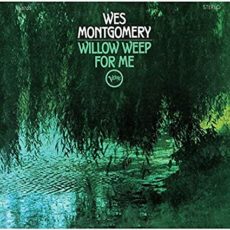
Willow Weep for Me is a jazz album recorded in 1965 by guitarist Wes Montgomery and was posthumously released in 1969. The arranger and conductor on the session was Claus Ogerman.
The album reached number 12 on the Billboard Jazz album chart in 1969. At the 1970 Grammy Awards Willow Weep for Me won the Grammy Award for Best Jazz Instrumental Album, Individual or Group.
After Montgomery’s death in 1968, Verve Records used recordings from the sessions that produced Smokin’ at the Half Note and the label hired arranger Claus Ogerman to write string and brass arrangements for “Willow Weep for Me”, “Portrait of Jennie,” “Oh! You Crazy Moon,” and “Misty.” Subsequent reissues erased the new backing arrangements.
Track Listing | 41:09- Willow Weep for Me (Ann Ronell) – 7:42
- Impressions (John Coltrane) – 5:01
- Portrait of Jenny (Burdge, Robinson) – 2:45
- The Surrey with the Fringe on Top (Rodgers, Hammerstein II) – 5:20
- Oh, You Crazy Moon (Burke, Jimmy Van Heusen) – 5:27
- Four on Six (Wes Montgomery) – 9:29
- Misty (Johnny Burke, Erroll Garner) – 6:45
- Wes Montgomery – guitar
- Wynton Kelly – piano
- Paul Chambers – bass
- Jimmy Cobb – drums
More Posts: adventure,club,genius,guitar,jazz,museum,music,preserving,restaurant,travel,voyager

Daily Dose Of Jazz…
Michael Arlt was born in Bünde, Westfalen, Germany on July 1, 1960 and began playing guitar as a teenager. From the beginning, he was interested in a musical gamut, playing in rock, blues, fusion, and free bands. Going to Boston, Massachusetts in the mid-Eighties, he studied at Berklee College of Music, took private lessons from Mike Metheny, and then continued his studies in the Netherlands at the Amsterdam Academy of Arts under Wim Overgaauw.
Since that time, Michael has performed in a variety of ensembles with musicians like Maria de Fatima, Jerry Granelli, Sigi Busch, Rick Hollander, Leszek Zadlo, Wolfgang Ekholt, Joris Teepe, Paquito D’Rivera, Herbert Joos, and Luciano Biondini. He has recorded with Roman Schwaller, Houston Person and Red Holloway. He founded his own trio and the group Brassless with who he recorded. With Don Kostelnik and Duck Scott he forms the organ trio We Three who recorded several albums.
Arlt has been a part of the Lemongrass and Weathertunes music projects, which were founded by the brothers Roland and Daniel Voss. Since the late 1990s, Arlt has been playing with Rick Hollander, in the trio of Reinette van Zijtveld and in a duo with Christian Eckert. As a lecturer, he has taught jazz guitar and harmony at the University of Music in Würzburg since 1990. Guitarist Michael Arlt continues to explore and perform in the genre. of modern jazz.
More Posts: bandeader,guitar,history,instrumental,jazz,music