


Daily Dose Of Jazz…
Buddy Deppenschmidt was born William Henry Deppenschmidt on February 16, 1936 in Philadelphia, Pennsylvania. His father was a saxophonist and bandleader under the name Buddy Williams, but his mother moved him to Richmond, Virginia when he was four.
Self-taught, he started playing drums professionally while in his teens and then went on the road in the western U.S. with the territory band Ronnie Bartley Orchestra. Returning home, he played with local bands and became the drummer for the Newton Thomas Trio through the mid to late Fifties, which was also the touring rhythm section for the Billy Butterfield Quintet. When the Newton Thomas Trio played the Virginia Beach Jazz Festival, it received rave reviews on a bill that included the Dave Brubeck Quartet and the Charlie Byrd Trio. Two nights later, Charlie Byrd came into the Jolly Roger jazz club where Buddy was playing, and offered him the job as drummer with his trio. He played with the trio at the Showboat Lounge in Washington, D.C. from 1959–62.
In February 1961, while on a goodwill tour sponsored by the U.S. State Department, the Charlie Byrd Trio with Byrd on guitar, Keter Betts on bass, and Buddy on drums, they visited 18 countries throughout South and Central Americas, and Mexico. While in Brazil, he spent his free time with local musicians, teaching them jazz and learning bossa nova. It was his idea to record an album combining jazz and bossa nova with Stan Getz.
After Byrd, Deppenschmidt joined the Tee Carson Trio in the early Sixties, then moved to Pennsylvania and formed the Jazz Renaissance, was also the drummer with the John Coates Trio, toured the midwest and west coast with the Bernard Peiffer Trio and studied with drummer Joe Morello.
He’s worked on A Thousand Clowns, Wall Street, Bossa Nova, The Lake House, and Whatever Works movie soundtracks. He’s played with a who’s who list of jazz musicians from Mose Allison and Chet Baker to Coleman Hawkins and Shirley Horn, Phil Woods and more.
Drummer Buddy Deppenschmidt, biographies are in The Encyclopedia of Jazz in the Sixties and The New Grove Dictionary of Jazz, transitioned on March 20, 2021 in Pennsylvania from complications of COVID-19. He was 85 years old.

More Posts: bandleader,drums,history,instrumental,jazz,music
Three Wishes
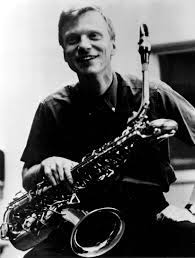
Gerry Mulligan was approached by Pannonica and asked if he could be granted three wishes what his be and his response was:
- “To play high trumpet accurately, drums, sing. And if there was a fourth, money.”
*Excerpt from Three Wishes: An Intimate Look at Jazz Greats ~ Compiled and Photographed by Pannonica de Koenigswarter
More Posts: baroness,clarinet,history,instrumental,jazz,music,pannonica,saxophone,three,wishes
Daily Dose Of Jazz…
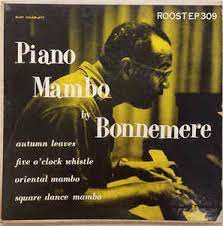
Edward Valentine Bonnemère was born on February 15, 1921 in Harlem, New York and during his school days was a church pianist. After military service in World War II he played with Claude Hopkins, and received his master’s degree from New York University.
In 1953 Eddie led a combo with Ray Barretto in the Savoy Ballroom. In 1955, he had a Mambo band, then in 1956 moved to Detroit, Michigan and became part of the house band at Baker’s Keyboard Lounge. He released a 10-inch album Ti-Pi-Tin / Five O’Clock Whistle on the Royal Roost label. He followed in 1959 with his trio recording Piano Bon-Bons and in 1960 The Sound of Memory. By 1964, with the participation of Kenny Burrell, he released his Jazz Orient-ed album on Prestige Records.
The mid-1960s, Bonnemère was one of the protagonists of an Africanization of the Catholic Mass spearheaded by Fr Clarence Rivers, as part of the Black Catholic Movement. Influenced by Mary Lou Williams he composed the Missa Hodierna for jazz ensemble and choir, which was first presented in 1966 during a service in Harlem’s St. Charles Borromeo Church. It was the first Jazz Mass ever in the United States. This mass was also performed in the Town Hall together with Howard McGhee’s instrumental composition Bless You.
In later years he worked as a church musician and composed the Missa Laetare and other liturgical works. He was also musical director of the Church of St. Thomas the Apostle in Manhattan, New York whose choir recorded his Mass for Every Season.
Pianist and composer Eddie Bonnemère transitioned on March 19, 1996 in New York City.
More Posts: bandleader,composer,history,instrumental,jazz,music,piano

Daily Dose Of Jazz…
Elliott Lawrence was born Elliott Lawrence Broza on February 14, 1925 in Philadelphia, Pennsylvania. His parents were radio and television variety show pioneers who created and produced the long running Horn and Hardart Children’s Hour.
Growing up in this show business environment, Lawrence began studying piano at the age of three. His first public performance was at age four conducting the orchestra on the Children’s Hour stage show. At six he wrote his first composition, Falling Down Stairs, and was stricken with polio, from which he recovered. By the age of 12, he had formed his first band, a 15-piece unit called The Band Busters, and began doing club dates on the weekends. Finishing high school at age 16 he entered the University of Pennsylvania. During his junior year his band, now named The Elliot Broza Orchestra, began playing college proms around the state. At Penn, majoring in symphonic conducting under Harl McDonald, he was offered the position as assistant conductor of the Philadelphia Orchestra upon graduation.
Changing his name to Elliot Lawrence when he became the music director of WCAU’S House Band in 1945, they premiered on the radio as The Elliot Lawrence Orchestra. From 1946 to 1954, the band toured around the United States year round, while recording for Decca, Columbia, RCA, Fantasy, and Vik records. In 1949, the band performed a three-week stint with the Nat King Cole Trio at the Paramount Theater in New York City, during which time it recorded Gerry Mulligan’s Elevation, later named “one of the top 50 best jazz recordings of the 20th century” by the Smithsonian Institution.
Landing in New York City in 1955 as the big band era came to a close, he began to do radio shows such as The Red Buttons show, the Jack Sterling Show and hosted Melody Street. He went to the Soviet Union with Ed Sullivan, met Gower Champion and became his musical director on his Bye Bye Birdie, which garnered him a Tony nomination. After 1960, Lawrence gave up jazz and began composing and arranging for television, film, and stage. He won the Tony Award for his second show, How to Succeed in Business Without Really Trying in 1962. This led to a 16-year career as a Broadway Conductor and musical director and later to his almost 50-year career as the “go to” conductor for big television events and specials.
As a composer, he scored the movies Network and The French Connection, won nine Emmy awards for musical direction, and was music director for the TonyAwards. Pianist, bandleader and conductor Elliott Lawrence transitioned on July 2, 2021 at the age of 96 in Manhattan, New York.
Requisites
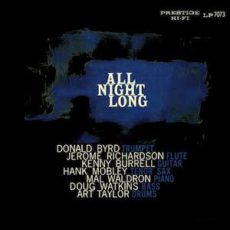
All Night Long ~ The Prestige All-Stars | By Eddie CarterThis morning’s choice from the library is a recent acquisition I’ve been hunting for since it was reissued as part of The Prestige Mono Series. It’s a swinging Fifties jam session that was originally released in 1957 by The Prestige All-Stars. All Night Long (Prestige PRLP 7073/PRST 7289) brings together a first-class ensemble, Donald Byrd on trumpet, Hank Mobley on tenor sax, Jerome Richardson (tracks: A1, B1 to B3) on flute, and (track: A1) on tenor sax, Mal Waldron on piano, Kenny Burrell on guitar, Doug Watkins on bass, and Art Taylor on drums. My copy used in this report is the 2012 Analogue Productions Mono audiophile reissue (APRJ 7073 – PRLP 7073).
Side One opens with Kenny Burrell’s All Night Long occupying the entire side. Art kicks off the song with an infectious beat. Kenny starts the opening solo with exquisite execution. Jerome’s flute flows with a happy feeling on the first of two statements. Hank takes us on a carefree joyride in the next reading, then Donald speaks his peace with a stellar presentation. Jerome resurfaces on tenor for a sparkling performance, and Mal gives a soulful effort on the next interpretation. Art follows with a brief exchange with the principal soloists before the group takes the song out. Side Two starts with the first of two tunes by Hank Mobley, Boo-Lu. Richardson sets the mood of this happy groove on the melody and opening chorus. Burrell, Byrd, Mobley, and Waldron follow with four short solos ahead of the reprise and close.
Flickers by Mal Waldron suggests a homage to the movies. It begins with the ensemble’s collective mid~tempo theme. Jerome is up first and shines with a light-hearted warmth. Donald and Hank follow with one easygoing reading each, then trade a few feisty riffs. Kenny turns in a tasty performance next and Mal applies blues-rooted energy to the finale leading to the closing chorus and Doug’s slow fade into oblivion. Mobley’s Li’l Hankie comes at you at medium speed with the ensemble in unison on the melody. Hank leads off the solos with a marvelous interpretation. Donald delves into the second reading on muted trumpet mining a vein of musical riches. Kenny tells a short story that makes every note count on the third statement. Jerome lights a fuse of creative inspiration on the next performance, followed by a stimulating conversation between the front line, Waldron, and Richardson ahead of the ending theme.
Bob Weinstock supervised the original album and the man behind the dials was Rudy Van Gelder. Kevin Gray did the remastering from the analog tapes. The record has a flat-edge and deep groove on the label like the original release, and the album cover has a high gloss. This reissue was pressed on 200-gram audiophile vinyl by Quality Record Pressings. The soundstage is outstanding, transporting the musicians to your listening room and the record is silent until the music starts. Burrell, Byrd, Watkins, and Taylor also appear on the companion album, All Day Long, recorded just a few days after this date. If you’re a Hard-Bop fan and are looking for an album with superb musicianship, I can’t think of a better choice to introduce you to The Prestige All-Stars than All Night Long! It’s a gorgeous recording that’s highly recommended and well worth adding to your library!
~ All Day Long (Prestige PRLP 7081/PRST 7277) – Source: Discogs.com © 2022 by Edward Thomas Carter

More Posts: bass,choice,classic,collectible,collector,drums,flute,guitar,history,instrumental,jazz,music,piano,saxophone,trumpet