

Hollywood On 52nd Street
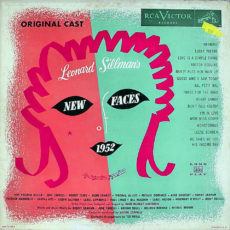
Guess Who I Saw Today is a popular jazz song composed by Murray Grand with lyrics by Elisse Boyd. The song was originally composed for Leonard Sillman’s Broadway musical revue New Faces of 1952 in which it was sung by June Carroll.
The revue opened on Broadway at the Royale Theatre on May 16, 1952 and ran for 365 performances. It was produced by Leonard Sillman, directed by John Murray Anderson and John Beal with choreography by Richard Barstow. The sketches were written by Ronny Graham and Brooks. The songs were composed by, among others, Harnick, Graham, Murray Grand and Arthur Siegel.
The cast featured Graham, Kitt, Clary, Virginia Bosler, June Carroll, Virginia De Luce, Alice Ghostley, Patricia Hammerlee, Carol Lawrence, Paul Lynde and Bill Milliken. De Luce and Graham won the 1952 Theatre World Award. The revue marked Kitt’s Broadway debut, singing a sultry rendition of “Monotonous”, about how boring a life of luxury was.
Two years later, the name was abridged to New Faces and was adapted into a motion picture filmed in Cinemascope and Eastmancolor and was released by 20th Century Fox on March 6, 1954. It helped jumpstart the Hollywood careers of several young performers including Paul Lynde, Alice Ghostley, Eartha Kitt, Robert Clary, Carol Lawrence, Ronny Graham, performer/writer Mel Brooks (as Melvin Brooks), and lyricist Sheldon Harnick.


Three Wishes
Lammar Wright told the Baroness his three wishes were:- “Complete mastery over my instrument.”
- “To have a contented life.”
- “That music would really become a musical language.”

More Posts: baroness,history,instrumental,jazz,musician,pannonica,three,wishes
Requisites
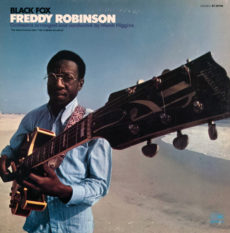
Black Fox is a 1970 album released by Freddy Robinson of the World Pacific record label. The photography and art design were both provided by Ron Wolin. The producers for this date were Dee Ervin and Monk Higgins, the latter also arranged and conducted. Liner Notes were written by Bob Hatchett. The album was alternately titled The Coming Atlantis.
The tracklist on this soul jazz and modern electric blues album include four tunes on Side A – Before Six, The Coming Atlantis, (I’m A) Fool For You and Freddy’s Sermon. Side B rendered the title track Black Fox, The Oggum Boogum Song, Rita and Monkin’ Around.
Crediting the performers are Backing Vocals – Adrienne Williams, Alexandra Brown, Difosco Ervin, Mamie Galore, Patricia Dunn; Fender & Upright Bass – Bob West; Bass Clarinet & Baritone Saxophone – Ernest Williams; Bongos & Congas – King Errison; Drums – Paul Humphrey; Piano – Joe Sample; Flute – Allen Butler; Guitar – Fred L. Robinson; Organ – Monk Higgins; Percussion – Dee Ervin, Strings – Sid Sharp; Tenor Saxophone – Plas Johnson; Trumpet – Allen Brisbois and Vibraphone – Alan C. Estes.

More Posts: choice,classic,collectible,collector,guitar,history,instrumental,jazz,music

Three Wishes
Lou Donaldson replied to NIca with one simple answer:- “I have asthma a bit. I’d like to get rid of that. I can’t think of anything else.”
More Posts: baroness,history,instrumental,jazz,musician,pannonica,three,wishes
Requisites
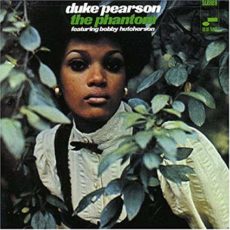
The Phantom is the twelfth album by American pianist and arranger Duke Pearson featuring performances recorded in 1968 and released on the Blue Note label.
Two separate sessions recorded the six tunes for a little over a half hour of music totalling thirty-eight minutes and thirty-six seconds, considered your average length in those days. The compositions are The Phantom, Blues for Alvina, Bunda Amerela (Little Yellow Streetcar), Los Ojos Alegres (The Happy Eyes), Say You’re Mine and The Moana Surf.
All compositions were composed by Pearson except #2 by Willie Wilson and #6 by Jerry Dodgion. Track #3 was recorded on June 24, 1968 and on September 11, 1968 they laid down the other five tunes.
Along with Pearson on the sessions were Jerry Dodgion – flute, alto flute, Bobby Hutcherson – vibes, Sam Brown and Al Gafa – guitar, Bob Cranshaw – bass, Mickey Roker – drums, Victor Pantoja – congas and Carlos ‘Patato’ Valdés – conga, güiro.
The recording session was produced by Francis Wolff at the Van Gelder Studios in Englewood Cliffs, New Jersey. Wolff is credited for the cover photography as well and the design was by Florenza Venosa Associates.
More Posts: choice,classic,collectible,collector,history,instrumental,jazz,music,piano