

Daily Dose Of Jazz…
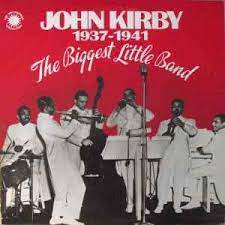
William “O’Neil” Spencer was born on November 25, 1909 in Cedarville, Ohio and began his career with local bands in the Buffalo, New York area. In 1931, he began working for Al Sears before joining up with the Mills Blue Rhythm Band from 1931 to 1936, which later became the Lucky Millinder Orchestra.
However, it wasn’t until 1937 after joining the popular John Kirby Sextet that he truly became an influential force on the jazz scene. Unfortunately, Spencer had to leave for a time in 1941 due to tuberculosis. However, during the late Thirties he recorded with numerous other groups, including Red Allen, Sidney Bechet, Jimmie Noone, Johnny Dodds, Frankie Newton, Milt Hearth, and Lil Armstrong.
He left the Kirby sextet in 1941 to work briefly with Louis Armstrong, but returned in ’42. His career, however, was cut short in 1943 when he contracted tuberculosis. Drummer and singer O’Neil Spencer transitioned on July 24, 1944 in New York City at the age of thirty-five.

More Posts: drums,history,instrumental,jazz,music
The Jazz Voyager
Getting back on a plane once more and in an enclosed space I continue to mask up to protect myself because these variants are steadily morphing. People are still dying daily, maybe not at the rate of its height but nonetheless keep yourself safe.
This Jazz Voyager has decided to head up the East coast and make the sojourn to New England as his next stop. This is where a day earlier I will resume visualizing the autumn colors of this neck of the woods, as they say. I hope to get near some lake water to see the reflection which I’ve missed for many years. So my next stop is Old Lyme, Connecticut for a jazz encounter with bassist Matthew Parrish and saxophonist Houston Person at The Side Door. Located within the Old Lyme Inn at 85 Lyme Street 06371.
These two musicians, an elder master and a mature performer are perfectly matched to bring not only the romance but the heat as they most definitely swing together. This 68 seat venue brings an air of intimacy to every performance. For more information visit notoriousjazz.com/event or thesidedoorjazz.com. The club’s number is 860.434.2600.

More Posts: adventure,album,bass,club,festival,genius,jazz,museum,music,preserving,restaurant,saxophone,travel
Daily Dose Of Jazz…
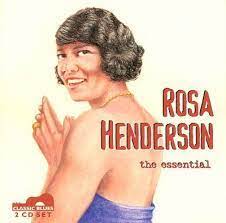
Rosa Henderson was born Rosa Deschamps on November 24, 1896 in Henderson, Kentucky. Her career as an entertainer began in 1913 when she joined her uncle’s circus troupe. She married Douglas “Slim” Henderson in 1918 and began traveling with his Mason-Henderson show. As a musical comedian she started during the early 1920s after moving to New York City, where she performed on Broadway. She would eventually perform in London.
Over the course of nine years she recorded over one hundred songs beginning in 1923. During that time she sometimes used pseudonyms such as Sally Ritz, Flora Dale, Sarah Johnson, Josephine Thomas, Gladys White, and Mamie Harris. She was accompanied by the Virginians, Fletcher Henderson’s Jazz Five, Fletcher Henderson’s Orchestra, Fletcher Henderson’s Club Alabam Orchestra, the Choo Choo Jazzers, the Kansas City Five, the Three Jolly Miners, the Kansas City Four, the Three Hot Eskimos, and the Four Black Diamonds.
She recorded for Ajax Records, Columbia, Paramount, Victor, and Vocalion Records. Her recordings include Afternoon Blues, Doggone Blues, Do Right Blues, He May Be Your Dog But He’s Wearing My Collar, and Papa If You Can’t Do Better (I’ll Let a Better Papa Move In).
After 1926, due largely in part to the death of her husband her recordings became limited, however, she continued performing until 1932. At that point Rosa took a job in a New York department store, but continued to perform benefit concerts until the Sixties.
Unrelated to Fletcher, Horace, Katherine, or Edmonia Henderson, vocalist Rosa Henderson, who sang jazz, blues and was a vaudeville performer of the Harlem Renaissance era, transitioned from a heart attack in 1968 on April 6, 1968.
More Posts: bandleader,history,instrumental,jazz,music,vocal
GUITAR SUMMIT IV
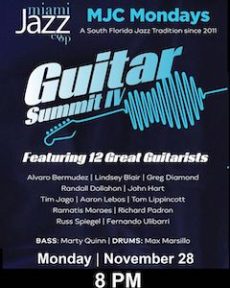
The Miami Jazz Cooperative is a nonprofit organization supporting jazz in South Florida by facilitating performance opportunities for musicians, entertaining audiences, and educating the community.
The summit brings twelve world class guitarist together for an evening of exciting performances and fun!
More Posts: adventure,album,club,festival,genius,guitar,jazz,museum,music,preserving,restaurant,travel
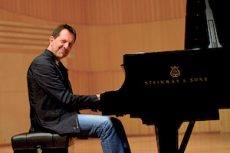
ALAN PASQUA TRIO
Alan Pasqua is an American rock and jazz pianist, a Steinway Piano Artist, Grammy Nominee and Professor of Jazz Studies at USC Thornton School of Music. He has been a member of the bands of Bob Dylan and Santana, played and recorded with jazz artists including Tony Williams, Jack DeJohnette, Paul Motian, Dave Holland, Michael Brecker, Randy Brecker, Joe Henderson, Stanley Clarke, Gary Burton and worked with composers John Williams, Quincy Jones, Dave Grusin, Jerry Goldsmith and Henry Mancini.
More Posts: adventure,album,club,festival,genius,jazz,museum,music,piano,preserving,restaurant,travel