

Requisites
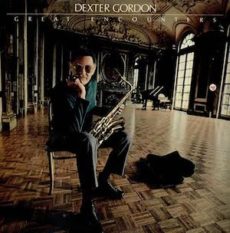
Great Encounters ~ Dexter Gordon | By Eddie Carter
Dexter Gordon steps into the spotlight for this report with two sessions making up the album, Great Encounters (Columbia JC 35978). Side One consists of two tracks recorded live at Carnegie Hall on September 23, 1978. The three tracks on Side Two were recorded at CBS Recording Studios on May 1, 1978, and January 26, 1979. The personnel appearing with Dexter on this record are Woody Shaw on trumpet, Curtis Fuller on trombone, and Eddie Jefferson on vocals (tracks: B1, B3), Johnny Griffin on tenor sax (tracks: A1, B1), George Cables on piano, Rufus Reid on bass, and Eddie Gladden on drums. My copy used in this report is the 1979 US Stereo album.
Blues Up and Down was written in 1950 by Gene Ammons and Sonny Stitt. This tune is the epitome of the terms, “blowing session”, or “cutting session”, and was first heard on Battle of The Saxes. Both saxophonists begin the melody at a blistering speed. Dexter gives a lengthy performance rivaling the speed of Indy 500 race cars. Johnny responds with an amazing quickness on the next reading. Dex and Griff continue sparring with each other vigorously until the climax. Cake, a Gordon original, was written in 1962, premiering on his album Go, as Cheese Cake. The trio makes an efficient introduction, then both horns work together on the melody. Gordon goes first with a heated reading. Griffin delivers the second solo with the impact of a brick through a plate-glass window and Gladden has a brief conversation with both saxes into the close. Both songs also appear on the CD album, Live at Carnegie Hall (1998).
The mood changes to start Side Two with a rollicking rendition of Gordon and Jefferson’s original Diggin’ In. The front line gets the party started with a lively introduction, then Jefferson stokes the engines with an impressive vocal melody and an exchange with Dexter on the lead solo. The saxophonist takes over for a jubilant reading that swings like mad. Woody comes in next to fuel the rhythm section with fire from his horn. Curtis gets the last word with an enthusiastic presentation. Ruby My Dear was written by Thelonious Monk in 1947 and appeared on Genius of Modern Music (1952). Lyrics were added by Sally Swisher for Carmen McRae who sang it on her tribute album, Carmen Sings Monk (1990). Gordon’s opening statement is picturesque, lovely, and elegantly presented. Cables expresses a haunting dreaminess on the second reading ahead of a gentle climax.
It’s Only a Paper Moon was written in 1933 by Harold Arlen, E.Y. Harburg, and Billy Rose. The song starts on a joyous introduction by the trio segueing into the lively opening chorus by Dexter. Eddie creates pure pleasure in a vigorous vocal interpretation. Dex is inspired on the following statement, then Woody has a brief uptempo improvisation that’s especially gratifying. George communicates his excitement next on a short statement and Curtis hits a perfect stride with a concise comment before the ending. The choice of using Jefferson for this album happened when Dexter met up with him at The Tin Palace after performing at The Village Vanguard. My only regret is that he couldn’t be used for the entire album instead of just two tracks. Eddie was an innovator of Vocalese, his treatments of classic songs and ballads were fresh and exciting, possessing a tremendous fire and imagination.
Six months after this recording session, Eddie Jefferson was shot and killed after leaving Baker’s Keyboard Lounge in Detroit, Michigan on May 8, 1979, by a disgruntled dancer he fired. The engineers behind the dials on Great Encounters are Tom Arrison (tracks: A1, A2), Don Puluse (track: B1), and Jerry Smith (tracks: B2, B3). The live and studio tracks are wonderfully recorded with a stunning soundstage that places the listener in the concert venue and the studio. If you’re a fan of Dexter Gordon, Great Encounters is an underrated album of wonderful performances that I recommend for your library, and it might just become one of your favorites!
~ Vocalese – a musical composition consisting of the singing of melody with vowel sounds or nonsense syllables rather than text, as for special effect in classical compositions, in polyphonic jazz singing by special groups, or in virtuoso vocal exercises. Source: Dictionary.com
~ Battle of The Saxes (Prestige PRLP 107), Carmen Sings Monk (Novus 3086-1-N), Extensions (Atlantic SD 19258), Genius of Modern Music (Blue Note BLP 5002), Go (Blue Note BLP 4112/BST 84112), Live at Carnegie Hall (Columbia Legacy CK 65312) – Source: Discogs.com ~ Eddie Jefferson, It’s Only a Paper Moon, Ruby My Dear – Source: Wikipedia.org ~ © 2021 by Edward Thomas Carter

More Posts: choice,classic,collectible,collector,history,instrumental,jazz,music,saxophone
Daily Dose Of Jazz…
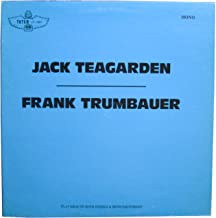
Orie Frank Trumbauer was born on May 30, 1901 in Carbondale, Illinois, Trumbauer grew up in St Louis, Missouri, the son of a musical mother who directed saxophone and theater orchestras. His first important professional engagements were with the Edgar Benson and Ray Miller bands, shortly followed by the Mound City Blue Blowers, a local group that became nationally famous through their recordings on Brunswick.
Trumbauer recruited Bix Beiderbecke for Jean Goldkette’s Victor Recording Orchestra, of which he became musical director. After leaving Goldkette, he and Beiderbecke worked briefly in Adrian Rollini’s short lived New Yorkers band, then joined Paul Whiteman in 1927. In 1927, he signed a contract with OKeh and released a 78 recording of Singin’ the Blues. Originally recorded and released by the Original Dixieland Jass Band in 1920, the Okeh recording became a smash hit. Fletcher Henderson and His Orchestra would record it in 1931 in the Trumbauer-Beiderbecke version.
He played with Whiteman for eight of the following nine years. Frank had a separate contract with OKeh from 1927 through 1930, where he recorded some of the most legendary small group jazz recordings of the era with Brunswick, Columbia, and Victor.
Leading The Three T’s, featuring the Teagarden brothers in 1936, two years later he and Mannie Klein co-led a band. In 1940 he left music to use his pilot skills to join the Civil Aeronautics Authority. Frank became a test pilot during World War II he was a test pilot with North American Aviation, and trained military crews in the operation of the B-25 Mitchell bomber. He continued to work for the CAA after the war, and also played in the NBC Orchestra. After 1947, although he continued to play and record, he earned most of his income in aviation.
Saxophonist, bassoonist, clarinetist and composer Frank Trumbauer, who was the influence for Lester Young, passed away of a sudden heart attack on June 11, 1956 in Kansas City, Missouri, age 55.

More Posts: alto saxophone,bassoon,C-melody saxophone,clarinet,history,instrumental,jazz,music

Daily Dose Of Jazz…
Sandy Mosse was born on May 29, 1929 in Detroit, Michigan and learned clarinet and alto saxophone early in life, but switched to tenor saxophone at the beginning of the 1950s. Based out of Chicago, Illinois during the decade, he made several forays abroad, playing in Paris with Wallace Bishop in 1951. On his 1953 tour of Europe he performed with Django Reinhardt and Woody Herman.
Upon returning to Chicago in 1955 he played with Bill Russo, Chubby Jackson, James Moody, and Cy Touff. Mosse and Touff also co-led an octet called Pieces of Eight late in the 1950s into the early 1960s, featuring trumpeter John Howell. He received awards from Down Beat and Playboy late in the 1950s.
The 1960s saw him playing with Buddy Rich, Maynard Ferguson, and Dave Remington. During this time Sandy formed a band with flugelhornist Warren Kime called Pieces of Eight. Unfortunately, that same decade he was diagnosed with cancer.
Marrying a Dutch woman Clara, he moved to Amsterdam in the 1970s, playing on national radio and teaching at the Royal Dutch Conservatory. Recording less, he occasionally toured the U.S. with Zoot Sims and Al Cohn. In the Netherlands, he played with an ensemble called Volume Two, with Irvin Rochlin, Klaus Flenter, Evert Hekkema, Ben Gerritsen, and Lex Cohen.
Tenor saxophonist Sandy Mosse, influenced by Lester Young, passed away on July 1, 1983 in Amsterdam, Netherlands.
More Posts: bandleader,history,instrumental,jazz,music,saxophone
Daily Dose Of Jazz…
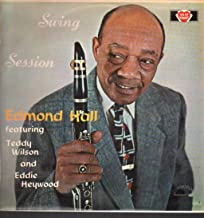
Arthur “Traps” Trappier was born on May 28, 1910 in Georgetown, South Carolina and played with Charlie Skeets and Blanche Calloway in the late 1920s. After working steadily through the 1930s, he joined Fats Waller in 1941-42 before serving in the military during World War II.
He led his own trio in various hotels in New York City in the 1950s, and played as a sideman into the 1970s. Among those he played with are Josh White, Wilbur De Paris, Edmond Hall, Sy Oliver, Hot Lips Page, Buddy Johnson, Wingy Manone, Sidney Bechet, Benny Goodman, and Red Allen.
He recorded with Waller, Hall, Conrad Janis, Punch Miller, Mutt Carey, Tony Prenti, Willie “The Lion” Smith, and Rex Stewart. Drummer Arthur Trappier passed away on May 17, 1975 in New York City.
More Posts: drums,history,instrumental,jazz,music
The Quarantined Jazz Voyager
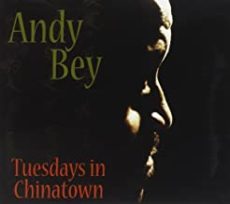
TUESDAYS IN CHINATOWN | ANDY BEYPolitics, business and society are taking another foreboding step towards the past normal by allowing people who have been vaccinated to move unmasked. Ther are, however, no checks and balances as no one is checking these people as they come into stores. Thinking this is too early, I remain safe and comfortable in my home.
On that note, this week I am listening to another favorite of mine, male baritone vocalist by the name of Andy Bey and I have chosen his 2001 Tuesdays In Chinatown release. The horns were arranged by Geri Allen, engineered and mixed by Dave Kowalski, mastered by Ron McMaster, and produced by Herb Jordan. The photography was taken by Frank Stewart.
Track Listing | 63:01- Tuesdays In Chinatown ~ 6:52
- Fragile (Sting) ~ 4:50
- Bridges (Milton Nascimento) ~ 4:58
- Saidas E. Bandeiras (Fernando Brant / Milton Nascimento) ~ 5:36
- In A Mist (Bix Beiderbecke) ~ 7:06
- I’ll Remeber April (Gene DePaul / Pat Johnston / Patricia Johnston / Don Raye) ~ 5:35
- Invitation (Bronislaw Kaper / Paul Francis Webster) ~ 7:01
- Little Girl Blue (Lorenz Hart / Richard Rodgers) ~ 6:17
- Just Friends (John Klenner / Sam M. Lewis) ~ 2:40
- Feelin’ Lowdown (Big Bill Broonzy) ~ 6:18
- Andy Bey ~ piano, vocal
- Peter Washington, Ron Carter ~ Bass
- Peter Sanders ~ Cello (2)
- Marty Ehrlich ~ Clarinet, Bass Clarinet, Alto Flute
- Victor Lewis ~ Drums
- Earl Gardner, John Sneider ~ Flugelhorn, Trumpet
- Paul Meyers ~ Guitar
- Mino Cinelu ~ Percussion
- Steve Turre ~ Trombone
- Barry Finclair ~ Viola
- Andy Stein ~ Violin, String Arrangements
- Laura Seaton ~ Violin

More Posts: adventure,album,club,genius,jazz,museum,music,preserving,restaurant,travel,vocal