

Requisites
Jammin’ With Gene ~ Gene Ammons All-Stars | By Eddie Carter
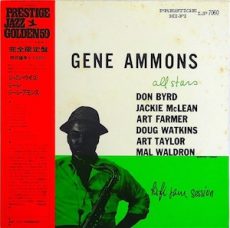
A few evenings ago, after dinner, I was enjoying a good book when I suddenly craved some jazz with a tenor sax. That decision led me to today’s discussion. Upon going to the shelf, I rediscovered one of my favorite records by the Gene Ammons All-Stars. “Jammin’ With Gene” (Prestige PRLP 7060) was the tenor saxophonist’s third release as a leader when it hit the stores in 1956. It was also the second of seven blowing session albums he recorded forthe label. The personnel for this date is a stellar supporting cast: Art Farmer and Donald Byrd on trumpet, Jackie McLean on alto sax, Mal Waldron on piano, Doug Watkins on bass, and Arthur Taylor on drums. My copy of this album is the 1977 Victor Musical Industries Japanese mono reissue (Prestige VIJ-5039).
The first side opens with the title tune, Jammin’ With Gene, by Gene Ammons. From the start, the septet establishes a cohesive atmosphere, with the front line delivering the melody in tight, harmonious unison. Gene takes the lead solo, slipping into a soulful groove that floats effortlessly over the rich foundation provided by his fellow musicians. Donald steps in next, his interpretation unfolding with increasing intensity, from a gentle warmth to a robust climax, also with the front line shadowing him. Art and Jackie then state their cases in the subsequent two readings, each presentation adding a fresh layer of expression. Mal wraps things up with a laid-back performance, which is followed by the group circling back to their unified closing chorus.
The album’s only standard, We’ll Be Together Again, by Carl Fischer and Frankie Laine, opens gently as Gene, Mal, and Doug’s introduction segues into a subtle, slow-moving melody by Ammons. Gene then steps forward, launching the opening statement with a smooth, relaxed swing. Art follows, infusing the second reading with vivacious energy, and then Jackie picks up the rhythm with lively, enthusiastic lines. Donald delivers the goods on the following interpretation, after which Mal ushers in a flowing groove leading into Gene’s closing passage back into a ballad tempo for the group’s graceful finish.
The album’s finale, Not Really The Blues by Johnny Mandel, is a lively, up-tempo tune that takes off with a brisk melody from the whole ensemble. Donald leads off, delivering a spirited statement that sets the pace, then Jackie adds some bite with sharp, energetic phrasing. Art keeps the momentum high with his vigorous contribution, while Gene steps in with high-octane in the next solo. Mal keeps things simmering with his smooth piano work, paving the way for a rapid-fire exchange among Farmer, Byrd, McLean, and Ammons. The excitement builds as Donald, Jackie, Art, and Gene trade choruses in a heated musical conversation, driving the group toward a swift and exhilarating exit.
Bob Weinstock supervised the session, and Rudy Van Gelder was responsible for the recording duties. This reissue’s sound quality is a delight to hear, with a vivid soundstage that transports the musicians to the sweet spot in your listening room. If you’re a Gene Ammons fan and appreciate a good bop album, I happily recommend “Jammin’ With Gene” by the Gene Ammons All-Stars for a spot in your library. It’s an underrated, but excellent album that every tenor sax enthusiast should seek out on their next record-shopping trip!
~ We’ll Be Together Again – Source: JazzStandards.com
© 2025 by Edward Thomas Carter

More Posts: choice,classic,collectible,collector,history,instrumental,jazz,music,saxophone

DC JAZZFEST
Eaton, DC | 1201 K Street NW, Washington, DC 20005
- Soundtrack to a Coup d’Etat | 4:00pm
- Reggie Bowens Group with special guest Brent Birckhead | 5:30pm
- Heidi Martin | 6:45pm
Kennedy Center Millenium Stage | 2700 F Street, NW, Washington, DC 20566
- Joshua Bayer Quintet | 6:00pm
We Act Radio | 1920 Martin Luther King Jr Ave SE, Washington, DC 20020
- Jazz & Poetry: tribute to Thomas Sayers Ellis featuring Tyler Leak & Freeform with special guest poet Kenny Carroll
The Hamilton Live | 600 14th St NW, Washington, DC 20005 | Sold Out
- Jazz DC Orchestra directed by Allyn Johnson with special guest Christie Dashiell, Brandee Younger and Paul Carr
Mr. Henry’s | 601 Pennsylvania Avenue SE, Washington, DC 20003
- Herb Scott and Capitol Hill Jazz Foundation JAM | 8:00pm
Cover: Check Website
More Posts: adventure,bandleader,genius,instrumental,jazz,music,preserving,travel,vocal

ROY AYERS TRIBUTE
Atlanta is celebrating the legendary Roy Ayers. A pioneer of jazz-funk, vibraphonist, composer, and producer whose sound became the heartbeat of Black culture from the 1970s through today. Often dubbed the “Godfather of Neo-Soul,” Ayers’ genre-bending artistry shaped the sonic foundation for countless artists, from Erykah Badu and The Roots to A Tribe Called Quest and Common.
Long before the dancefloors of Harlem to the airwaves of London and the sample-heavy beats of 90s hip hop, Roy Ayers’ Ayers started recording as a bebop sideman in 1962. In 1963, he released his debut studio album West Coast Vibes featuring a collaboration with the saxophonist Curtis Amy. He rose to prominence when he dropped out of Los Angeles City College and joined jazz flautist Herbie Mann in 1966. His music has transcended generations, inspiring a movement rooted in rhythm, liberation, and Black excellence.
Hosted by WCLK’s Morris Baxter, the evening will be opened by Heda Rose, followed by Mark Adams and a host of Atlanta musicians and vocalists.
Cover: $30.00 ~ $55.00More Posts: adventure,bandleader,club,genius,instrumental,jazz,music,preserving,travel,vibraphone,vocal

TONY HIGHTOWER
Singer/Songwriter Tony Hightower is taking up the mantle to be a bridge that ushers R&B audiences into Jazz…Real Jazz. With years of experience as a musical performer and actor with familiar roots that place him firmly within the music’s firmament, the Atlanta native is still just getting started on this benevolent turn in his journey. And he is bringing a lot of young people with him.
Beyond his contributions as a vocalist to the successful projects of Gerald Levert, Jimmy Jam and Terry Lewis, the soundtrack for “Money Train,” Goodie Mob’s certified gold album “Soul Food,” Society of Soul’s album “Brainchild,” Pebbles’ album “Straight From My Heart,” Lionel Richie’s album “Louder Than Words,” and Outkast, he has preoduced and recorded his own albums and has performed around the East Coast and in Europe.
Cover: $40.00
More Posts: adventure,bandleader,club,genius,instrumental,jazz,music,preserving,travel,vocal
Daily Dose Of Jazz…
James Benjamin Sherman was born on August 17, 1908 in Williamsport, Pennsylvania. He played piano in dance bands in the late 1920s and played on and off with Jimmy Gorham in the metropolitan Philadelphia area. In 1930 he began playing on a steamboat in Alphonso Trent’s band, then played in the 1930s with Peanuts Holland, Al Sears, Stuff Smith, Lil Armstrong, Putney Dandridge, Mildred Bailey, and Billie Holiday.
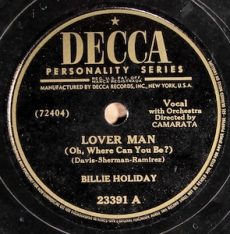
From the mid- to late ’30s Jimmy played in various swing groups but is best known for his hand in composing the jazz standard Lover Man, co-written with Jimmy Davis and Roger Ramirez, and was first recorded by Billie Holiday
He became the pianist and arranger for The Charioteers in 1938, remaining with the group until 1952. Following this he played primarily locally in eastern Pennsylvania. In 1960 he took up a residency at Miss Jeanne’s Crossroad Tavern in Chester County, Pennsylvania, where he played until shortly before his death.
Pianist and arranger Jimmy Sherman died on October 11, 1975 in Philadelphia, Pennsylvania.
More Posts: arranger,bandleader,composer,history,instrumental,jazz,music,piano