


CONNIE HAN
Pianist and provocateur Connie Han has created an edgy blend of modern and traditional jazz with her incendiary Mack Avenue Records debut CRIME ZONE. At 26, this young lioness is on a fast-climbing trajectory to jazz stardom with rave reviews from The New York Times, Jazziz Magazine, Downbeat Magazine, and more. According to Downbeat Magazine, Han has “already absorbed the post-bop piano masters” with “all the technical mastery she’ll ever need.” The New York Times describes her as “the rare musician with fearsome technical chops, a breadth of historical knowledge and enough originality to write tunes that absorb your ear easily.” Weaving in and out of the tradition, Han pays tribute to McCoy Tyner, Mulgrew Miller, and Kenny Kirkland with her own unique edge and fire at the piano.
Her connection to jazz began at the Los Angeles County High School for the Arts. After graduation, Han accepted a full-tuition scholarship to UCLA but chose to leave school after three weeks to pursue her professional career. It was at this time she sought out drummer/producer Bill Wysaske to begin work on what would eventually culminate her signing with Mack Avenue Records.
“This record is meant to be a statement about being rebellious… but within the tradition,” Han explains. “It’s provocative and fresh in its own way while still honoring the rich legacy of jazz.” The title, CRIME ZONE, reinforces how I brand myself as an artist: a provocateur of creative music.” “With this album she’s booking a place as a star in the jazz firmament of tomorrow,” says All About Jazz.” Watch out for Connie Han, the face (and shape) of jazz to come.”
Doors at 6:00 PM, Show at 7:00 PM | Doors at 8:45 PM, Show at 9:15 PM
More Posts: adventure,album,club,festival,genius,jazz,museum,music,piano,preserving,restaurant,travel

JOEY ALEXANDER
It’s no coincidence two of the titles on pianist, bandleader and composer Joey Alexander’s inspirational debut on Mack Avenue Records, Origin, contain the words “rise” and “rising.”
“The Latin root of the word ‘origin’ is orire, which means to rise,” explains the restlessly searching musician, who has performed everywhere from the Obama White House to the Grand Ole Opry and has been nominated for three GRAMMY® awards. “During this pandemic, I think the first thing we should do is to start with being hopeful, which is the main theme of Origin. Instead of making it a source of frustration, I made it the source of inspiration to express myself in music.”
Good plan. On his sixth album as a leader, his first featuring all his own material, Alexander has stretched his imagination into new territory, challenging himself to write rich melodic and harmonic interplay without ever abandoning the emotional candor and transparency that have captivated crowds and catapulted his albums to the top of the jazz charts.
Showtimes: December 2 & 3
Doors at 6:00 PM, Show at 7:00 PM | Doors at 8:45 PM, Show at 9:15 PM
More Posts: adventure,album,club,festival,genius,jazz,museum,music,piano,preserving,restaurant,travel

TAWANDA
With John DiMartino, Marco Panascia & Tim Horner
An official Resonance Records CD Release performance! The first 30 ticket buyers will receive a FREE copy of Tawanda Suessbrich-Joaquim’s newest release, “SMILE!”
Since she grew up in the Deep South to a mother from Germany and a father from Mozambique, her unique cultural DNA opened up her heart and mind to many worlds of music that are still an integral part of everything she sings.
Jazz is one form of music that transcends most other genres and has done so throughout the ages. Its complexity, off beat rhythms, sophistication and constant desire to improvise and evolve itself courses through its precious origins. Those traditions run deep within the soul of award-winning vocalist Tawanda Suessbrich-Joaquim and there is no greater gift than seeing her sing her story in full flight.
A vibrant mix of cultural heritages that underpin her every move, Tawanda was raised in the deep south of New Mexico on the border with Texas. She is proudly a first generation American with a mother from Germany and a father from Mozambique. That fusion of intoxicating backgrounds gave her access to music that many do not experience and which will forever stay in her heart.
Always looking forward, Tawanda delves deep into the worldwide Jazz scene and explores the multi-genre fusion that can be found in its paradise of riches. That desire to respect not only her peers but the origins of her name which translates as ‘we are more’ in a Bantu dialect called Shona, has embedded a deep-rooted desire within her to give back to those around her.
There is no better affirmation of her talent than winning the prestigious 2020 Sarah Vaughan Vocal Jazz competition. Now based in Los Angeles and with a whole host of performances that have enthralled audiences everywhere, Tawanda Suessbrich-Joaquim is set to soar on the wings of success.
More Posts: adventure,album,bass,club,drums,festival,genius,jazz,museum,music,piano,preserving,restaurant,travel,vocal

CHARLES MCPHERSON & SEAN JONES
Charles McPherson with Sean Jones featuring Jeb Patton, Russell Hall & Billy Drummond
Thursday-Sunday, November 10-13th
Thursday: 7:30pm
Friday & Saturday: 7pm & 9:30pm
Sunday: 5pm & 7:30pm
Four incredible nights with these five grand masters!
“Charles is the very definition of excellence in our music. He is the definitive master on this instrument. He plays with exceptional harmonic accuracy and sophistication. He performs free-flowing, melodic and thematically developed solos with unbelievable fire and an unparalleled depth of soul.” – Wynton Marsalis
More Posts: adventure,album,bass,club,drums,festival,genius,jazz,museum,music,piano,preserving,restaurant,saxophone,travel,trumpet
Daily Dose Of Jazz…
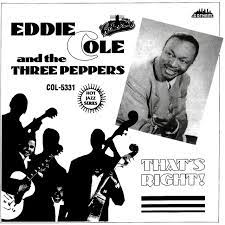
Edward Bennett Coles was born October 29, 1910 in Montgomery, Alabama and was the second oldest of ten children and the oldest son. He studied both piano and bass from a young age and formed his first band at age 17. Three years later at age 20, he joined Noble Sissle’s band the Sizzling Syncopators, stayed there six years and performed with greats such as Sidney Bechet and Clarence Brereton.
After a tour of Europe in 1936, Cole left Sissle’s band to join his brother Nat’s group, the Rogues of Rhythm. He appeared in the TV show Bourbon Street Beat in 1959 and later appeared on The Law and Mr. Jones and The Jack Benny Program.
Retiring in the 1960s, bassist, pianist and vocalist Eddie Cole, who was a member of the Cole dynasty of Nat, Freddy and Ike, transitioned on June 18, 1970 at the age of 59 in Los Angeles, California.

More Posts: bandleader,bass,history,instrumental,jazz,music,piano,vocal