

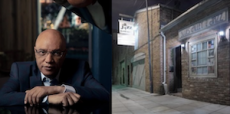
BILLY CHILDS TRIO
Billy Childs has emerged as one of the foremost American composers of his era, successfully marrying the musical products of his heritage with the Western neoclassical traditions of the twentieth century in a powerful symbiosis of style, range, and dynamism.
Thus far, in his career, Childs has garnered seventeen Grammy nominations and six Grammy awards including two for Best Instrumental Jazz Album (Winds of Change in 2024 and Rebirth in 2018), and two for Best Arrangement Accompanying a Vocalist (including New York Tendaberry from Map to the Treasure: Reimagining Laura Nyro, featuring Renee Fleming and Yo-Yo Ma). In 2006, Childs was awarded a Chamber Music America composer’s grant, and in 2009 was the recipient of a Guggenheim Fellowship. In 2013 he was awarded the Doris Duke Performing Artist Award. He has also been awarded a composers award from the American Academy of Arts and Letters (2015). In 2018, Childs was named “Outstanding Alumnus” of the Thornton School of Music (sharing that honor with, among others, Morton Lauridsen, Michael Tilson Thomas, and Marilyn Horne). Childs has also served as president of Chamber Music America (2016-2022).
Born in Los Angeles, California he entered USC as a composition major, graduating four years later with a bachelor of music in composition under the tutelage of Robert Linn. Since then Mr. Childs has received a number of orchestral and chamber commissions from, among others: Esa-Pekka Salonen and the Los Angeles Philharmonic, the Detroit Symphony Orchestra under the baton of Leonard Slatkin, the Los Angeles Master Chorale, Monterey Jazz Festival, the Dorian Wind Quintet, the Lincoln Center Jazz Orchestra, the American Brass Quintet, the Ying Quartet, the Lyris Quartet, Anne Akiko Meyers, Rachel Barton Pine, and Inna Faliks.
As a pianist Childs has performed with, among others, Freddie Hubbard, J.J. Johnson, Yo-Yo Ma, Sting, Renee Fleming, the Los Angeles Philharmonic, the Detroit Symphony, Chick Corea, the Kronos Quartet, Wynton Marsalis, Jack DeJohnette, the Dorian Wind Quintet, Ying Quartet, the American Brass Quintet, and Dave Holland.
Childs’ solo jazz recording career includes four critically acclaimed albums on the Windham Hill Jazz label and two volumes of Chamber Jazz music (Lyric, Vol. 1, 2006 and Autumn: In Moving Pictures, Vol. 2, 2010). Childs expanded upon his talent for seamlessly straddling the lines between jazz and classical worlds with a collection of re-imagined Laura Nyro compositions for Sony Masterworks, released in September 2014. Map to the Treasure: Reimagining Laura Nyro, was produced by Larry Klein and features as guest artists, among others: Renée Fleming, Yo-Yo Ma, Wayne Shorter, Alison Kraus, Dianne Reeves, Chris Botti, Esperanza Spalding, and Lisa Fischer. In 2017, Childs released the first of his three Mack Avenue recordings, the Grammy Award-winning Rebirth, which was followed by 2020’s Acceptance and 2023’s Grammy Award-winning The Winds of Change.
Childs is an in-demand clinician, whose recent invitations include working with students at the Guildhall School of Music and Drama in London, masterclasses at the Folkwang University of the Arts in Essen, Germany, and an educational residency at the University of North Florida in Jacksonville.
Tickets: $35.00 +$7.00 fee
Showtimes: 7:00pm & 9:30pm
More Posts: bandleader,club,composer,genius,instrumental,jazz,music,piano,preserving,travel
Daily Dose Of Jazz…
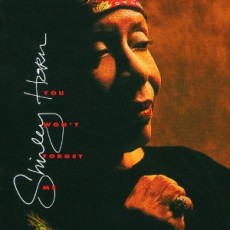
Shirley Valerie Horn was born on May 1, 1934 in Washington, D.C. and was encouraged by her grandmother to begin piano lessons at age four. At twelve she studied piano and composition at Howard University and later majored there in classical music. Unable to afford to attend, Shirley was forced to decline an offered a place at the Juilliard School. Forming her first jazz piano trio when she was twenty, her early piano influences were Errol Garner, Oscar Peterson and Ahmad Jamal that moved away from her classical background.
She then became enamored with the famous U Street jazz area of Washington, sneaking into jazz clubs before she was of legal age. She was most noted for her ability to accompany herself with nearly incomparable independence and ability on the piano while singing, the rich, lush, smoky contralto gave an unprecedented expression to every song she sang. Although she could swing as strongly as any straight-ahead jazz artist, Horn’s reputation rode on her exquisite ballad work.
She recorded with Stuff Smith in 1959, and on small labels into the Sixties. Horn first achieved fame in 1960, when Miles Davis discovered her and his public praise was a rare commodity. She eventually landed on Mercury and Impulse and over the course of her career she recorded some four-dozen albums both as leader and sideman.
Following the arrival of the Beatles, Horn scaled down performances to her native D.C. clubs, raised her daughter and worked full time in an office. Recording sporadically from 1965 through the late 80s, by the early Nineties her resurgence came with “Here’s To Life” and the albums began to flow, nearly one a year until 2003.
The small setting performer, singer and pianist Shirley Horn kept her same trio for twenty-five years. In the early 200s due to health issues she cut back her schedule, and battling diabetes and breast cancer passed away on October 20, 2005. She was nominated for a Grammy 9 times and won for “I Remember Miles”, performed for several White House invites, received an honorary Doctorate from Berklee College of Music and was given a NEA Jazz Master Award.
Daily Dose Of Jazz…
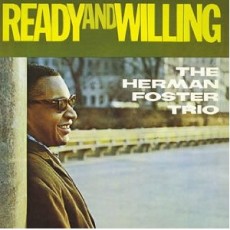
Herman Foster was born on April 26, 1928 in Philadelphia, Pennsylvania and began his musical career before age ten playing the violin, clarinet, saxophone, and piano. A self-taught pianist, Foster created a distinguished earthy sound. When his family moved to New York City in 1947, Herman began to attend jam sessions and then played with Eric Dixon, Dick Carter and the big band of Herb Jones.
His success came when he met Lou Donaldson and the two played together for thirteen years from 1953 to 1966. During the 1950s he worked with King Curtis, Bill English and Seldon Powell, in the 1960s with Al Casey, in addition to playing with his own trio over the next decade. He returned to work in Donaldson’s quartet in the 1980s.
He released four records as a leader for Epic, Argo and Timeless Records and as a sideman recorded nineteen albums with Lou Donaldson, Gloria Lynne, Johnny Hartman, Hisayo Tominaga, George V. Johnson Jr., Joan Shaw, Al Casey and King Curtis.
On April 3, 1999, bebop pianist Herman Foster passed away in New York City.

More Posts: piano
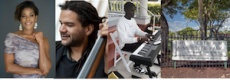
NICOLE HENRY, SENEGAL APOSTOLO & JOHN MARQUIS
Esther Mae Armbrister Park welcomes the Nicole Henry Quintet, the Senegal Apostolo Trio and the John Marquis Trio for an evening of jazz celebrating Jazzin’ The Grove Spring Swing! The event is ree and open to the public. Bring your chairs, blankets and coolers for a fantastic evening of live jazz.
World class vocalist Nicole Henry’s versatile and emotionally driven performances have captivated audiences in twenty countries. She has ensconced herself in the jazz ranks of acclaimed interpreters as she tours with her quartet or performing with orchestras and big bands. Her repertoire comes from the American Songbook, classic and contemporary jazz, popular standards, blues, and originals. Her numerous accolades include Traditional Jazz Performance, Best New Jazz Artist, and Best Solo Musician from Soul Train, HMV Japan Awards and Miami New Times, respectively. She was hailed as One of Eight Black Artists Making Waves in 2024 by Symphonic Distribution and BroadwayWorld Miami named her Vocalist of the Decade.
Double bassist Senegal Apostolo is a Miami-based professional musician, bassist, and educator, known for his work with JazzSLAM, and has been featured in performances with the FIU Music Hour. A graduate of the FIU School of Music, he performs in jazz ensembles and provides music programming for children. He co-founded Miami-based music academy, Sol Music Studios, and conducts interactive musical programs for young children. His discography can be found on SoundCloud, Boomplay and Instagram.
Pianist John Marquis began playing at an early age and has been playing through his high school matriculation. Along with his bandmates, bassist Gavin Jules and drummer Dwayne James, they are soon to be graduating seniors from the renowned performing and visual arts Dillard Center for the Arts located within Dillard 6-12 Magnet School, located in Fort Lauderdale. To be accepted into the program each student had to audition and undergo a rigorous years of training that has prepared them for a career in the arts.
Cover: FREE
More Posts: adventure,bandleader,bass,festival,genius,instrumental,jazz,music,piano,preserving,travel,vocal
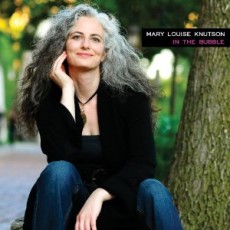
Daily Dose Of Jazz…
Mary Louise Knutson was born on April 19, 1966. The Minneapolis based jazz pianist and composer released her debut CD “Call Me When You Get There” in 2001 charted in the Top 50 in the U.S. and Canada that brought her national recognition. Knutson’s 2011 sophomore project on her Meridian Label, “In The Bubble”, charted in the Top 10 on JazzWeek and stayed for an unprecedented 19 weeks straight.
Mary received Lawrence University’s distinguished Nathan M. Pusey Alumni Achievement Award, was a Top 5 finalist in the Kennedy Center’s Mary Lou Williams “Women In Jazz” Pianist Competition, has been nominated for Jazz Artist of the Year and Pianist of the Year by the Minneapolis Music Awards, and has won two composition awards from Billboard Magazine.
As an educator she has sat on the faculty of Carleton College instructing jazz piano and improvisation, and currently teaches privately and conducts a variety of master classes such as Intro to Composition, Freedom From the Written Page: Beginning Improv for Pianists, and Making Sense of Jazz, among others.
Knutson has performed and toured with jazz greats Dizzy Gillespie, Bobby McFerrin, Dianne Reeves, Kevin Mahogany, Nicholas Payton, Ernie Watts, Slide Hampton, Greg Abate, Bobby Shew and Von Freeman to name a few and has crossed over into other genres to play with Smokey Robinson, Trisha Yearwood, Donny Osmond, Phyllis Diller, Rob Schneider and more. The pianist regularly performs with her group, with area vocalists Connie Evingson and Debbie Duncan; and with the JazzMN Orchestra, the Minnesota Orchestra and the Chuck Lazarus Quartet.
More Posts: piano